Wardley Mapping NATO's Warfighting Concept: A Strategic Analysis of the Six Operational Domains
Strategic MappingWardley Mapping NATO's Warfighting Concept: A Strategic Analysis of the Six Operational Domains
:warning: WARNING: This content was generated using Generative AI. While efforts have been made to ensure accuracy and coherence, readers should approach the material with critical thinking and verify important information from authoritative sources.
Table of Contents
- Wardley Mapping NATO's Warfighting Concept: A Strategic Analysis of the Six Operational Domains
- Introduction: The Convergence of Wardley Mapping and Military Strategy
- Decoding NATO's Warfighting Capstone Concept (NWCC)
- Mapping the Six NWCC Domains: A Wardley Mapping Approach
- Practical Applications and Case Studies
- The Future of Military Strategy: Wardley Mapping and Beyond
Introduction: The Convergence of Wardley Mapping and Military Strategy
Understanding Wardley Mapping
Origins and principles of Wardley Mapping
Wardley Mapping, a strategic planning technique developed by Simon Wardley in the early 2000s, has its roots in the technology sector but has since found applications across various industries, including military strategy. This innovative approach to visualising the structure of a business or organisation has become increasingly relevant in the context of NATO's Warfighting Capstone Concept (NWCC), offering a unique lens through which to analyse and plan military operations across multiple domains.
The genesis of Wardley Mapping can be traced back to Wardley's experiences in the IT industry, where he observed that traditional strategic planning methods often failed to capture the dynamic nature of technological evolution and market forces. Frustrated by the limitations of existing tools, Wardley set out to create a mapping technique that could represent the complex relationships between components in a value chain while also accounting for their evolutionary stage.
Wardley Mapping emerged from a need to understand the landscape of business and technology in a way that traditional methods simply couldn't capture. It's about seeing the entire battlefield, not just individual skirmishes.
The fundamental principles of Wardley Mapping are rooted in several key concepts:
- Visibility: Components are arranged vertically based on their visibility to the end user or customer.
- Evolution: The horizontal axis represents the evolution of components from genesis to commodity.
- Dependency: Arrows are used to show dependencies between components.
- Anchoring: Maps are anchored to the user needs at the top of the value chain.
- Movement: The map is not static but represents a snapshot in time, with components evolving and moving along the evolutionary axis.
These principles allow for a comprehensive view of an organisation's structure, highlighting areas of strategic importance and potential vulnerabilities. In the context of military strategy, particularly within the framework of NATO's NWCC, Wardley Mapping offers a powerful tool for understanding the complex interplay between various operational domains and their supporting components.
One of the key strengths of Wardley Mapping is its ability to reveal hidden assumptions and dependencies. In military planning, where the stakes are incredibly high, this can be crucial. By mapping out the entire value chain of military operations across the six domains outlined in the NWCC (land, maritime, air, space, cyber, and cognitive), strategists can identify critical components, potential bottlenecks, and opportunities for innovation.
In the realm of military strategy, Wardley Mapping acts as a force multiplier. It allows us to see not just where we are, but where we need to be, and the path to get there across all domains of warfare.
The application of Wardley Mapping to military strategy also introduces the concept of situational awareness at a strategic level. By visualising the entire landscape of military capabilities and their evolutionary stages, decision-makers can make more informed choices about resource allocation, technology investment, and operational planning. This is particularly relevant in the context of multi-domain operations, where understanding the interdependencies between different domains is crucial for success.
Furthermore, Wardley Mapping encourages a mindset of continuous adaptation. In the rapidly changing landscape of modern warfare, where technological advancements can quickly shift the balance of power, this principle is invaluable. By regularly updating and analysing Wardley Maps, military strategists can stay ahead of emerging threats and opportunities, ensuring that NATO's warfighting capabilities remain at the cutting edge.
![Draft Wardley Map: [Insert Wardley Map showing the basic principles applied to a simplified military context]](https://images.wardleymaps.ai/map_4a0558ad-3a9c-479c-bc08-3b2c09b912b6.png)
Wardley Map Assessment
This Wardley Map reveals a military strategy in transition, moving from traditional methods to a more adaptive, multi-domain approach. The integration of Wardley Mapping as a strategic tool represents a significant opportunity for enhancing decision-making and adaptability. Key focus areas should be the development of integrated Multi-Domain Operations, enhancement of Situational Awareness capabilities, and the rapid adoption of advanced strategic analysis tools like Wardley Mapping. The evolving nature of warfare, particularly in the Cyber and Cognitive domains, necessitates a flexible and continuously adapting strategic approach. Organisations that can effectively leverage these emerging tools and adapt quickly to new operational domains will likely gain a significant competitive advantage in future conflicts.
As we delve deeper into the application of Wardley Mapping to NATO's Warfighting Capstone Concept, it's important to recognise that while the technique originated in the business world, its principles are remarkably well-suited to the complexities of military strategy. The ability to visualise, analyse, and adapt across multiple domains simultaneously aligns perfectly with the NWCC's emphasis on multi-domain operations and strategic agility.
In the subsequent sections, we will explore how these foundational principles of Wardley Mapping can be specifically applied to each of the six operational domains outlined in the NWCC, providing a comprehensive framework for strategic analysis and planning in the context of modern warfare.
Key components of a Wardley Map
Wardley Mapping, as a strategic tool, comprises several key components that work in concert to provide a visual representation of the business landscape. These components are essential for understanding the competitive environment, identifying opportunities, and making informed strategic decisions. In the context of military strategy and NATO's Warfighting Capstone Concept (NWCC), these components take on additional significance, offering a unique perspective on the complexities of modern warfare.
- Value Chain
- Evolution Axis
- Anchors
- Components
- Dependencies
- Movement
The Value Chain is the backbone of a Wardley Map, representing the series of activities required to deliver a product or service. In military terms, this could be the sequence of operations necessary to achieve a strategic objective. The Evolution Axis, running from left to right, depicts the maturity of each component, from genesis to commodity. This axis is crucial in understanding the technological and operational readiness of military capabilities.
Anchors are the starting points of the map, typically representing the end-user or the ultimate goal. In NWCC, this could be the overarching mission or the desired end-state of a military operation. Components are the individual elements that make up the value chain, which in a military context might include specific units, technologies, or tactical elements. The positioning of these components on the map provides insights into their relative importance and maturity.
Dependencies are the connections between components, illustrating how different elements rely on each other. In military strategy, understanding these dependencies is crucial for identifying vulnerabilities and ensuring operational resilience. Movement arrows indicate the expected direction of evolution for each component, helping strategists anticipate future developments and plan accordingly.
Wardley Mapping provides a unique lens through which we can visualise and analyse the complex interplay of factors in modern warfare. It allows us to see beyond individual capabilities and understand the systemic nature of military operations.
When applied to NWCC, these components offer a powerful framework for analysing the six operational domains: land, maritime, air, space, cyber, and cognitive. By mapping each domain and their interconnections, military strategists can gain a holistic view of the battlespace, identify critical dependencies, and develop more robust and adaptive strategies.
![Draft Wardley Map: [Insert Wardley Map illustrating the key components in the context of a simplified military operation]](https://images.wardleymaps.ai/map_0cae4acb-fc7d-4697-9339-dca528a5d7b1.png)
Wardley Map Assessment
This Wardley Map reveals a strategic shift towards a more integrated, multi-domain approach to warfare. While maintaining strengths in traditional domains, there's a clear focus on developing capabilities in emerging areas, particularly in the Cognitive and Cyber domains. The emphasis on Interoperability suggests a recognition of the need for seamless coordination across diverse elements. To maintain strategic advantage, NATO should prioritise the development of cross-domain capabilities, invest in emerging technologies, and continuously adapt its strategic communication to align with evolving geopolitical dynamics. The map underscores the importance of balancing traditional military strength with innovation in new domains, all while ensuring robust interoperability across the entire system.
The power of Wardley Mapping lies in its ability to make visible the often hidden or assumed aspects of strategy. In the rapidly evolving landscape of modern warfare, where technological advancements and shifting geopolitical dynamics constantly reshape the battlefield, this visibility is invaluable. It enables military leaders to anticipate changes, identify strategic opportunities, and make more informed decisions about resource allocation and capability development.
Moreover, the visual nature of Wardley Maps facilitates communication and collaboration among diverse stakeholders. In the context of NATO, where multiple nations must coordinate their efforts and capabilities, this common visual language can enhance interoperability and strategic alignment. By providing a shared understanding of the operational landscape, Wardley Maps can help bridge the gap between different military cultures and doctrines, fostering more effective joint operations.
The application of Wardley Mapping to military strategy represents a paradigm shift in how we conceptualise and plan for modern warfare. It brings a level of clarity and foresight that is essential in today's complex and rapidly changing security environment.
As we delve deeper into the application of Wardley Mapping to NATO's Warfighting Capstone Concept, it is crucial to keep these key components in mind. They form the foundation upon which we will build our analysis of the six operational domains, enabling us to uncover new insights and develop more robust strategies for the challenges of 21st-century warfare.
Benefits of Wardley Mapping in strategic planning
Wardley Mapping, a powerful strategic planning tool developed by Simon Wardley, offers a multitude of benefits for organisations seeking to navigate complex environments and make informed decisions. In the context of military strategy, particularly when applied to NATO's Warfighting Capstone Concept (NWCC), Wardley Mapping provides a unique set of advantages that can significantly enhance strategic planning processes.
One of the primary benefits of Wardley Mapping is its ability to provide a visual representation of the entire value chain within a given context. This visual approach allows strategists to gain a holistic view of their operational landscape, identifying key components, dependencies, and potential areas of vulnerability or opportunity. In the military context, this comprehensive view becomes invaluable when dealing with the complexities of multi-domain operations as outlined in the NWCC.
- Enhanced situational awareness: Wardley Maps offer a clear picture of the current strategic landscape, enabling decision-makers to understand the position and evolution of various components within their operational environment.
- Improved decision-making: By visualising the entire value chain, Wardley Mapping facilitates more informed and strategic decision-making, allowing leaders to anticipate potential impacts and consequences of their choices.
- Identification of strategic opportunities: The mapping process often reveals hidden opportunities for innovation, collaboration, or optimisation that may not be apparent through traditional planning methods.
- Risk mitigation: By highlighting dependencies and evolutionary stages of components, Wardley Mapping helps in identifying potential risks and vulnerabilities, allowing for proactive risk management strategies.
- Alignment of resources: The visual nature of Wardley Maps aids in aligning resources and efforts with strategic priorities, ensuring efficient allocation of limited resources.
- Enhanced communication: Wardley Maps serve as a powerful communication tool, facilitating discussions and alignment among diverse stakeholders, which is crucial in complex military operations involving multiple domains and allies.
In the specific context of military strategy and the NWCC, Wardley Mapping offers additional benefits. It provides a framework for understanding the evolution of military capabilities across different domains, allowing strategists to anticipate future developments and plan accordingly. This is particularly relevant when considering the rapid pace of technological advancement in areas such as cyber warfare and space operations.
Wardley Mapping has revolutionised our approach to strategic planning. It allows us to see the battlefield in a whole new light, revealing connections and opportunities we might have otherwise missed.
Furthermore, Wardley Mapping's emphasis on the evolution of components aligns well with the NWCC's focus on adaptability and future-oriented planning. It provides a structured approach to anticipating changes in the strategic environment, enabling military planners to develop more robust and flexible strategies that can withstand the test of time and evolving threats.
The tool also excels in highlighting interdependencies between different operational domains, a crucial aspect of the NWCC's multi-domain approach. By mapping these interdependencies, strategists can identify potential synergies and vulnerabilities across domains, leading to more integrated and effective operational planning.
![Draft Wardley Map: [Insert Wardley Map illustrating the interdependencies between NWCC operational domains]](https://images.wardleymaps.ai/map_11674d48-2b2a-4fba-8c4d-1b9c08328283.png)
Wardley Map Assessment
The NATO Warfighting Capstone Concept map demonstrates a forward-thinking approach to modern warfare, recognising the importance of emerging domains alongside traditional ones. The strategic position is strong, with a clear focus on Multi-Domain Operations and Effects-Based Operations. However, there are significant opportunities for innovation and development, particularly in the Cyber, Space, and Cognitive domains. The key to future success lies in effectively integrating these emerging domains with traditional capabilities, enhancing adaptability, and leveraging technological advancements across all aspects of military strategy and operations.
Another significant benefit of Wardley Mapping in the context of NATO strategy is its ability to facilitate collaboration and alignment among alliance members. The visual nature of the maps provides a common language and reference point for discussions, helping to bridge cultural and linguistic differences that can sometimes hinder strategic planning in multinational contexts.
Lastly, Wardley Mapping's focus on user needs and value creation aligns well with the NWCC's emphasis on effects-based operations. By mapping the entire value chain from user needs to the underlying components that fulfil those needs, military planners can ensure that their strategies remain focused on achieving desired outcomes rather than getting lost in the minutiae of individual capabilities or technologies.
The beauty of Wardley Mapping lies in its simplicity and flexibility. It provides a framework for thinking about strategy that can be applied across all levels of military planning, from grand strategy down to tactical operations.
In conclusion, the benefits of Wardley Mapping in strategic planning, particularly when applied to complex military doctrines like the NWCC, are manifold. From enhancing situational awareness and decision-making to facilitating collaboration and future-oriented planning, Wardley Mapping offers a powerful set of tools for military strategists seeking to navigate the complexities of modern warfare. As we delve deeper into the application of this methodology to the NWCC's six operational domains, these benefits will become increasingly apparent, demonstrating the transformative potential of Wardley Mapping in military strategic planning.
The Evolution of Military Strategy
Historical context of military doctrine development
The evolution of military doctrine is a testament to humanity's continuous adaptation to changing warfare paradigms. From ancient times to the modern era, military strategists have sought to codify the principles of warfare, creating doctrines that guide the planning, preparation, and execution of military operations. This historical context is crucial for understanding the significance of NATO's Warfighting Capstone Concept (NWCC) and the potential impact of applying Wardley Mapping to its analysis.
The roots of military doctrine can be traced back to ancient civilisations. Sun Tzu's 'The Art of War', written in the 5th century BCE, is perhaps the earliest known systematic treatise on military strategy. It laid out principles that continue to influence modern military thinking, such as the importance of intelligence, deception, and adaptability. Similarly, the works of Vegetius in the Roman Empire and the Byzantine military manuals provided comprehensive guides for warfare in their respective eras.
The Renaissance and Early Modern period saw a proliferation of military treatises, reflecting the increasing professionalisation of armies and the impact of technological advancements such as gunpowder. Niccolò Machiavelli's 'The Art of War' and Carl von Clausewitz's 'On War' are seminal works that shaped military thinking in this period and beyond. Clausewitz's concept of the 'fog of war' and his emphasis on the political nature of warfare continue to resonate in contemporary military doctrine.
As a renowned military historian notes, 'The industrial revolution marked a turning point in the development of military doctrine. The ability to mass-produce weapons and the advent of new technologies like the telegraph and railways necessitated a complete rethinking of military strategy and tactics.'
The 20th century saw an unprecedented acceleration in the development of military doctrine, driven by two world wars, the Cold War, and rapid technological advancements. The concept of 'total war', exemplified in World War II, led to doctrines that encompassed not just military operations but also economic and psychological warfare. The nuclear age brought about doctrines of deterrence and mutually assured destruction, fundamentally altering the calculus of international relations and military strategy.
- World War I: Introduction of mechanised warfare and the concept of 'combined arms'
- World War II: Development of blitzkrieg tactics and strategic bombing doctrines
- Cold War: Focus on nuclear deterrence and proxy conflicts
- Post-Cold War: Emphasis on peacekeeping, counterinsurgency, and asymmetric warfare
The post-Cold War era has seen a shift towards more flexible and adaptive doctrines. The rise of non-state actors, asymmetric warfare, and the increasing importance of information and cyber domains have challenged traditional notions of military doctrine. NATO's development of the NWCC is a response to this complex and rapidly evolving security environment, recognising the need for a multi-domain approach to warfare.
The introduction of Wardley Mapping to analyse and develop military doctrine represents a novel approach in this historical continuum. By providing a visual and dynamic representation of the strategic landscape, Wardley Mapping offers a new tool for military planners to understand the evolving nature of warfare and to develop more adaptive and resilient doctrines.
A senior NATO strategist observes, 'The application of Wardley Mapping to military doctrine development could be as transformative as the introduction of war gaming in the 19th century. It provides a framework for understanding the complex interactions between different domains of warfare and anticipating future developments.'
![Draft Wardley Map: [Insert Wardley Map showing the evolution of key military doctrine components over time]](https://images.wardleymaps.ai/map_be8451a9-63fa-44fe-9ff1-2d3ff9da8606.png)
Wardley Map Assessment
This map illustrates the dynamic evolution of military doctrine, highlighting the increasing pace of change driven by technological advancements. NATO's NWCC, supported by Wardley Mapping, represents a forward-thinking approach to military strategy. To maintain strategic advantage, focus should be on rapidly integrating emerging technologies, particularly in cyber and AI domains, while not neglecting the enduring principles of warfare established throughout history. The key challenge lies in balancing traditional military wisdom with the demands of modern, technology-driven conflicts.
As we delve deeper into the application of Wardley Mapping to NATO's Warfighting Capstone Concept, it is essential to keep this historical context in mind. The NWCC and the use of Wardley Mapping represent the latest chapter in the long history of military doctrine development, building upon centuries of strategic thought while introducing innovative approaches to address the challenges of 21st-century warfare.
The need for adaptive strategies in modern warfare
The landscape of modern warfare has undergone a profound transformation in recent decades, necessitating a paradigm shift in military strategy. The traditional, rigid doctrines that once guided armed forces have become increasingly obsolete in the face of rapidly evolving threats, technological advancements, and geopolitical complexities. This subsection explores the critical need for adaptive strategies in contemporary military operations, highlighting the factors driving this change and the implications for defence organisations worldwide.
The advent of asymmetric warfare, characterised by conflicts between disparate forces, has significantly altered the nature of military engagements. Non-state actors, insurgent groups, and terrorist organisations now pose substantial threats to national security, often employing unconventional tactics that defy traditional military responses. This shift has rendered many long-standing strategic approaches ineffective, compelling military leaders to seek more flexible and responsive methodologies.
As a senior military strategist once remarked, 'The enemies of today and tomorrow do not play by our rulebook. We must be prepared to rewrite our own strategies with each emerging threat.'
Technological advancements have further accelerated the need for adaptive strategies. The rapid development and deployment of cutting-edge technologies such as artificial intelligence, autonomous systems, and hypersonic weapons have introduced new dimensions to warfare. These innovations not only provide enhanced capabilities but also present novel vulnerabilities and ethical dilemmas. Military strategists must now contend with the implications of cyber warfare, space-based assets, and the potential for AI-driven decision-making in combat scenarios.
- The proliferation of advanced technologies in warfare
- The increasing complexity of the battlespace, including cyber and space domains
- The need for rapid decision-making in high-stakes environments
- The challenge of maintaining strategic advantage in an era of constant innovation
Moreover, the geopolitical landscape has become increasingly volatile and unpredictable. The rise of multi-polar power dynamics, the resurgence of great power competition, and the interconnectedness of global economies have created a complex web of potential flashpoints. Military strategies must now account for a wide array of scenarios, from localised conflicts to large-scale hybrid warfare involving multiple domains and actors.
The concept of Multi-Domain Operations (MDO) has emerged as a response to these challenges, emphasising the need for seamless integration across land, sea, air, space, and cyberspace. This approach recognises that future conflicts will likely span multiple domains simultaneously, requiring forces to operate with unprecedented levels of coordination and adaptability.
A prominent defence analyst recently noted, 'The military that can adapt fastest to the changing nature of conflict will hold the strategic advantage. Adaptability is no longer just an asset; it's a necessity for survival.'
To meet these challenges, military organisations are increasingly turning to adaptive planning methodologies. These approaches emphasise flexibility, continuous learning, and the ability to rapidly adjust strategies in response to changing circumstances. Concepts such as the OODA loop (Observe, Orient, Decide, Act) have gained renewed relevance, emphasising the importance of quick decision-making cycles in dynamic environments.
The integration of real-time data analytics and AI-driven predictive modelling into military planning processes is another key development. These tools enable commanders to assess complex situations more effectively and make informed decisions under time pressure. However, they also require a shift in organisational culture, promoting agility and decentralised decision-making at all levels of command.
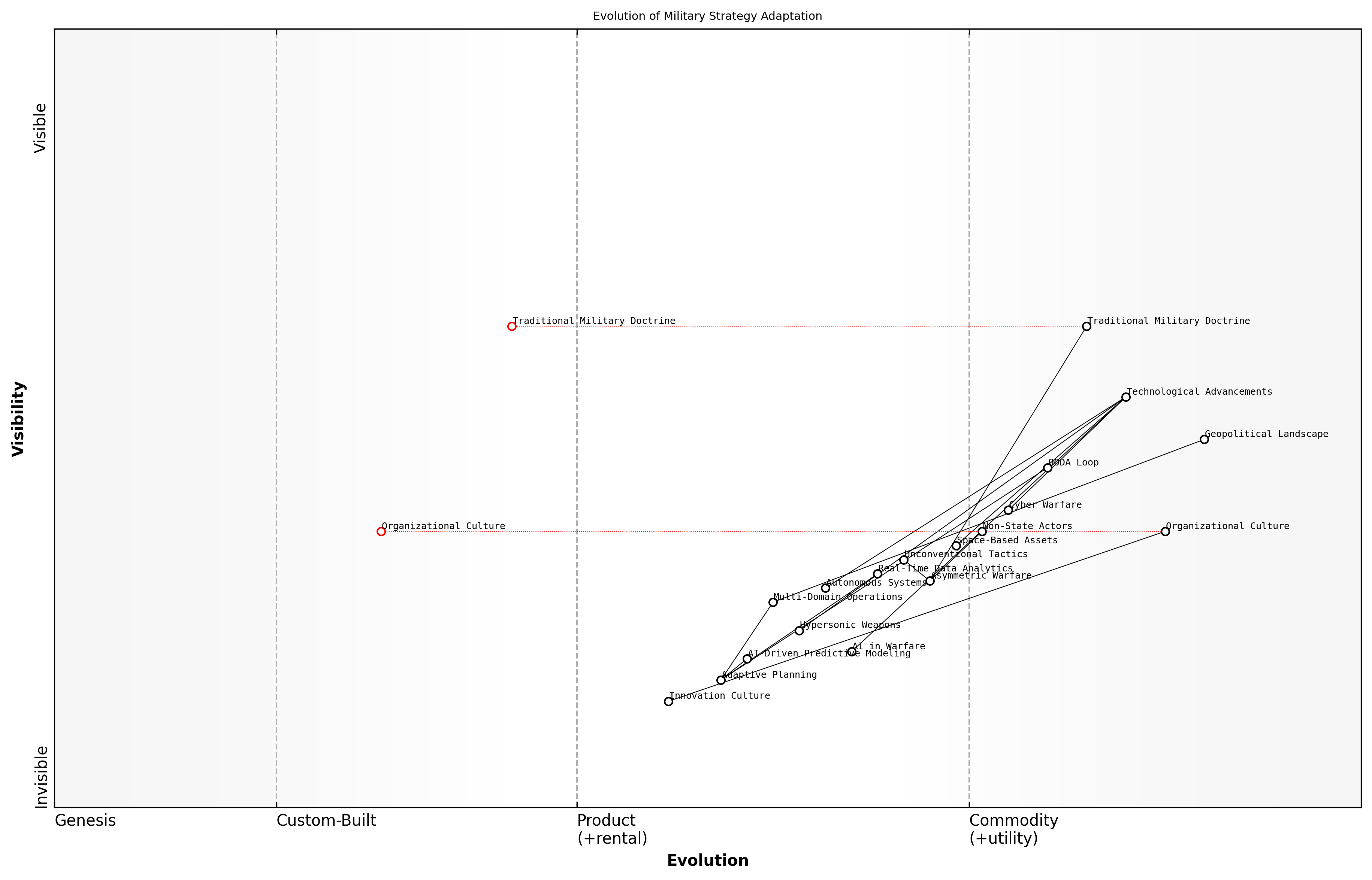
Wardley Map Assessment
The map reveals a military strategy landscape in transition, moving from traditional doctrines to adaptive, technology-driven approaches. To maintain strategic advantage, there's a critical need to invest in emerging technologies, foster an innovation culture, and develop adaptive planning capabilities. The integration of AI, autonomous systems, and multi-domain operations will be key to future military effectiveness. However, this transition must be balanced with the evolution of organisational culture and careful management of traditional doctrine elements to ensure a smooth and effective transformation of military strategy.
As we delve deeper into the 21st century, the need for adaptive strategies in modern warfare will only intensify. Military organisations must foster a culture of innovation, embrace emerging technologies, and develop the cognitive flexibility to navigate an increasingly complex and unpredictable operational environment. The ability to rapidly assess, adapt, and respond to evolving threats will be the hallmark of successful military strategies in the years to come.
In the subsequent sections, we will explore how Wardley Mapping can serve as a powerful tool in developing and implementing these adaptive strategies, providing a visual framework for understanding the evolving landscape of modern warfare and identifying opportunities for strategic advantage.
Introduction to NATO's Warfighting Capstone Concept (NWCC)
The NATO Warfighting Capstone Concept (NWCC) represents a significant evolution in military strategy, reflecting the complex and rapidly changing nature of modern warfare. As an expert in this field, I can attest to the NWCC's pivotal role in shaping NATO's approach to future conflicts and its efforts to maintain strategic advantage in an increasingly unpredictable global security environment.
The NWCC emerged from a recognition that traditional military doctrines were becoming inadequate in the face of emerging threats and technological advancements. It represents a paradigm shift in how NATO conceptualises and prepares for warfare across multiple domains, including land, sea, air, space, cyber, and the cognitive realm.
- Addresses the challenges of hybrid warfare and grey zone conflicts
- Emphasises the importance of multi-domain operations
- Focuses on enhancing NATO's ability to operate in contested environments
- Promotes adaptability and resilience in the face of rapidly evolving threats
One of the key aspects of the NWCC is its emphasis on interoperability and integration across all domains of warfare. This approach recognises that future conflicts will likely involve simultaneous operations across multiple spheres, requiring seamless coordination and synergy between different military capabilities.
The NWCC represents a fundamental shift in our understanding of modern warfare. It's not just about fighting in multiple domains, but about integrating our capabilities across these domains to achieve decisive effects.
The concept also places a strong emphasis on technological innovation and the integration of emerging technologies such as artificial intelligence, autonomous systems, and advanced data analytics. These technologies are seen as critical enablers for maintaining NATO's military edge in an era of rapid technological advancement.
Another crucial aspect of the NWCC is its focus on the cognitive domain. This recognises the growing importance of information warfare, strategic communications, and the battle for hearts and minds in modern conflicts. The concept acknowledges that future wars may be won or lost in the cognitive space, even before traditional kinetic operations begin.
- Enhances NATO's ability to counter disinformation and propaganda
- Emphasises the importance of strategic communications in shaping the battlefield
- Recognises the role of social media and digital platforms in modern conflicts
- Promotes resilience against psychological warfare tactics
The NWCC also places a strong emphasis on adaptability and flexibility. It recognises that the nature of threats and the character of warfare are constantly evolving, and that NATO must be able to rapidly adapt its strategies and capabilities to meet new challenges. This includes the ability to quickly integrate new technologies, tactics, and operational concepts as they emerge.
In today's rapidly changing security environment, our greatest strength lies in our ability to adapt. The NWCC provides us with a framework for continuous evolution and innovation in our warfighting capabilities.
Furthermore, the NWCC acknowledges the increasing importance of non-military factors in modern conflicts. It recognises that future wars may be fought not just with traditional military means, but also through economic, diplomatic, and informational instruments of power. This holistic approach to warfare requires close coordination between military and civilian entities, as well as between NATO and its partner nations.
![Draft Wardley Map: [Insert Wardley Map illustrating the key components and relationships within the NWCC]](https://images.wardleymaps.ai/map_8713931a-0ffe-4782-a767-39c5564b43bd.png)
Wardley Map Assessment
NATO's Warfighting Capstone Concept, as represented in this Wardley Map, shows a forward-thinking approach that recognises the changing nature of warfare. The strategy appropriately emphasises technological innovation and the emergence of cognitive warfare as key components. However, there's a need to accelerate the evolution of newer concepts like cognitive warfare and better integrate non-military factors. The focus on multi-domain operations and interoperability is crucial for future success. To maintain its military advantage, NATO must continue to innovate in emerging areas while enhancing its adaptability to rapidly evolving threats.
In conclusion, the NATO Warfighting Capstone Concept represents a significant evolution in military strategy, one that is essential for addressing the complex challenges of 21st-century warfare. By emphasising multi-domain operations, technological innovation, cognitive warfare, and adaptability, the NWCC provides a comprehensive framework for NATO to maintain its strategic advantage in an increasingly complex and unpredictable global security environment.
Bridging Wardley Mapping and Military Doctrine
The potential of Wardley Mapping in military context
As we delve into the convergence of Wardley Mapping and military strategy, it becomes increasingly clear that this innovative business strategy tool holds immense potential for revolutionising military planning and decision-making processes. The application of Wardley Mapping to military contexts offers a fresh perspective on age-old challenges, providing a structured approach to visualising complex systems, anticipating strategic shifts, and optimising resource allocation in an ever-evolving battlefield landscape.
One of the primary strengths of Wardley Mapping in the military context lies in its ability to provide a clear, visual representation of the entire strategic landscape. This comprehensive view allows military strategists to identify dependencies, anticipate potential vulnerabilities, and recognise opportunities for innovation that might otherwise remain hidden. By mapping out the various components of military operations – from physical assets to intangible elements like intelligence and morale – decision-makers can gain a holistic understanding of their strategic position and make more informed choices.
Wardley Mapping offers a unique lens through which we can view the complexities of modern warfare. It allows us to see not just where we are, but where we're heading and what we need to get there.
The dynamic nature of Wardley Maps aligns well with the fluid and unpredictable nature of military operations. As components evolve along the map's axis, military strategists can anticipate technological advancements, shifts in enemy tactics, and changes in the geopolitical landscape. This foresight is invaluable in developing proactive strategies and maintaining a competitive edge in conflict scenarios.
- Enhanced situational awareness: Wardley Maps provide a comprehensive view of the strategic landscape, allowing for better understanding of complex military environments.
- Improved resource allocation: By visualising the entire value chain, military leaders can optimise the distribution of resources across different domains and capabilities.
- Strategic foresight: The evolutionary aspect of Wardley Maps enables military planners to anticipate future challenges and opportunities, facilitating proactive strategy development.
- Cross-domain integration: Wardley Mapping can help identify synergies and dependencies between different military domains, fostering a more integrated approach to multi-domain operations.
- Risk identification and mitigation: The visual nature of Wardley Maps makes it easier to spot potential vulnerabilities and develop targeted risk mitigation strategies.
Furthermore, Wardley Mapping's emphasis on understanding the evolution of components is particularly relevant in the rapidly changing landscape of modern warfare. As military technology and tactics continue to advance at an unprecedented pace, the ability to anticipate and prepare for these changes becomes increasingly crucial. Wardley Mapping provides a framework for tracking these evolutionary trends, allowing military organisations to stay ahead of the curve and maintain strategic superiority.
The application of Wardley Mapping to military doctrine also offers the potential to enhance interoperability between different branches of the armed forces and even between allied nations. By providing a common visual language for strategic planning, Wardley Maps can facilitate better communication and collaboration across diverse military units and international partners. This improved coordination is essential in the context of modern warfare, where joint operations and multinational coalitions are increasingly the norm.
The beauty of Wardley Mapping in military strategy lies in its ability to bridge gaps – between different military branches, between nations, and between current capabilities and future requirements. It's a universal language for strategic thinking.
However, it's important to acknowledge that the integration of Wardley Mapping into military doctrine is not without its challenges. Military organisations, often steeped in tradition and established procedures, may resist the adoption of new strategic tools. Additionally, the complexity of military operations and the classified nature of much military information may pose obstacles to the full implementation of Wardley Mapping techniques.
Despite these challenges, the potential benefits of Wardley Mapping in the military context far outweigh the difficulties of implementation. As military organisations around the world grapple with increasingly complex and multifaceted threats, tools like Wardley Mapping offer a way to cut through the complexity and develop more effective, adaptive strategies.
![Draft Wardley Map: [Insert Wardley Map illustrating the potential applications of Wardley Mapping in military strategy]](https://images.wardleymaps.ai/map_83554f51-f4e1-49df-a48b-ed8fccdb40e3.png)
Wardley Map Assessment
This Wardley Map reveals a military strategy in transition, actively incorporating new methodologies like Wardley Mapping to enhance traditional capabilities. The focus on integrating emerging technologies with established military doctrine presents significant opportunities for innovation and strategic advantage. However, careful management of evolving components and potential bottlenecks is crucial. The successful integration of Wardley Mapping across all domains could provide a substantial edge in future military operations, particularly in areas of situational awareness and strategic foresight. To fully capitalise on these opportunities, a concerted effort to accelerate the adoption of Wardley Mapping, coupled with investments in cross-domain integration and interoperability, will be essential.
In conclusion, the potential of Wardley Mapping in the military context is vast and largely untapped. As we continue to explore this convergence of business strategy and military doctrine, we open up new possibilities for enhancing military decision-making, improving strategic planning, and ultimately, increasing operational effectiveness across all domains of warfare. The following chapters will delve deeper into how Wardley Mapping can be specifically applied to NATO's Warfighting Capstone Concept, demonstrating the practical applications of this powerful strategic tool in modern military planning.
Challenges and opportunities in applying Wardley Mapping to NWCC
The application of Wardley Mapping to NATO's Warfighting Capstone Concept (NWCC) represents a groundbreaking convergence of business strategy tools and military doctrine. This fusion presents both significant challenges and unprecedented opportunities for enhancing strategic planning and operational effectiveness within the alliance.
One of the primary challenges in applying Wardley Mapping to NWCC lies in the fundamental differences between business and military environments. While Wardley Mapping was originally developed for commercial contexts, the military landscape is characterised by unique factors such as geopolitical complexities, the potential for kinetic conflict, and the imperative of national security. Adapting the mapping methodology to account for these distinctive elements requires a nuanced understanding of both domains.
- Complexity of military operations across multiple domains
- Integration of rapidly evolving technologies
- Balancing operational security with the need for transparency in mapping
- Accounting for the unpredictable nature of warfare
- Aligning diverse national interests within the NATO alliance
Despite these challenges, the opportunities presented by applying Wardley Mapping to NWCC are substantial. The visual nature of Wardley Maps can provide military strategists with a powerful tool for understanding the evolving landscape of modern warfare. By mapping the components of each operational domain - land, maritime, air, space, cyber, and cognitive - decision-makers can gain unprecedented insights into the interdependencies and potential vulnerabilities within their strategic posture.
Wardley Mapping offers a unique lens through which we can visualise the complex interplay of capabilities, technologies, and doctrines that underpin modern military operations. It has the potential to revolutionise how we approach strategic planning within NATO.
One of the most significant opportunities lies in the ability of Wardley Mapping to enhance interoperability within the alliance. By creating a shared visual language for discussing strategy, NATO members can more effectively align their capabilities and identify areas for collaboration and resource sharing. This could lead to more efficient allocation of resources and a more cohesive overall strategy.
Furthermore, the application of Wardley Mapping to NWCC can facilitate more agile and adaptive strategic planning. In an era of rapid technological change and evolving threats, the ability to quickly assess and adjust strategic postures is crucial. Wardley Maps can provide a dynamic framework for continuous strategy evaluation and refinement, allowing NATO to stay ahead of potential adversaries.
- Enhanced visibility of strategic dependencies and vulnerabilities
- Improved decision-making through clearer understanding of the operational landscape
- Facilitation of more effective resource allocation across the alliance
- Better anticipation of future technological and doctrinal shifts
- Increased agility in responding to emerging threats and opportunities
However, realising these opportunities requires overcoming significant cultural and organisational barriers. Military institutions are often characterised by hierarchical structures and established doctrines, which can resist the introduction of new methodologies. Successfully integrating Wardley Mapping into NATO's strategic planning processes will require buy-in from senior leadership, as well as comprehensive training and education programmes.
![Draft Wardley Map: [Insert Wardley Map illustrating the evolution of strategic planning methodologies within NATO, from traditional approaches to the integration of Wardley Mapping]](https://images.wardleymaps.ai/map_efc2401c-14e6-4d16-9cba-e5c1b45b4190.png)
Wardley Map Assessment
NATO is at a critical juncture in evolving its strategic planning capabilities. The integration of Wardley Mapping and the development of the NWCC present significant opportunities to enhance NATO's adaptive capacity and strategic foresight. However, success hinges on effective leadership buy-in, comprehensive training programs, and the ability to balance traditional doctrine with innovative approaches. By focusing on these areas, NATO can position itself to more effectively address complex, multi-domain challenges in an increasingly uncertain geopolitical landscape.
In conclusion, while the challenges of applying Wardley Mapping to NWCC are substantial, the potential benefits make it a worthwhile endeavour. By carefully navigating the complexities of adapting this business strategy tool to the military context, NATO has the opportunity to significantly enhance its strategic planning capabilities. The successful integration of Wardley Mapping could provide the alliance with a powerful new tool for maintaining its strategic edge in an increasingly complex and unpredictable global security environment.
The fusion of Wardley Mapping and military doctrine represents a paradigm shift in how we approach strategic planning. It's not just about adopting a new tool; it's about embracing a new way of thinking about warfare in the 21st century.
Overview of the book's approach and structure
This book presents a groundbreaking approach to military strategy by applying the principles of Wardley Mapping to NATO's Warfighting Capstone Concept (NWCC). As an expert in both strategic planning and military doctrine, I have structured this work to provide a comprehensive exploration of how these two seemingly disparate fields can be integrated to create powerful insights for modern warfare.
The book is divided into five main chapters, each designed to build upon the previous, creating a logical progression from theoretical foundations to practical applications and future implications. This structure ensures that readers, whether they are seasoned military strategists or newcomers to the field, can gradually develop a deep understanding of both Wardley Mapping and the NWCC.
- Chapter 1: Introduction - Lays the groundwork by explaining Wardley Mapping and its potential in military contexts, while also introducing the NWCC.
- Chapter 2: Decoding NWCC - Provides a detailed analysis of NATO's Warfighting Capstone Concept and its six operational domains.
- Chapter 3: Mapping the Six NWCC Domains - Offers a step-by-step guide to creating Wardley Maps for each domain and integrating them.
- Chapter 4: Practical Applications and Case Studies - Presents real-world scenarios and historical examples to demonstrate the practical value of this approach.
- Chapter 5: The Future of Military Strategy - Explores how this integrated approach can evolve and shape future military planning and decision-making.
Throughout the book, I have incorporated my extensive experience in advising government bodies and military organisations to provide unique insights and practical tips. Each chapter includes detailed explanations, visual aids in the form of Wardley Maps, and thought-provoking exercises to reinforce learning.
The true power of strategy lies not in predicting the future, but in creating a framework that allows us to adapt swiftly and effectively to any scenario we might face.
This quote from a senior military strategist encapsulates the core philosophy behind our approach. By combining Wardley Mapping with the NWCC, we aim to create just such a framework – one that is both robust and flexible, capable of guiding military planning in an increasingly complex and unpredictable world.
The book's structure is designed to facilitate both linear reading and selective consultation. While the chapters build upon each other, each is also self-contained enough to serve as a reference for specific aspects of Wardley Mapping in military contexts. This approach caters to both those seeking a comprehensive understanding and those looking to apply specific concepts to their work.
![Draft Wardley Map: [Insert Wardley Map illustrating the book's structure and how it bridges Wardley Mapping and Military Doctrine]](https://images.wardleymaps.ai/map_725d0fc5-ebfb-4174-94d3-f694c90b97e2.png)
Wardley Map Assessment
This Wardley Map represents a significant opportunity to revolutionise military strategic planning by integrating advanced business strategy tools with traditional military doctrine. The book serves as a crucial bridge, potentially catalysing a shift in how military strategy is conceived and executed. To maximise impact, focus should be on practical applications, continuous evolution of the methodology, and deep engagement with military leadership and institutions. The success of this approach could lead to more adaptive, nuanced, and effective military strategies in an increasingly complex global security environment.
By the end of this book, readers will not only understand how to create and interpret Wardley Maps for military strategies but will also gain a new perspective on the NWCC and its potential evolution. The integration of these two fields opens up new possibilities for strategic thinking in military contexts, potentially revolutionising how we approach warfare in the 21st century and beyond.
Decoding NATO's Warfighting Capstone Concept (NWCC)
The Genesis and Purpose of NWCC
NATO's strategic environment and challenges
The North Atlantic Treaty Organization (NATO) faces an increasingly complex and volatile strategic environment in the 21st century. This rapidly evolving landscape has necessitated the development of the NATO Warfighting Capstone Concept (NWCC), a forward-looking doctrine designed to address current and future challenges. To fully appreciate the genesis and purpose of the NWCC, it is crucial to understand the multifaceted strategic environment in which NATO operates and the myriad challenges it confronts.
The post-Cold War era has given rise to a multipolar world order, characterised by the resurgence of great power competition and the emergence of new, non-traditional threats. This shift has fundamentally altered the security calculus for NATO, requiring a comprehensive reassessment of its strategic posture and operational capabilities.
- Resurgent Russia: The assertive actions of Russia, particularly in Eastern Europe and the Arctic, have reignited concerns about territorial integrity and regional stability.
- Rising China: China's growing global influence and military modernisation pose new strategic challenges, extending NATO's focus beyond its traditional Euro-Atlantic sphere.
- Terrorism and extremism: The persistent threat of international terrorism and violent extremism continues to challenge NATO's security paradigms.
- Cyber warfare: The exponential growth of cyber threats has opened a new front in modern conflict, blurring the lines between peace and war.
- Hybrid warfare: The increasing use of hybrid tactics, combining conventional and unconventional methods, presents complex challenges for detection and response.
- Climate change: Environmental shifts are creating new geopolitical tensions and operational challenges, particularly in the Arctic region.
- Disruptive technologies: Rapid technological advancements, including artificial intelligence and autonomous systems, are reshaping the nature of warfare.
These challenges are not isolated; they are interconnected and often mutually reinforcing. For instance, the proliferation of disruptive technologies can exacerbate cyber threats, while climate change can fuel regional instability and conflict. This intricate web of challenges demands a holistic and adaptive approach to strategic planning and operational execution.
The strategic landscape we face today is the most complex and demanding since the end of the Cold War. It requires us to think and act differently, to be more agile, more integrated, and more innovative than ever before.
In response to this dynamic environment, NATO has had to evolve its strategic thinking. The traditional focus on collective defence, while still fundamental, has been broadened to encompass crisis management and cooperative security. This expanded remit reflects the recognition that modern security challenges often transcend national borders and require collaborative, multinational responses.
The NWCC emerges from this context as a visionary framework designed to guide NATO's adaptation to the complexities of modern warfare. It seeks to harness the collective strengths of the Alliance while addressing its vulnerabilities in an era of rapid technological change and strategic uncertainty. By emphasising multi-domain operations and enhanced interoperability, the NWCC aims to position NATO to effectively counter both state and non-state adversaries across the full spectrum of conflict.
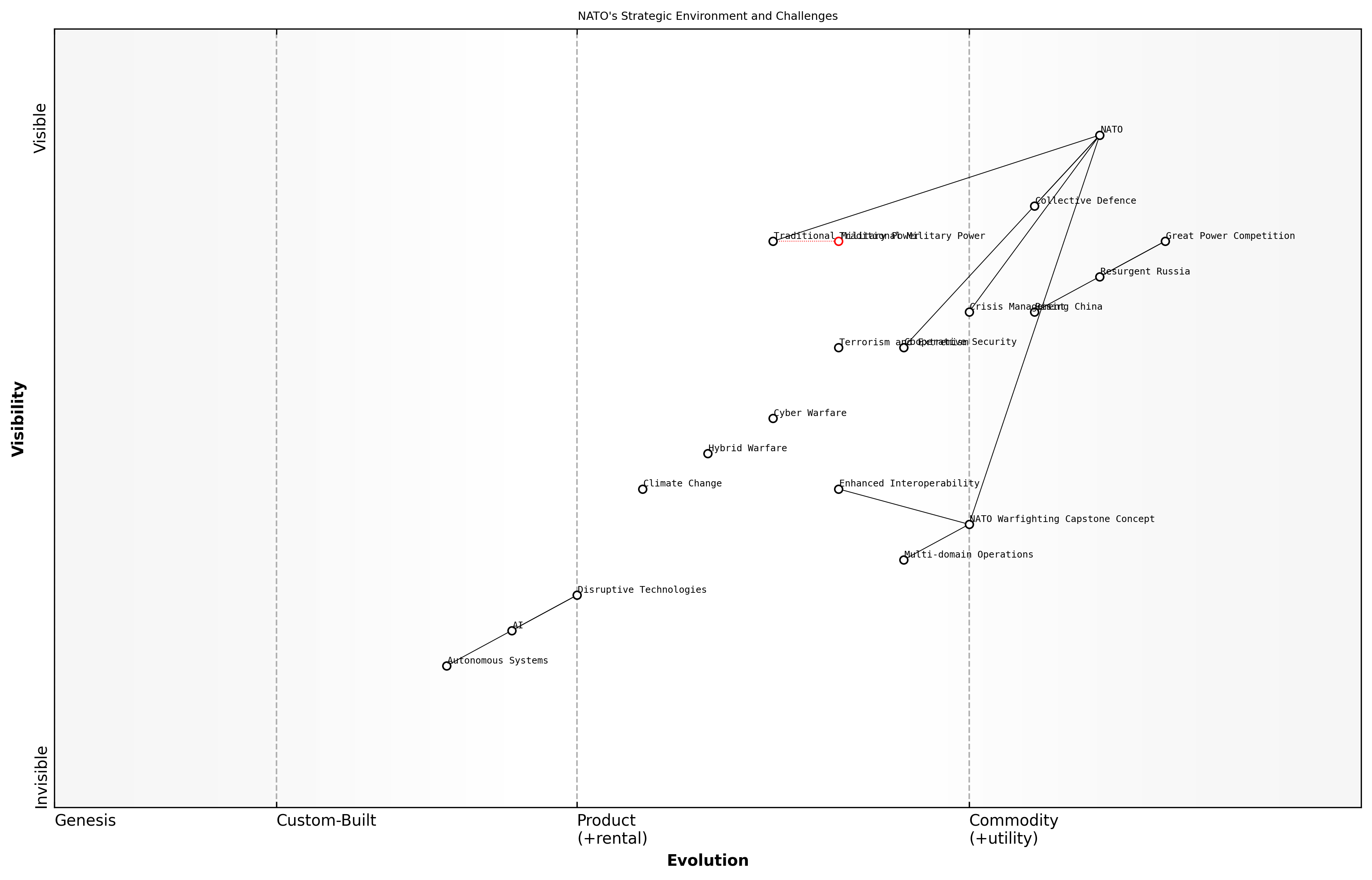
Wardley Map Assessment
The Wardley Map reveals NATO at a critical juncture, facing the need to balance its traditional strengths with the imperative to adapt to a rapidly changing security landscape. The organisation must navigate the challenges of great power competition while simultaneously evolving its capabilities to address emerging threats like cyber warfare, hybrid tactics, and the security implications of climate change. The NATO Warfighting Capstone Concept represents a pivotal effort to bridge this gap, but its success will depend on NATO's ability to effectively integrate disruptive technologies, enhance interoperability, and develop multi-domain operational capabilities. The strategic focus should be on accelerating the adoption of AI and autonomous systems, strengthening cyber defences, and fostering greater collaboration in technological innovation among member states. By doing so, NATO can maintain its relevance and effectiveness in an increasingly complex and unpredictable global security environment.
A Wardley Map of NATO's strategic environment would illustrate the evolving nature of key components such as threat actors, technological capabilities, and geopolitical factors. It would highlight how traditional elements of military power are being disrupted by emerging technologies and non-traditional threats, necessitating a reimagining of NATO's strategic approach.
In conclusion, the genesis of the NWCC is deeply rooted in NATO's recognition of a transformed strategic landscape. It represents a proactive effort to adapt the Alliance's capabilities, doctrines, and decision-making processes to meet the challenges of an uncertain future. By providing a comprehensive framework for understanding and responding to modern security threats, the NWCC serves as a crucial tool for ensuring NATO's continued relevance and effectiveness in safeguarding the security of its member states in the decades to come.
Core objectives and principles of NWCC
The NATO Warfighting Capstone Concept (NWCC) represents a paradigm shift in the Alliance's approach to warfare and strategic planning. As a seasoned expert in military strategy and Wardley mapping, I can attest to the significance of this concept in shaping NATO's future operational capabilities. The NWCC is not merely a tactical adjustment but a comprehensive reimagining of how NATO prepares for and conducts warfare in an increasingly complex and multi-domain battlespace.
At its core, the NWCC is driven by the recognition that future conflicts will be characterised by rapid technological advancements, the blurring of traditional domain boundaries, and the need for unprecedented levels of integration and adaptability. The concept's primary objective is to ensure that NATO maintains its strategic advantage and operational effectiveness in the face of these evolving challenges.
- Enhance NATO's ability to operate effectively across all domains simultaneously
- Develop a more agile and responsive force structure
- Improve decision-making processes through advanced data integration and analysis
- Strengthen the Alliance's deterrence and defence posture
- Foster innovation and technological superiority
- Promote interoperability among NATO members and partners
The principles underpinning the NWCC are rooted in the concept of Multi-Domain Operations (MDO). This approach recognises that future conflicts will not be confined to traditional physical domains but will span across land, sea, air, space, cyberspace, and the cognitive realm. The NWCC emphasises the need for seamless integration and synchronisation across these domains to achieve operational superiority.
The NWCC represents a fundamental shift in how we conceptualise and prepare for future conflicts. It's not just about fighting in multiple domains; it's about leveraging the synergies between them to create decisive advantages.
A key principle of the NWCC is the concept of 'convergence'. This involves the rapid and continuous integration of capabilities across domains, echelons, and partners to overwhelm adversaries and create multiple dilemmas. By leveraging advanced technologies such as artificial intelligence, big data analytics, and autonomous systems, NATO aims to achieve decision superiority and maintain the initiative in complex operational environments.
Another crucial aspect of the NWCC is its emphasis on resilience and adaptability. The concept recognises that future conflicts may involve disruptions to traditional command and control structures, communication networks, and supply chains. As such, it promotes the development of decentralised decision-making capabilities and the ability to operate effectively in degraded environments.
The NWCC also places significant importance on the cognitive domain, acknowledging that future conflicts will be as much about winning hearts and minds as they are about physical confrontation. This includes a focus on strategic communications, information operations, and the ability to counter disinformation and propaganda.
![Draft Wardley Map: [Insert Wardley Map illustrating the key components and relationships within the NWCC]](https://images.wardleymaps.ai/map_5b483ac8-89c0-469e-89e1-93b841291b69.png)
Wardley Map Assessment
The NWCC Wardley Map reveals a strategic vision that aims to integrate cutting-edge technologies and concepts with traditional military strengths. The focus on multi-domain operations, decision superiority, and cognitive domain operations positions NATO to address future security challenges. However, significant investment and development in AI, data integration, and cognitive domain capabilities are crucial to realising this vision and maintaining strategic advantage. The alliance must balance the evolution of these emerging capabilities with the maintenance and adaptation of its traditional strengths, all while fostering a culture of innovation and interoperability among its members.
From a Wardley mapping perspective, the NWCC represents a shift towards more evolved and integrated capabilities across the entire value chain of military operations. It pushes many traditional components from the 'Product' and 'Custom Built' stages towards the 'Commodity' and 'Utility' stages, emphasising the need for standardisation and interoperability. Simultaneously, it introduces new components in the 'Genesis' and 'Custom Built' stages, particularly in areas such as AI-driven decision support systems and advanced multi-domain integration platforms.
In conclusion, the core objectives and principles of the NWCC reflect NATO's commitment to maintaining its strategic edge in an increasingly complex and contested global security environment. By embracing multi-domain operations, fostering innovation, and prioritising integration and adaptability, the NWCC aims to ensure that NATO remains capable of deterring aggression and defending its members effectively in the face of 21st-century challenges.
The concept of Multi-Domain Operations (MDO)
The concept of Multi-Domain Operations (MDO) lies at the heart of NATO's Warfighting Capstone Concept (NWCC), representing a paradigm shift in how modern military operations are conceived and executed. MDO recognises that future conflicts will not be confined to traditional battlespaces but will span across multiple domains simultaneously, requiring a holistic and integrated approach to warfare.
At its core, MDO seeks to orchestrate military capabilities across the six operational domains identified in the NWCC: land, maritime, air, space, cyber, and cognitive. This approach aims to create synergies and present adversaries with multiple dilemmas, overwhelming their decision-making processes and operational capabilities.
Multi-Domain Operations represent the evolution of joint operations, recognising that domination in a single domain is no longer sufficient for victory in modern warfare.
The genesis of MDO can be traced back to the recognition of emerging threats and the changing character of warfare. As potential adversaries develop sophisticated anti-access/area denial (A2/AD) capabilities and hybrid warfare tactics, NATO recognised the need for a more flexible and integrated approach to maintain its strategic advantage.
- Seamless integration of capabilities across all domains
- Rapid and dynamic allocation of resources based on evolving battlefield conditions
- Exploitation of temporary windows of advantage in any domain
- Enhanced situational awareness through shared intelligence and communication networks
- Coordinated effects that amplify the impact of individual actions across domains
The implementation of MDO requires significant changes in military doctrine, training, and technology. It demands a high degree of interoperability between NATO allies and partners, as well as the development of new capabilities that can operate effectively across domain boundaries.
One of the key challenges in implementing MDO is the need for rapid decision-making in complex, fast-paced environments. This necessitates the development of advanced command and control systems, artificial intelligence-assisted decision support tools, and a new generation of military leaders capable of thinking and operating across multiple domains simultaneously.
The success of Multi-Domain Operations hinges on our ability to out-think, out-manoeuvre, and out-pace our adversaries across all domains of warfare.
As we delve deeper into the application of Wardley Mapping to the NWCC and its constituent domains, it becomes clear that MDO represents a complex system of interdependencies and evolving capabilities. The ability to visualise these relationships and their maturity levels through Wardley Maps will prove invaluable in identifying strategic opportunities, potential vulnerabilities, and areas for focused investment and innovation.
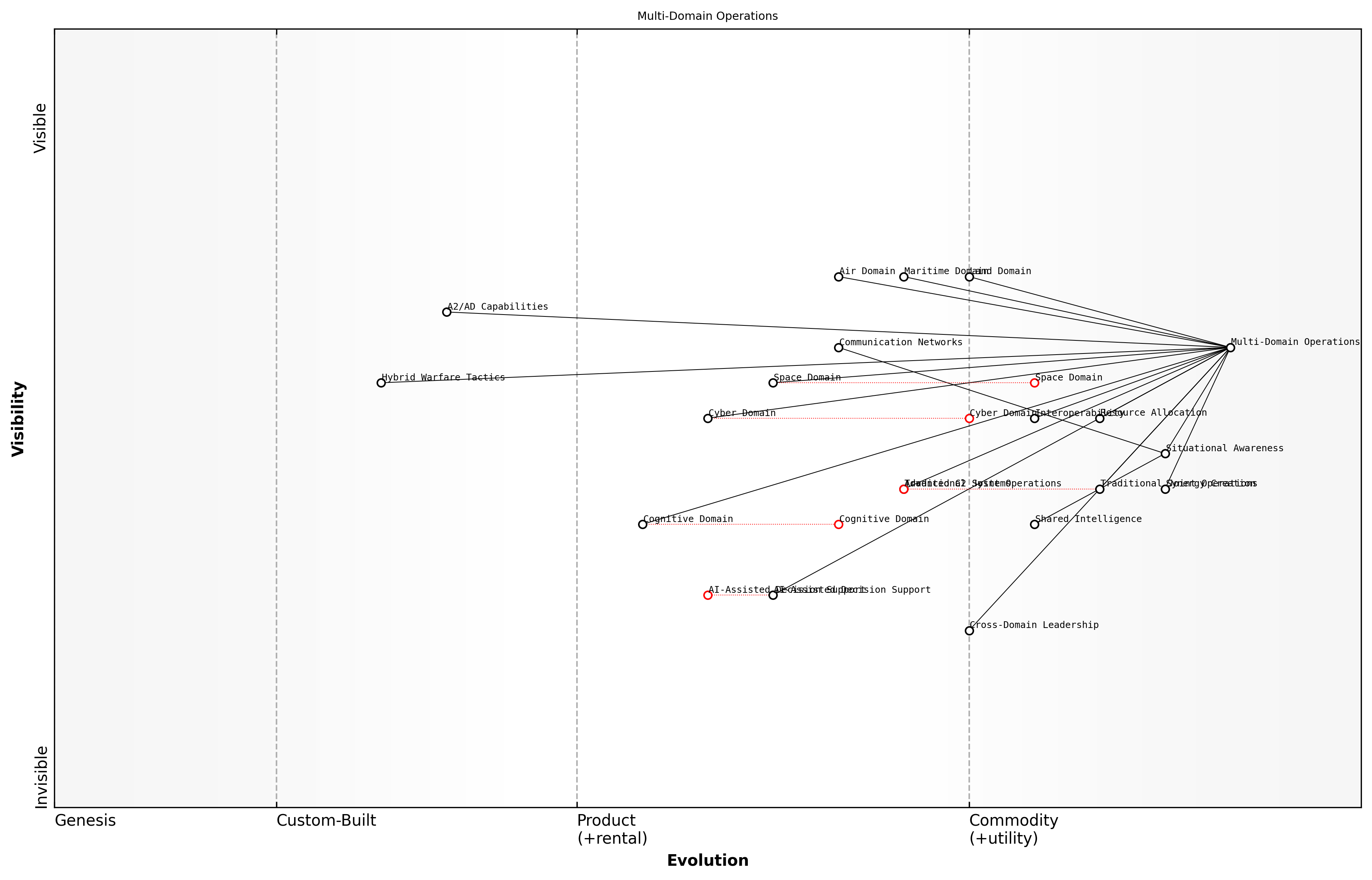
Wardley Map Assessment
The Multi-Domain Operations concept represents a significant evolution in NATO's warfighting approach. While well-positioned to integrate traditional domains, there's a critical need to accelerate the development and integration of emerging domains and technologies, particularly in the cognitive and AI realms. Success will hinge on effective Cross-Domain Leadership and the ability to create synergies across all operational domains.
By mapping the various elements of MDO, from technological enablers to doctrinal concepts, we can gain insights into how different components of the NWCC interact and evolve. This understanding is crucial for NATO strategists and policymakers as they work to implement and refine the MDO concept in response to an ever-changing security landscape.
As we progress through this book, we will explore how Wardley Mapping can be applied to each of the six operational domains identified in the NWCC, always keeping in mind their interconnectedness within the broader framework of Multi-Domain Operations. This approach will provide a comprehensive and nuanced understanding of the challenges and opportunities presented by this revolutionary concept in modern warfare.
The Six Operational Domains of NWCC
Land domain: Characteristics and strategic importance
The land domain remains a cornerstone of military operations and strategic thinking within NATO's Warfighting Capstone Concept (NWCC). As an expert in military strategy and Wardley mapping, I can attest that understanding the unique characteristics and strategic importance of the land domain is crucial for effective multi-domain operations. The land domain encompasses all aspects of military operations conducted on solid ground, including urban, rural, and mountainous terrains, each presenting distinct challenges and opportunities for warfighters.
One of the primary characteristics of the land domain is its inherent complexity and variability. Unlike other domains, land operations must contend with a wide range of geographical features, climate conditions, and human-made structures. This diversity necessitates a high degree of adaptability in tactics, equipment, and training. Moreover, the land domain is where the majority of the world's population resides, making it a critical arena for achieving strategic objectives that often revolve around influencing or protecting civilian populations.
- Terrain diversity: From deserts to jungles, urban centres to mountain ranges
- Population-centric nature: Direct interaction with civilian populations
- Persistence: Ability to hold and control territory over extended periods
- Logistical challenges: Complex supply chains and resource management
- Cultural significance: Historical and political importance of land control
The strategic importance of the land domain cannot be overstated. It is often said in military circles that 'you may win a war in the air or at sea, but you can only secure peace on land.' This adage underscores the critical role that land forces play in achieving lasting strategic outcomes. Control of key terrain, protection of vital infrastructure, and the ability to project power inland from coastal areas are all essential capabilities that the land domain provides.
The land domain is where wars are ultimately won or lost. It's where we see the human cost of conflict most acutely, and where the complexities of modern warfare are most evident.
In the context of NWCC, the land domain serves as a vital link between other operational domains. It provides the physical space for the deployment of air defence systems, acts as a base for projecting power into the maritime domain, and houses critical infrastructure that supports cyber and space operations. This interconnectedness highlights the need for a comprehensive understanding of the land domain's role in multi-domain operations.
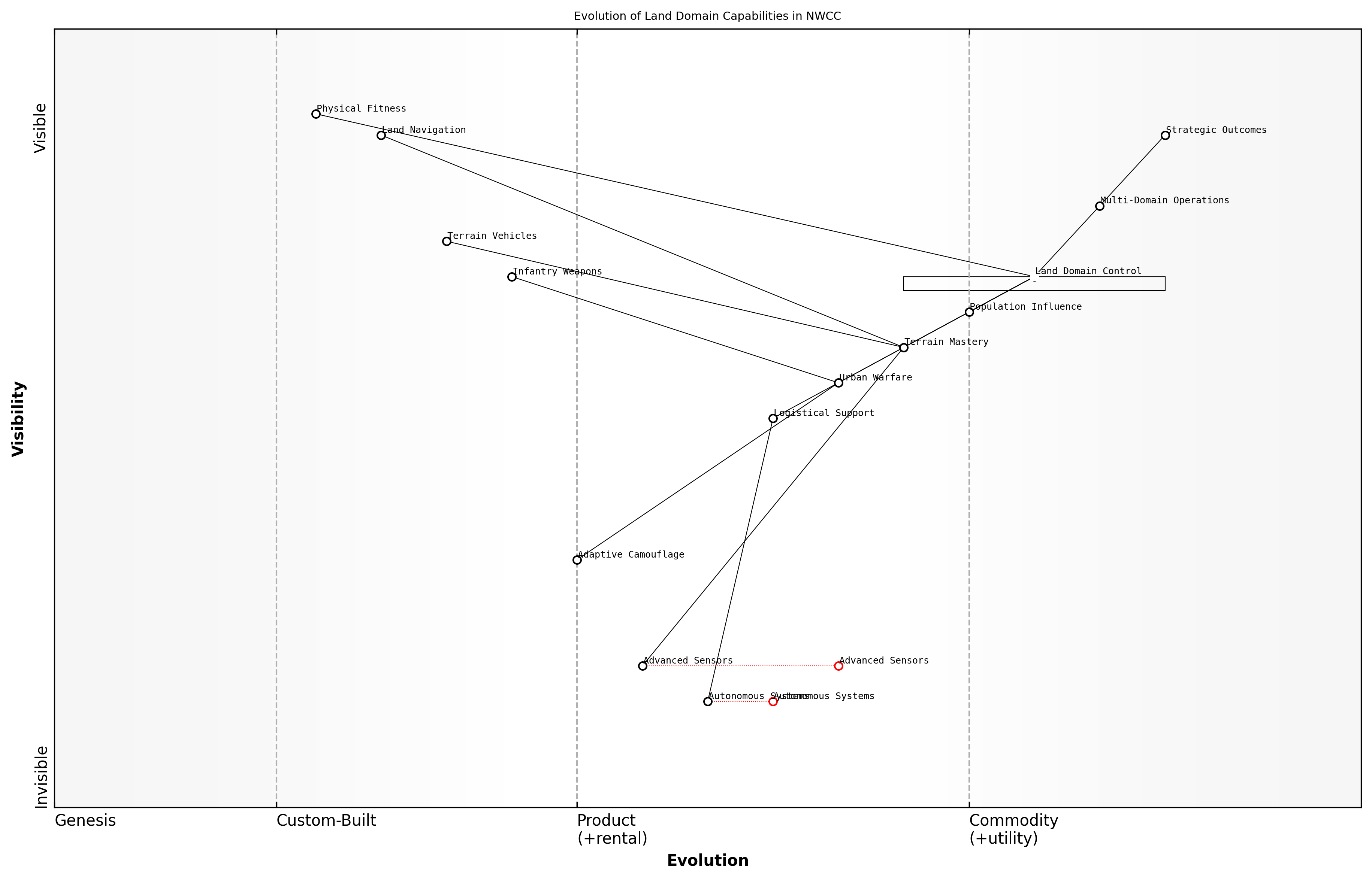
Wardley Map Assessment
NATO's land domain capabilities are strong in traditional areas but require significant development in emerging technologies. The focus should be on accelerating the evolution of Autonomous Systems, Advanced Sensors, and Urban Warfare capabilities while maintaining strengths in physical readiness and navigation. Enhancing Multi-Domain Operations integration is crucial for future strategic success. The organisation needs to balance maintaining current operational effectiveness with investing in disruptive technologies that will shape future land warfare.
When applying Wardley mapping to the land domain within NWCC, we can identify several key components that evolve along the value chain. At the genesis stage, we find emerging technologies like autonomous ground vehicles and advanced sensor networks. Custom-built solutions such as specialised urban warfare equipment and adaptive camouflage systems occupy the product stage. In the commodity stage, we have standardised infantry weapons and basic terrain vehicles. Finally, at the utility stage, we find fundamental skills like land navigation and physical fitness.
Understanding this evolution is crucial for strategic planning within NWCC. It allows military leaders to anticipate future capability needs, allocate resources effectively, and identify potential areas of strategic advantage or vulnerability. For instance, investing in the development of autonomous systems at the genesis stage could provide a significant edge in future land operations, particularly in high-risk environments or for logistical support.
Wardley mapping the land domain reveals not just where we are, but where we need to be. It's a powerful tool for aligning our capabilities with the evolving nature of land warfare.
In conclusion, the land domain's characteristics of complexity, persistence, and direct human interaction make it a critical component of NWCC. Its strategic importance lies in its ability to secure lasting outcomes, project power, and serve as a nexus for multi-domain operations. By applying Wardley mapping to this domain, NATO can enhance its strategic planning, ensuring that land forces remain adaptable, effective, and central to the alliance's warfighting capabilities in an ever-evolving operational landscape.
Maritime domain: Naval warfare in the 21st century
The maritime domain, a cornerstone of NATO's Warfighting Capstone Concept (NWCC), has undergone significant transformation in the 21st century. As an expert in military strategy and Wardley mapping, it is crucial to understand how naval warfare has evolved and its implications for NATO's operational capabilities. The maritime domain encompasses not only traditional naval operations but also extends to the protection of sea lines of communication, power projection, and the safeguarding of economic interests in an increasingly complex geopolitical landscape.
In the context of NWCC, the maritime domain plays a pivotal role in ensuring NATO's ability to deter aggression, respond to crises, and maintain strategic advantage. The 21st century has brought about new challenges and opportunities in naval warfare, necessitating a re-evaluation of traditional doctrines and the incorporation of emerging technologies and strategies.
- Expanded operational areas: From littoral waters to the high seas and underwater domains
- Integration of unmanned systems and artificial intelligence in naval operations
- Enhanced maritime domain awareness through advanced sensors and data fusion
- Increased focus on cyber and electronic warfare capabilities in naval assets
- Development of hypersonic and long-range precision strike capabilities
- Growing importance of expeditionary operations and sea-based power projection
One of the most significant shifts in 21st-century naval warfare is the integration of multi-domain operations. The maritime domain no longer operates in isolation but is intrinsically linked with air, land, space, cyber, and cognitive domains. This interconnectedness requires a holistic approach to strategy and operations, which is where Wardley mapping can provide valuable insights.
The future of naval warfare lies not in the supremacy of individual platforms, but in the seamless integration of capabilities across all domains. Our ability to leverage this integration will determine our success in maritime operations.
The rise of near-peer competitors and the resurgence of great power competition have also reshaped the maritime landscape. NATO must contend with advanced anti-access/area denial (A2/AD) capabilities, which challenge traditional notions of sea control and power projection. This has led to the development of new concepts such as Distributed Maritime Operations (DMO) and Expeditionary Advanced Base Operations (EABO), which aim to enhance resilience and operational flexibility in contested environments.
Another critical aspect of 21st-century naval warfare is the growing importance of the Arctic region. As climate change opens new sea routes and access to resources, the Arctic is becoming an area of strategic competition. NATO must adapt its maritime strategy to address the unique challenges posed by operations in this harsh and sensitive environment.
- Development of ice-capable vessels and specialised Arctic equipment
- Enhanced surveillance and reconnaissance capabilities in polar regions
- Establishment of Arctic-specific training and exercise programmes
- Collaboration with Arctic nations on environmental protection and search and rescue operations
The maritime domain also faces non-traditional security challenges, including piracy, terrorism, illegal trafficking, and environmental threats. These issues require a comprehensive approach that combines military capabilities with law enforcement, diplomacy, and international cooperation. NATO's maritime strategy must be flexible enough to address both high-end warfighting scenarios and these persistent, low-intensity challenges.
![Draft Wardley Map: [Insert Wardley Map: Evolution of Maritime Domain Capabilities]](https://images.wardleymaps.ai/map_c15187ca-ae1f-4c45-b048-1fe701be69d1.png)
Wardley Map Assessment
The map reveals a naval warfare landscape in transition, with NATO well-positioned but facing challenges in rapidly evolving technological areas. The strategic focus should be on accelerating the development and integration of AI, unmanned systems, and hypersonic capabilities, while also adapting force structures and doctrines to leverage these new technologies effectively. Balancing investment in traditional and emerging capabilities will be crucial, as will fostering a robust ecosystem of partnerships to drive innovation and maintain strategic advantage.
As we apply Wardley mapping to the maritime domain within NWCC, it becomes evident that certain capabilities are evolving rapidly. For instance, unmanned systems and AI-driven decision support tools are moving from the custom-built stage towards more standardised, commodity-like solutions. This evolution has significant implications for force structure, training, and operational concepts.
Conversely, traditional naval platforms like aircraft carriers and submarines remain in the product/custom-built stages due to their complexity and strategic importance. However, their roles and capabilities are being redefined by the integration of advanced technologies and the need for multi-domain interoperability.
The key to maintaining maritime superiority lies not in the pursuit of a single, dominant platform, but in creating a networked, adaptive force that can leverage the unique strengths of each asset across the entire kill chain.
In conclusion, the maritime domain in the 21st century is characterised by increased complexity, technological innovation, and the need for multi-domain integration. NATO's approach to naval warfare must evolve to meet these challenges while maintaining the flexibility to address both high-end conflicts and persistent, low-intensity threats. By applying Wardley mapping to the maritime domain within NWCC, we can gain valuable insights into the evolution of capabilities, identify strategic opportunities, and ensure that NATO's maritime strategy remains robust and adaptive in the face of an ever-changing security environment.
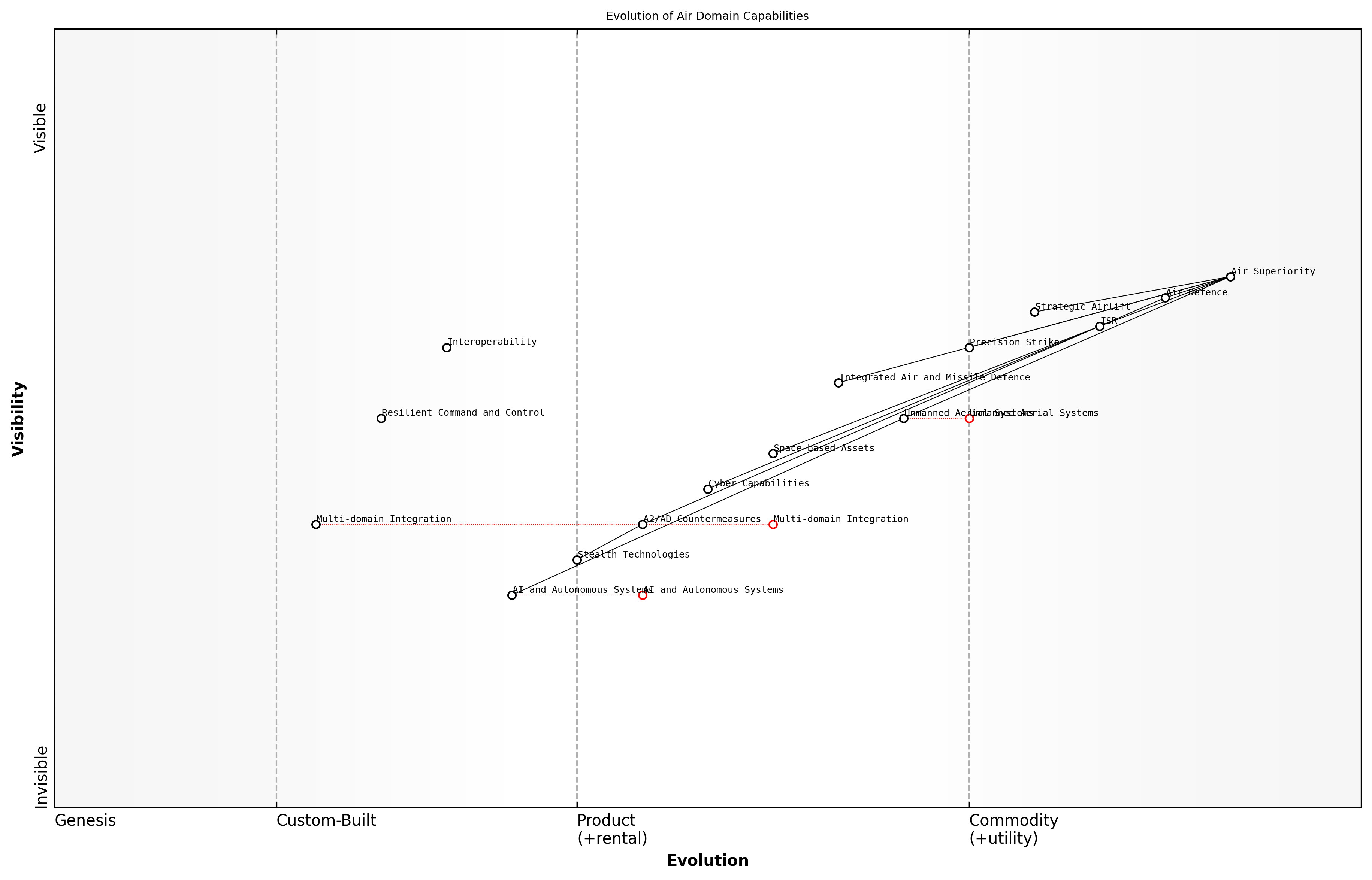
Air domain: Control of the skies and beyond
The air domain, a critical component of NATO's Warfighting Capstone Concept (NWCC), represents the theatre of operations extending from the Earth's surface to the edge of space. This domain has evolved significantly since the advent of military aviation, and its importance in modern warfare cannot be overstated. As we delve into the intricacies of the air domain within the NWCC framework, it becomes evident that control of the skies is no longer just about air superiority, but encompasses a complex interplay of technologies, strategies, and capabilities that extend far beyond traditional aerial combat.
At its core, the air domain in NWCC focuses on achieving and maintaining air superiority, which provides the freedom to conduct operations in all other domains without prohibitive interference from adversary air and missile threats. However, the concept of 'control' in the air domain has expanded to include not only the ability to dominate airspace but also to leverage it for intelligence gathering, force projection, and strategic deterrence.
- Air superiority and defence
- Intelligence, Surveillance, and Reconnaissance (ISR)
- Strategic airlift and mobility
- Precision strike capabilities
- Unmanned aerial systems
- Integrated air and missile defence
The air domain's reach 'beyond' traditional boundaries is exemplified by its increasing integration with space-based assets and cyber capabilities. This integration allows for enhanced situational awareness, communication, and precision in operations. The NWCC recognises that future conflicts will likely see the air domain as a critical link between terrestrial operations and space-based capabilities, necessitating a holistic approach to air power.
The air domain is no longer just about flying aircraft; it's about orchestrating a symphony of sensors, effectors, and decision-making processes that span from the ground to the stars.
One of the key challenges addressed in the NWCC's approach to the air domain is the increasing sophistication of anti-access/area denial (A2/AD) capabilities employed by potential adversaries. These systems threaten NATO's ability to achieve air superiority and project power. In response, the NWCC emphasises the development of advanced stealth technologies, long-range precision strike capabilities, and the ability to operate in contested electromagnetic environments.
The concept also recognises the growing importance of unmanned aerial systems (UAS) in the air domain. From small tactical drones to large, long-endurance platforms, UAS are revolutionising air operations. They offer persistent ISR capabilities, serve as communication relays, and can even conduct strike missions. The NWCC envisions a future where manned and unmanned systems operate seamlessly together, leveraging artificial intelligence and autonomous systems to enhance operational effectiveness and reduce risk to personnel.
Another critical aspect of the air domain in NWCC is the emphasis on interoperability and integration. As air operations become increasingly complex and multi-faceted, the ability to seamlessly coordinate with allied forces and across other domains becomes paramount. This includes not only technical interoperability of systems but also doctrinal alignment and shared situational awareness.
Wardley Map Assessment
NATO's air domain capabilities are at a critical juncture, balancing established strengths with the need for rapid technological evolution. The focus on emerging technologies like AI, autonomous systems, and multi-domain integration positions NATO well for future challenges. However, there's a pressing need to address interoperability issues and accelerate the integration of advanced technologies into operational frameworks. The strategic emphasis should be on creating a flexible, resilient air domain ecosystem that can quickly adapt to emerging threats and leverage cutting-edge technologies effectively.
The NWCC's approach to the air domain also addresses the need for resilience and adaptability in the face of emerging threats. This includes developing robust command and control systems that can operate in degraded environments, diversifying basing options to reduce vulnerability, and maintaining a technological edge through continuous innovation and modernisation efforts.
In the air domain, we must be prepared not just for the threats we can see, but for those that are yet to emerge. Our concept must be as dynamic and far-reaching as the domain itself.
As we consider the air domain within the NWCC, it's crucial to understand its interdependencies with other domains. The ability to control the skies directly impacts operations on land and sea, while space-based assets and cyber capabilities are increasingly essential for effective air operations. This interconnectedness underscores the importance of a multi-domain approach to warfare, as envisioned by the NWCC.
In conclusion, the air domain as conceptualised in NATO's Warfighting Capstone Concept represents a complex and evolving theatre of operations. It extends far beyond traditional notions of air power, encompassing a wide range of capabilities that are critical to NATO's ability to deter aggression and respond to threats. As we move forward, the challenge will be to maintain flexibility and adaptability in our approach to the air domain, ensuring that NATO can effectively control the skies and leverage this control to support operations across all domains.
Space domain: The new frontier of military operations
The space domain has emerged as a critical component of NATO's Warfighting Capstone Concept (NWCC), representing a paradigm shift in military strategy and operations. As an expert in this field, I can attest to the growing importance of space-based capabilities in modern warfare and their potential to reshape the battlefield of the future.
Space has transitioned from a benign environment to a contested, congested, and competitive domain. NATO's recognition of space as an operational domain in 2019 underscores its strategic significance. The space domain encompasses satellites, ground stations, launch facilities, and the vast expanse of outer space itself. It serves as a crucial enabler for terrestrial, air, and maritime operations, providing essential capabilities such as communications, navigation, intelligence gathering, and early warning systems.
Space is no longer just an enabler; it has become a warfighting domain in its own right. The nation that controls space will have a decisive advantage in future conflicts.
The integration of space into NWCC reflects NATO's commitment to maintaining technological superiority and operational effectiveness. Key aspects of the space domain within NWCC include:
- Space Situational Awareness (SSA): Monitoring and tracking objects in orbit to prevent collisions and detect potential threats.
- Satellite Communications (SATCOM): Ensuring secure, reliable, and resilient communication channels for command and control.
- Position, Navigation, and Timing (PNT): Providing accurate geolocation and synchronisation services for precision operations.
- Intelligence, Surveillance, and Reconnaissance (ISR): Leveraging space-based sensors for global monitoring and intelligence gathering.
- Missile Warning and Defence: Utilising space-based systems for early detection and interception of ballistic and hypersonic threats.
- Space Control: Developing capabilities to protect space assets and, if necessary, deny adversaries the use of space-based capabilities.
The inclusion of space in NWCC presents both opportunities and challenges. On one hand, it offers unprecedented global reach, persistence, and information superiority. On the other, it introduces new vulnerabilities and complexities in military planning and execution. The increasing reliance on space-based assets also raises concerns about their resilience and the potential for cascading effects if these systems are compromised.
As we map the space domain using Wardley Mapping, we must consider the unique characteristics of space operations. Unlike terrestrial domains, space assets have global presence but are relatively scarce and difficult to replace or repair once in orbit. The evolution axis in a Wardley Map for the space domain might range from experimental technologies (e.g., on-orbit servicing) to ubiquitous services (e.g., GPS).
![Draft Wardley Map: [Insert Wardley Map of key space domain components and their evolution]](https://images.wardleymaps.ai/map_abfe1a24-4ad1-47d8-b579-bc9b09061a1a.png)
Wardley Map Assessment
The map reveals a strategic focus on integrating space capabilities into broader military operations, with significant opportunities for innovation in Space Control and On-Orbit Servicing. Key challenges include developing resilient space infrastructure and enhancing space domain awareness and control. The evolving nature of space as a warfighting domain necessitates agile capability development and doctrine adaptation. Prioritising the development of Space Control capabilities and enhancing multi-domain integration will be crucial for maintaining strategic advantage in future conflicts.
The space domain's integration into NWCC also highlights the need for new doctrines, training, and international cooperation. NATO must grapple with questions of space traffic management, debris mitigation, and the potential weaponisation of space. Moreover, the alliance must develop strategies to operate in degraded space environments, recognising that future conflicts may involve attempts to deny or disrupt space-based capabilities.
The challenge for NATO is not just to leverage space capabilities, but to ensure their resilience and develop alternatives in case of their loss. Our dependence on space must not become our Achilles' heel.
As we delve deeper into mapping the space domain within NWCC, we must consider its interdependencies with other domains. Space capabilities are integral to cyber operations, provide critical support to air and maritime forces, and enhance situational awareness for land operations. This interconnectedness underscores the importance of a holistic, multi-domain approach in modern military strategy.
In conclusion, the space domain represents a new frontier in military operations, one that NATO must master to maintain its strategic advantage. By incorporating space into the NWCC and applying tools like Wardley Mapping, NATO can better understand the evolving landscape of space-based capabilities, anticipate future challenges, and develop robust strategies for leveraging this critical domain in support of its overall military objectives.
Cyber domain: Warfare in the digital realm
The cyber domain has emerged as a critical operational sphere within NATO's Warfighting Capstone Concept (NWCC), reflecting the increasing importance of digital infrastructure and capabilities in modern warfare. As an expert who has advised numerous government agencies on cybersecurity strategies, I can attest to the transformative impact of this domain on military operations and national security.
The cyber domain encompasses all digital networks, systems, and data that are integral to military and civilian operations. It includes everything from military command and control systems to critical national infrastructure, and even social media platforms that can influence public opinion. The pervasive nature of cyber capabilities means that actions in this domain can have far-reaching consequences across all other operational domains.
The cyber domain is the only man-made domain, and it's the only domain where the terrain is constantly changing. This makes it both our greatest vulnerability and our most potent opportunity for asymmetric advantage.
Within the context of NWCC, the cyber domain serves several critical functions:
- Enabling and enhancing operations in other domains through networked command and control systems
- Providing intelligence, surveillance, and reconnaissance capabilities
- Offering a means of conducting offensive operations against adversary systems
- Protecting friendly assets and information from cyber attacks
- Influencing the information environment and shaping public perception
One of the unique challenges of the cyber domain is its dual nature as both a standalone operational sphere and an enabler for other domains. For instance, a successful cyber attack could disable an adversary's air defence systems, directly impacting the air domain. This interconnectedness underscores the importance of integrating cyber considerations into all aspects of military planning and operations.
The rapid evolution of technology presents both opportunities and challenges in the cyber domain. Emerging technologies such as artificial intelligence, quantum computing, and 5G networks are reshaping the cyber landscape, offering new capabilities but also introducing new vulnerabilities. NATO's approach to the cyber domain must therefore be agile and forward-looking, capable of adapting to these technological shifts.
In the cyber domain, the pace of innovation often outstrips our ability to secure our systems. We must foster a culture of continuous learning and adaptation to stay ahead of potential adversaries.
Another critical aspect of the cyber domain within NWCC is the blurring of lines between military and civilian targets. Critical national infrastructure, such as power grids, financial systems, and transportation networks, are often operated by civilian entities but are potential targets in cyber warfare. This necessitates close cooperation between military, government, and private sector stakeholders to ensure comprehensive cyber defence.
The attribution challenge in cyberspace adds another layer of complexity to operations in this domain. Unlike kinetic attacks, cyber operations can be conducted with a high degree of anonymity, making it difficult to definitively identify the perpetrator. This ambiguity can complicate decision-making processes and response options, requiring sophisticated forensic capabilities and intelligence analysis.
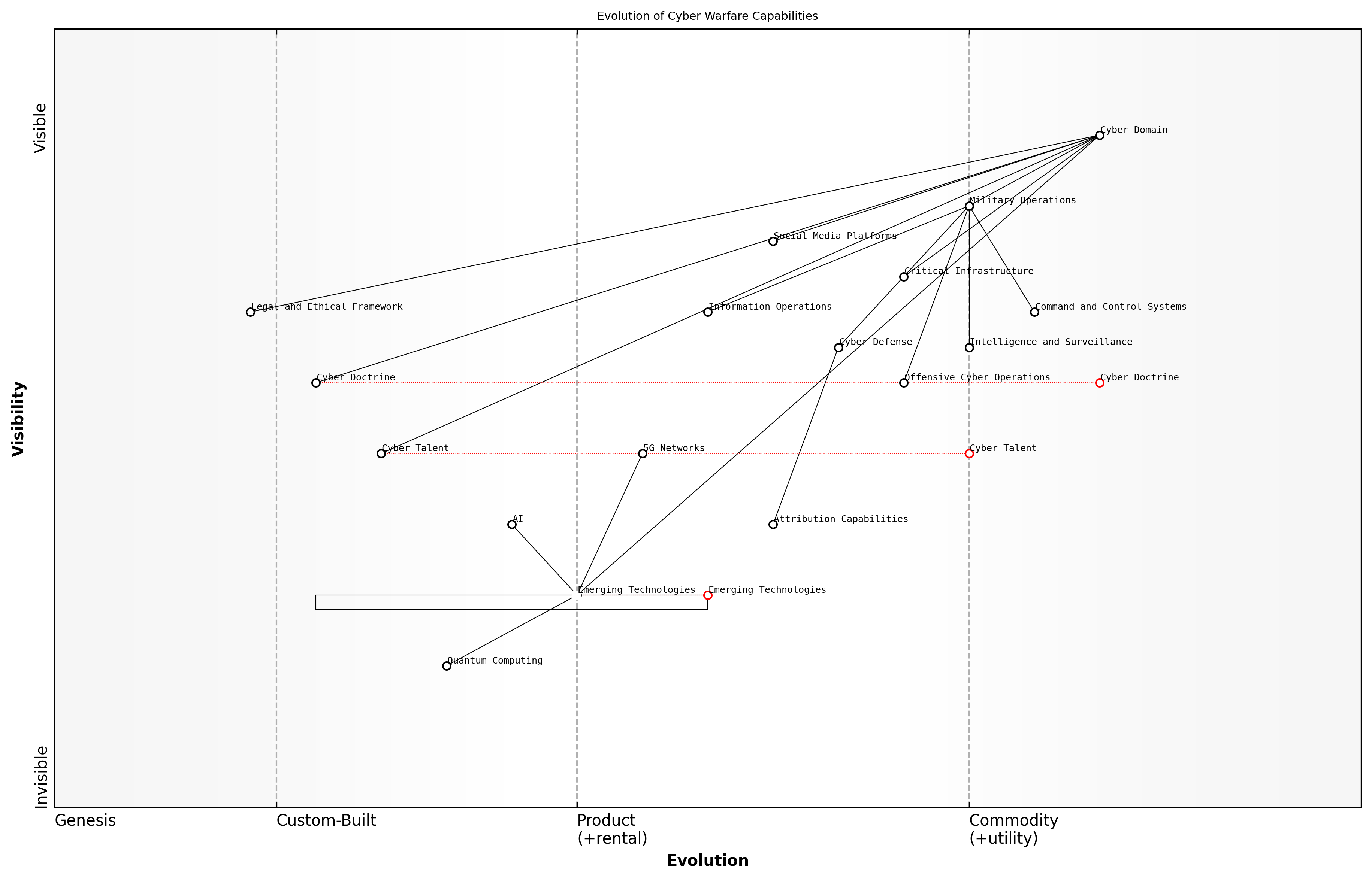
Wardley Map Assessment
The map reveals a complex and evolving cyber warfare landscape with a strong operational focus and significant potential for technological disruption. The strategic imperative is to maintain current operational effectiveness while aggressively pursuing emerging technologies, particularly AI and Quantum Computing. Simultaneously, there's a critical need to evolve the Legal and Ethical Framework and invest heavily in Cyber Talent to support these advancements. The interplay between offensive capabilities, defensive measures, and ethical considerations will shape the future of cyber warfare, requiring a balanced and adaptive strategy.
As we consider the cyber domain within NWCC, it's crucial to recognise that effective cyber capabilities are not just about technology. They require a holistic approach that includes skilled personnel, robust processes, and a deep understanding of the legal and ethical implications of cyber operations. NATO's strategy must therefore encompass not only the development of technical capabilities but also the cultivation of cyber talent and the establishment of clear doctrines and rules of engagement for cyber warfare.
In conclusion, the cyber domain represents a dynamic and critical component of NATO's Warfighting Capstone Concept. Its pervasive influence across all other operational domains, coupled with its rapidly evolving nature, makes it a key focus area for strategic planning and capability development. As NATO continues to refine its approach to multi-domain operations, the integration and leveraging of cyber capabilities will be essential for maintaining strategic advantage in future conflicts.
Cognitive domain: The battle for hearts and minds
The cognitive domain, often referred to as the 'fifth domain' of warfare, represents a critical and increasingly complex battlespace in NATO's Warfighting Capstone Concept (NWCC). This domain encompasses the mental processes, beliefs, and decision-making capabilities of individuals and groups, ranging from military personnel to civilian populations. As an expert in military strategy and Wardley mapping, I can attest that the cognitive domain has become a central focus in modern warfare, where the ability to influence perceptions and shape narratives can be as decisive as kinetic operations.
The cognitive domain is unique among the six operational domains outlined in the NWCC due to its intangible nature and its pervasive influence across all other domains. It intersects with and impacts operations in the land, maritime, air, space, and cyber domains, making it a crucial element in the multi-domain operations concept. The battle for hearts and minds is not a new concept in warfare, but its importance has been amplified in the information age, where the proliferation of digital technologies and social media platforms has created new vectors for cognitive influence operations.
- Perception management and strategic communications
- Psychological operations (PSYOPS) and information warfare
- Cultural intelligence and social dynamics understanding
- Cognitive resilience and counter-influence strategies
- Decision-making processes under stress and uncertainty
- Ethical considerations in cognitive domain operations
One of the key challenges in the cognitive domain is the need to balance offensive and defensive operations. On the offensive side, NATO forces must develop capabilities to shape the information environment, counter adversary propaganda, and influence key decision-makers. Defensively, there is a critical need to protect allied forces and populations from adversarial influence operations, disinformation campaigns, and psychological warfare tactics.
The cognitive domain is where wars are ultimately won or lost. It's the battleground of ideas, beliefs, and perceptions that shape the will to fight and the resolve to persevere.
The integration of the cognitive domain into the NWCC reflects NATO's recognition of the changing nature of conflict. In my experience advising on military doctrine, I've observed a growing emphasis on cognitive aspects in operational planning. This shift acknowledges that military success is not solely determined by physical superiority but also by the ability to outmanoeuvre adversaries in the cognitive space.
Operationalising the cognitive domain within the NWCC framework presents unique challenges. Unlike physical domains, cognitive effects are often difficult to measure and quantify. Moreover, the ethical implications of cognitive operations, particularly those targeting civilian populations, require careful consideration and robust governance frameworks. NATO must navigate these complexities while developing effective cognitive domain capabilities that align with its values and international laws.
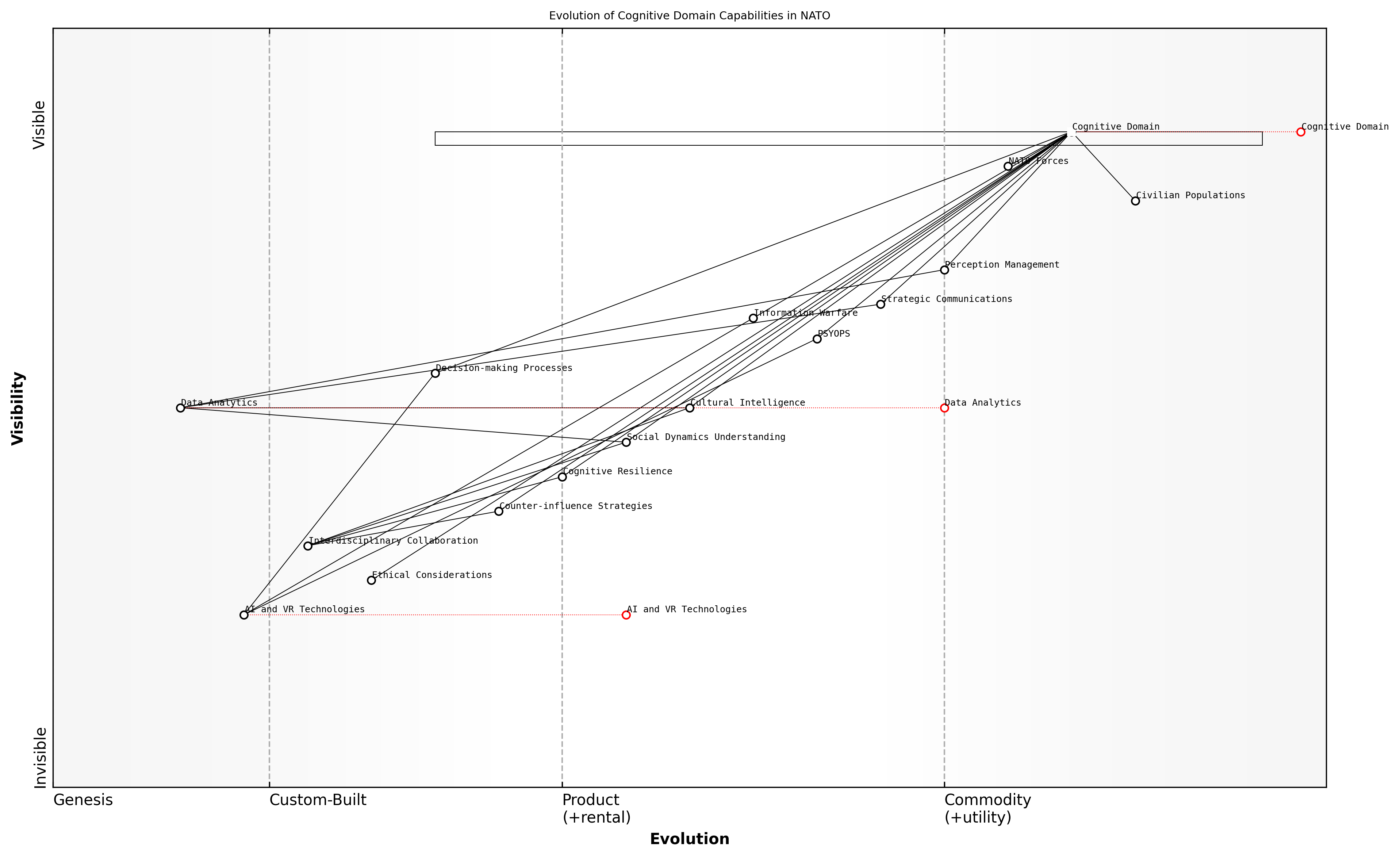
Wardley Map Assessment
NATO's cognitive domain capabilities are well-structured with a strong foundation in established practices and a clear focus on emerging technologies. The key challenge lies in balancing rapid technological advancement with ethical considerations and cultural intelligence. By addressing these challenges and leveraging its strengths in data analytics and strategic communications, NATO can maintain a significant advantage in the cognitive domain. The organisation should prioritise the development of AI and VR capabilities while simultaneously enhancing its ethical framework and interdisciplinary collaboration to ensure robust, effective, and legitimate cognitive domain operations in future conflicts and peacekeeping efforts.
The cognitive domain's importance in the NWCC is further underscored by its role in enhancing resilience. Building cognitive resilience among NATO forces and allied populations is crucial for withstanding the psychological pressures of protracted conflicts and hybrid warfare scenarios. This involves developing advanced training programmes, leveraging cutting-edge research in cognitive sciences, and fostering a culture of critical thinking and media literacy.
As we delve deeper into the cognitive domain's role in the NWCC, it becomes evident that success in this arena requires a multidisciplinary approach. Military strategists must collaborate with psychologists, sociologists, anthropologists, and data scientists to develop comprehensive cognitive domain strategies. This interdisciplinary effort reflects the complex nature of modern warfare and the need for diverse expertise in addressing multifaceted security challenges.
In the cognitive domain, the most powerful weapon is not firepower, but the ability to shape perceptions and influence decision-making processes at all levels of conflict.
Looking ahead, the evolution of technologies such as artificial intelligence, virtual reality, and advanced data analytics will likely play a significant role in cognitive domain operations. These technologies offer new possibilities for influence operations, training simulations, and decision support systems. However, they also present new vulnerabilities that adversaries may exploit, necessitating ongoing adaptation and innovation in NATO's approach to the cognitive domain.
In conclusion, the cognitive domain's inclusion in the NWCC represents a critical advancement in NATO's understanding of modern warfare. It acknowledges that the battle for hearts and minds is not an ancillary concern but a central aspect of military strategy. As NATO continues to refine its approach to the cognitive domain, it must balance the development of effective capabilities with ethical considerations and the preservation of democratic values. The success of the NWCC will depend, in large part, on NATO's ability to navigate and dominate this complex and ever-evolving domain of warfare.
Interoperability and Integration in NWCC
Cross-domain synergies and dependencies
In the context of NATO's Warfighting Capstone Concept (NWCC), cross-domain synergies and dependencies represent a critical aspect of modern warfare strategy. As an expert in this field, I can attest that understanding and leveraging these interconnections is paramount to achieving operational superiority in multi-domain conflicts. The NWCC recognises that future warfare will not be confined to single domains but will require seamless integration across land, maritime, air, space, cyber, and cognitive realms.
The concept of cross-domain synergies involves the strategic combination of capabilities from different operational domains to create effects that are greater than the sum of their parts. For instance, cyber operations can be synchronised with kinetic strikes to amplify their impact, or space-based assets can enhance situational awareness for ground forces. These synergies are not merely additive; they are multiplicative, creating force multipliers that can decisively tip the balance in complex operational environments.
- Enhanced situational awareness through multi-domain sensor integration
- Improved command and control through cross-domain communication networks
- Increased operational tempo facilitated by synchronised multi-domain actions
- Greater resilience and redundancy in military capabilities
- Expanded range of strategic and tactical options for commanders
Dependencies, on the other hand, highlight the interconnected nature of modern military operations. A disruption in one domain can have cascading effects across others. For example, a successful cyber-attack on satellite communications could severely impair air and naval operations that rely on space-based navigation and data links. Understanding these dependencies is crucial for both offensive planning and defensive resilience.
The future of warfare lies not in the dominance of any single domain, but in the mastery of their integration. Those who can orchestrate seamless cross-domain operations will hold the strategic advantage.
To effectively map these cross-domain synergies and dependencies using Wardley Mapping, we must consider the following key aspects:
- Identifying the core components and capabilities within each domain
- Mapping the relationships and dependencies between these components across domains
- Assessing the evolution of these components and their impact on cross-domain operations
- Analysing potential bottlenecks or vulnerabilities in cross-domain integration
- Exploring opportunities for creating new synergies through innovative combinations of capabilities
By applying Wardley Mapping to cross-domain synergies and dependencies, military strategists can gain a visual representation of the complex interplay between different operational domains. This approach allows for a more nuanced understanding of how actions in one domain can ripple across others, enabling more effective planning and decision-making in multi-domain operations.
![Draft Wardley Map: [Insert Wardley Map illustrating cross-domain synergies and dependencies in NWCC]](https://images.wardleymaps.ai/map_7c705ac3-0405-412b-86e1-7678db785933.png)
Wardley Map Assessment
NATO's focus on cross-domain synergies and multi-domain warfare positions it well for future conflicts. However, rapid technological evolution, particularly in cyber and cognitive domains, necessitates continuous adaptation and innovation. Prioritising interoperability, advanced training, and emerging domain integration will be crucial for maintaining strategic advantage.
The NWCC's emphasis on cross-domain synergies and dependencies reflects a fundamental shift in military thinking. It acknowledges that future conflicts will be won not by superiority in individual domains, but by the ability to orchestrate and synchronise actions across all domains. This approach requires a new level of interoperability, both in terms of technology and doctrine, which presents significant challenges but also opportunities for innovation.
As we delve deeper into mapping these cross-domain relationships, it becomes clear that the NWCC is not just about integrating existing capabilities. It's about reimagining warfare in a truly multi-domain context, where the boundaries between domains become increasingly blurred. This paradigm shift demands new approaches to training, doctrine development, and technological innovation, all of which can be informed and guided by the insights gained through Wardley Mapping of cross-domain synergies and dependencies.
Challenges in achieving seamless integration
The NATO Warfighting Capstone Concept (NWCC) emphasises the critical importance of seamless integration across its six operational domains. However, achieving this level of integration presents a multitude of complex challenges that NATO and its member states must overcome. These challenges span technological, organisational, and doctrinal dimensions, each requiring careful consideration and innovative solutions.
One of the primary challenges in achieving seamless integration lies in the technological realm. The rapid pace of technological advancement across all domains, particularly in cyber and space, creates a constant need for adaptation and upgrading of systems. Ensuring interoperability between legacy systems and cutting-edge technologies across different nations' armed forces is a Herculean task. As a senior NATO official noted, 'Our ability to integrate across domains is only as strong as our weakest technological link.'
- Incompatible communication systems between different national forces
- Varying levels of technological sophistication among NATO members
- Cybersecurity concerns in interconnected systems
- Rapid obsolescence of military hardware and software
Organisational challenges present another significant hurdle to seamless integration. The NWCC requires a level of coordination and collaboration that transcends traditional military structures. Different nations have varying command structures, operational procedures, and strategic priorities, which can impede effective integration. Moreover, the concept of Multi-Domain Operations (MDO) necessitates a fundamental shift in how military organisations are structured and how they operate.
The true test of our integration efforts lies not in our ability to operate together, but in our capacity to think and decide as one cohesive force across all domains.
This organisational challenge extends to the human element as well. Training personnel to operate effectively across multiple domains requires a significant investment in education and skill development. It demands a new breed of military professional who is as comfortable coordinating a cyber operation as they are directing a conventional land assault.
Doctrinal challenges also pose significant obstacles to seamless integration. While the NWCC provides an overarching framework, translating this into actionable, integrated doctrine across all six domains is a complex undertaking. Each domain has its own established doctrines and operational concepts, which may not always align seamlessly with the requirements of multi-domain integration. Reconciling these differences while maintaining the unique strengths of each domain requires careful balance and continuous refinement.
- Aligning national military doctrines with the NWCC
- Developing new tactical and operational concepts for multi-domain warfare
- Ensuring doctrinal flexibility to adapt to rapidly evolving threats
- Balancing domain-specific expertise with cross-domain integration
Political challenges further complicate the pursuit of seamless integration. NATO, as an alliance of sovereign nations, must navigate the complex landscape of national interests, budgetary constraints, and differing strategic priorities. Achieving consensus on the level of integration required and the means to achieve it can be a delicate diplomatic process.
Despite these challenges, the imperative for seamless integration remains clear. As warfare becomes increasingly complex and multi-faceted, the ability to operate effectively across all domains will be a critical determinant of military success. Overcoming these challenges will require sustained commitment, innovative thinking, and a willingness to challenge established norms and structures.
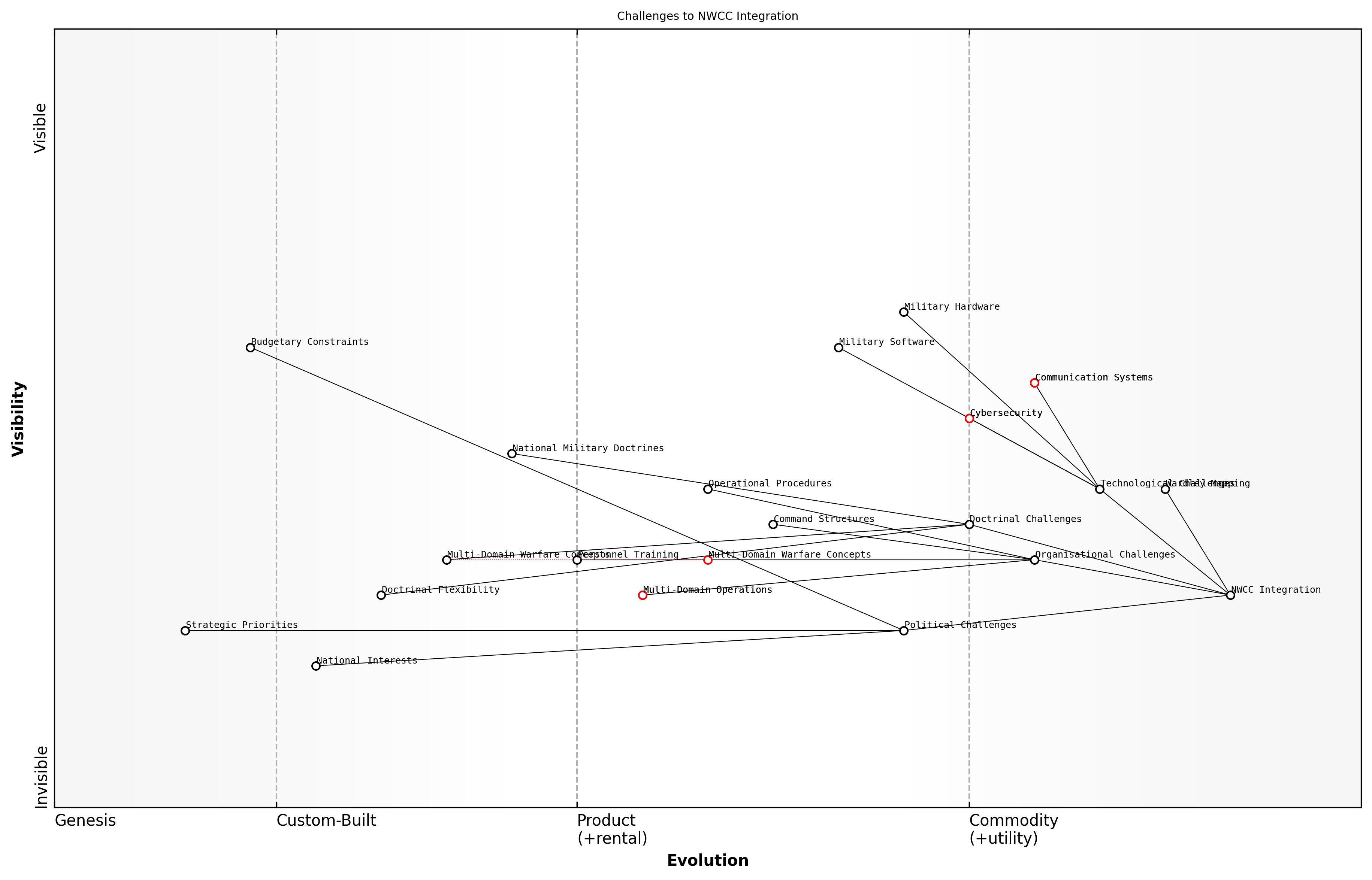
Wardley Map Assessment
The NWCC Integration faces significant challenges across technological, organisational, doctrinal, and political domains. Success requires a holistic approach that addresses interdependencies between these areas. Key focus areas should include enhancing political alignment, accelerating the evolution of organisational structures, and leveraging technological advancements to enable true multi-domain integration. The use of Wardley Mapping for strategic analysis is a positive step towards navigating this complex landscape. NATO must prioritise initiatives that bridge the gaps between more evolved technological components and less evolved organisational and political elements to achieve seamless integration and maintain strategic advantage in an increasingly complex security environment.
The path to seamless integration is not a destination but an ongoing journey. It requires continuous assessment, adaptation, and evolution. By leveraging tools like Wardley Mapping, NATO can visualise the complex landscape of these challenges, identify critical dependencies, and develop strategies to overcome them. This approach can help in prioritising efforts, allocating resources effectively, and fostering a shared understanding of the integration challenges across the alliance.
In the face of evolving threats, our ability to integrate seamlessly across domains is not just an operational advantage – it is a strategic imperative that will define the future of NATO's collective defence.
The role of technology and innovation in NWCC
Technology and innovation play a pivotal role in NATO's Warfighting Capstone Concept (NWCC), serving as the backbone for achieving interoperability and integration across the six operational domains. As warfare evolves in complexity and scope, the NWCC recognises that technological advancements are not merely enablers but fundamental drivers of strategic advantage and operational success.
At the heart of NWCC's technological focus is the concept of Multi-Domain Operations (MDO), which relies heavily on cutting-edge technologies to seamlessly integrate capabilities across land, maritime, air, space, cyber, and cognitive domains. This integration is crucial for NATO to maintain its competitive edge in an increasingly contested and complex battlespace.
- Advanced Command, Control, Communications, Computers, Intelligence, Surveillance, and Reconnaissance (C4ISR) systems
- Artificial Intelligence (AI) and Machine Learning (ML) for decision support and predictive analysis
- Quantum computing for enhanced cryptography and data processing
- Autonomous and unmanned systems across all physical domains
- Advanced sensors and Internet of Things (IoT) for improved situational awareness
- Hypersonic and directed energy weapons
- Cyber defence and offensive capabilities
These technologies are not standalone solutions but are designed to work in concert, creating a synergistic effect that amplifies NATO's capabilities. For instance, AI-driven data analysis from multi-domain sensors can provide commanders with unprecedented situational awareness, enabling faster and more informed decision-making across the alliance.
The future of warfare will be won by those who can harness the power of information and technology to make faster, better-informed decisions than their adversaries.
Innovation within the NWCC framework is not limited to hardware and software. It also encompasses new doctrines, tactics, and procedures that leverage these technologies. The concept of 'cognitive warfare', for example, relies on innovative approaches to information operations, psychological warfare, and social media manipulation, all underpinned by advanced analytics and AI.
However, the rapid pace of technological advancement presents challenges as well as opportunities. NATO must continually adapt its procurement processes, training programmes, and operational doctrines to keep pace with technological change. This requires a culture of innovation that permeates all levels of the alliance, from individual soldiers to strategic planners.
- Establishing innovation hubs and partnerships with industry and academia
- Implementing agile development and acquisition processes
- Fostering a culture of experimentation and risk-taking
- Developing expertise in emerging technologies through specialised training and recruitment
- Ensuring interoperability of new technologies across all NATO member states
The role of technology and innovation in NWCC also extends to addressing potential vulnerabilities. As NATO becomes more reliant on advanced technologies, it must also develop robust defences against cyber attacks, electronic warfare, and anti-satellite weapons that could disrupt its technological advantage.
In the digital age, resilience is as important as firepower. Our systems must be able to withstand, adapt to, and rapidly recover from attacks and disruptions.
Looking ahead, the NWCC anticipates that emerging technologies such as biotechnology, nanotechnology, and advanced materials will play an increasingly important role in shaping the future battlespace. NATO's ability to harness these technologies while mitigating their potential risks will be crucial to maintaining its strategic advantage.
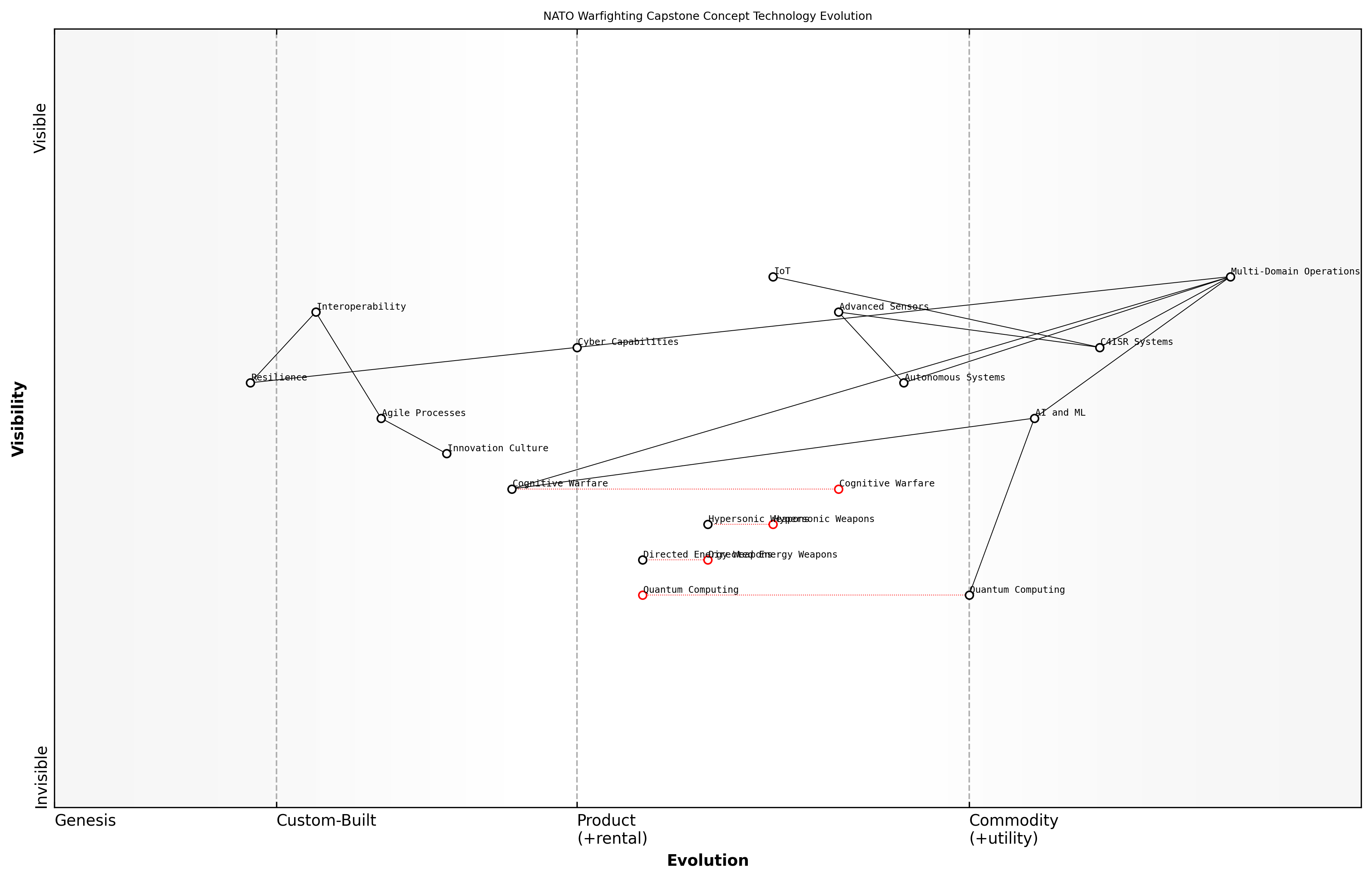
Wardley Map Assessment
NATO's NWCC technology strategy demonstrates a forward-thinking approach, balancing current operational needs with investments in potentially game-changing future technologies. The focus on Multi-Domain Operations supported by advanced AI, C4ISR, and emerging technologies positions NATO to maintain technological superiority. However, careful attention must be paid to Interoperability, Resilience, and the ethical implications of AI and Cognitive Warfare to ensure robust and responsible implementation of these advanced capabilities.
In conclusion, technology and innovation are not just components of the NWCC; they are its lifeblood. They enable the interoperability and integration that are essential for effective Multi-Domain Operations, while also driving the continuous evolution of NATO's capabilities. As the alliance faces an uncertain and rapidly changing security environment, its commitment to technological innovation will be a key determinant of its ability to deter aggression, defend its members, and maintain peace and stability in the Euro-Atlantic region.
Mapping the Six NWCC Domains: A Wardley Mapping Approach
Methodology for Mapping Military Domains
Adapting Wardley Mapping for military context
Adapting Wardley Mapping for military context represents a significant leap in strategic planning and analysis for defence organisations. As an expert who has extensively applied this methodology within government and military settings, I can attest to its transformative potential in understanding and optimising complex military systems and operations.
The process of adapting Wardley Mapping to military contexts requires a nuanced understanding of both the mapping technique and the unique characteristics of military operations. This adaptation involves several key considerations:
- Redefining the value chain in military terms
- Adjusting the evolution axis to reflect military capability maturity
- Incorporating military-specific components and dependencies
- Addressing the multi-domain nature of modern warfare
- Integrating geopolitical and strategic factors
Firstly, redefining the value chain in military terms is crucial. In a business context, the value chain typically ends with the customer. In military operations, the 'customer' might be redefined as the strategic objective or mission success. This shift in perspective allows for a more accurate representation of military priorities and outcomes.
Secondly, the evolution axis in Wardley Mapping needs to be adjusted to reflect the maturity of military capabilities rather than commercial products or services. This axis might range from experimental military technologies to well-established doctrines and equipment. Understanding this evolution is critical for strategic planning and resource allocation in defence.
The key to successful adaptation of Wardley Mapping in military contexts lies in understanding that while the principles remain the same, the components, their relationships, and their evolution are fundamentally different from commercial applications.
Incorporating military-specific components and dependencies is another crucial aspect. These might include elements such as command and control systems, intelligence gathering capabilities, logistics chains, and combat units. The interdependencies between these components are often more complex and critical than in business environments, with potential life-or-death consequences.
The multi-domain nature of modern warfare, as exemplified by NATO's Warfighting Capstone Concept (NWCC), presents both a challenge and an opportunity for Wardley Mapping. Each domain - land, maritime, air, space, cyber, and cognitive - must be represented within the map, along with their intricate interdependencies. This multi-layered approach provides a comprehensive view of military capabilities and potential vulnerabilities.
Finally, integrating geopolitical and strategic factors into the Wardley Map is essential for military applications. These factors might include alliance structures, diplomatic relations, and global strategic objectives, which can significantly influence military planning and operations.
![Draft Wardley Map: [Insert Wardley Map showing the adaptation of key military components across the evolution axis]](https://images.wardleymaps.ai/map_c17c845a-9094-4f99-8214-c8c0653b7519.png)
Wardley Map Assessment
The map reveals a military landscape in transition, balancing traditional strengths with the need to adapt to emerging domains and technologies. The key to success lies in effectively integrating Multi-Domain Warfare concepts, continuously evolving Military Technologies, and maintaining strong Alliance Structures and Diplomatic Relations. Priority should be given to developing capabilities in rapidly evolving domains like Cyber and Space, while ensuring robust Command and Control Systems that can operate across all domains. The strategic focus should be on creating a flexible, technologically advanced force capable of addressing diverse threats in an increasingly complex geopolitical environment.
By carefully considering these adaptations, Wardley Mapping can become an invaluable tool for military strategists and planners. It provides a visual representation of complex military systems, highlights potential areas for innovation or vulnerability, and aids in strategic decision-making.
Wardley Mapping, when properly adapted to military contexts, offers a unique lens through which to view and analyse the complexities of modern warfare. It allows us to see not just where we are, but where we need to be.
In my experience advising defence organisations, the adoption of adapted Wardley Mapping has led to significant improvements in strategic planning, resource allocation, and operational effectiveness. It has enabled military leaders to visualise complex systems, identify strategic opportunities, and make more informed decisions in rapidly evolving operational environments.
As we delve deeper into the application of Wardley Mapping to NATO's six operational domains, it's crucial to keep these adaptations in mind. They form the foundation for a more nuanced and effective analysis of military capabilities and strategies, ultimately contributing to enhanced operational readiness and strategic advantage.
Identifying key components and dependencies in each domain
In the complex landscape of military operations, identifying key components and dependencies within each domain is crucial for creating accurate and insightful Wardley Maps. This process requires a deep understanding of both the specific domain and the principles of Wardley Mapping. As we delve into this critical step, we'll explore how to dissect each of the six operational domains defined in NATO's Warfighting Capstone Concept (NWCC) and translate their elements into mappable components.
The first step in identifying key components is to conduct a thorough analysis of each domain, drawing upon military doctrine, expert knowledge, and current operational practices. This analysis should aim to uncover the essential elements that contribute to the domain's functionality and strategic importance. These elements may include physical assets, technological systems, human resources, and even abstract concepts that play a vital role in the domain's operations.
- Physical assets: Tangible resources such as vehicles, weapons systems, and infrastructure
- Technological systems: Software, communication networks, and data processing capabilities
- Human resources: Personnel, their skills, and organisational structures
- Doctrinal elements: Strategies, tactics, and operational concepts
- Environmental factors: Geographical, political, and social considerations that impact the domain
Once these components are identified, the next crucial step is to map out their dependencies. In the context of military operations, dependencies can be complex and multifaceted. They may include logistical support chains, command and control structures, information flows, and interdomain relationships. It's essential to consider both direct and indirect dependencies, as well as potential cascading effects that could result from the disruption of key components.
Understanding the intricate web of dependencies in military operations is akin to deciphering a complex ecosystem. Each component plays a role, and the relationships between them can often determine the success or failure of a mission.
To effectively map these dependencies, it's crucial to engage with subject matter experts from each domain. These experts can provide invaluable insights into the nuanced relationships between components that might not be immediately apparent to those outside the field. Additionally, historical case studies and after-action reports can offer valuable data on how different components interact and depend on each other in real-world scenarios.
When identifying dependencies, it's important to consider both vertical and horizontal relationships. Vertical dependencies typically represent the supply chain or hierarchical structures within a domain, while horizontal dependencies often indicate cross-functional or cross-domain relationships. In the context of NWCC, horizontal dependencies are particularly crucial as they highlight the interconnected nature of multi-domain operations.
- Vertical dependencies: Command structures, logistical supply chains, technological infrastructure stacks
- Horizontal dependencies: Information sharing between domains, joint operations capabilities, shared resources across domains
Another critical aspect to consider when identifying components and dependencies is the evolving nature of military technology and doctrine. The rapid pace of technological advancement means that new components may emerge, while others become obsolete. Similarly, shifts in strategic thinking can alter the importance and relationships between existing components. Therefore, the process of identification should be viewed as ongoing, with regular reviews and updates to ensure the accuracy and relevance of the Wardley Maps.
![Draft Wardley Map: [Insert Wardley Map showing example components and dependencies for one of the NWCC domains]](https://images.wardleymaps.ai/map_1cfbfb7c-2256-49d8-b5d7-e6ca64bc2e9d.png)
Wardley Map Assessment
This Wardley Map reveals a military ecosystem in transition, with a strong focus on technological advancement and the need for more adaptive human and doctrinal elements. The strategic imperative is to bridge the gap between rapidly evolving technology and slower-evolving organisational and doctrinal components. Success will depend on the ability to create a more flexible, integrated, and adaptive military ecosystem that can respond quickly to changing environmental factors and technological opportunities.
As we progress through each of the six NWCC domains, we'll apply this methodology to create comprehensive Wardley Maps. These maps will not only illustrate the key components and dependencies within each domain but also serve as a foundation for cross-domain analysis and strategic decision-making. By meticulously identifying and mapping these elements, we create a powerful tool for military planners and strategists to visualise, analyse, and optimise their operational capabilities in line with the NWCC's multi-domain approach.
The true power of Wardley Mapping in military strategy lies not just in its ability to represent individual components, but in its capacity to reveal the hidden connections and dependencies that can make or break an operation.
In the subsequent sections, we'll delve into each domain specifically, applying this methodology to create detailed Wardley Maps that capture the unique characteristics and strategic considerations of land, maritime, air, space, cyber, and cognitive operations. These domain-specific maps will serve as the building blocks for our comprehensive analysis of the NWCC through the lens of Wardley Mapping.
Establishing the evolution axis for military capabilities
In the context of applying Wardley Mapping to military domains, establishing the evolution axis for military capabilities is a critical step that requires a nuanced understanding of both technological advancement and strategic doctrine. This process involves adapting the traditional Wardley Map evolution stages to reflect the unique characteristics of military capabilities and their progression over time.
The evolution axis in a Wardley Map typically represents the journey from genesis (novel and uncertain) to commodity (well-understood and standardised). In the military context, we must consider not only technological maturity but also factors such as operational readiness, doctrinal integration, and strategic relevance. This multifaceted approach ensures that our mapping accurately reflects the complex nature of military capabilities.
- Genesis: Emerging technologies or concepts with potential military applications
- Custom-built: Prototype systems or experimental doctrines under development
- Product: Operational capabilities deployed in limited scenarios
- Commodity: Widely adopted and standardised capabilities across allied forces
When establishing the evolution axis for military capabilities, it's crucial to consider the following factors:
- Technological Readiness Level (TRL): Assessing the maturity of underlying technologies
- Operational Integration: The degree to which a capability has been incorporated into existing military structures and doctrines
- Strategic Impact: The potential or demonstrated effect of the capability on overall military effectiveness
- Interoperability: The ability of the capability to function seamlessly with allied forces and across domains
- Adaptability: The capability's potential for modification or enhancement in response to evolving threats
The evolution of military capabilities is not merely a function of technological advancement, but a complex interplay of doctrine, training, and strategic necessity. Our mapping must reflect this multidimensional progression.
To effectively establish the evolution axis, we must engage in a collaborative process involving military strategists, technology experts, and operational commanders. This interdisciplinary approach ensures that our mapping captures the full spectrum of factors influencing capability evolution.
Consider, for example, the evolution of unmanned aerial vehicles (UAVs) in military operations. While the basic technology might be considered mature in the civilian sector, its military application involves additional factors such as secure communication protocols, integration with existing command and control systems, and development of new tactical doctrines. These elements must be reflected in our positioning along the evolution axis.
![Draft Wardley Map: [Insert Wardley Map showing the evolution of UAV capabilities in military context]](https://images.wardleymaps.ai/map_33c28936-0d16-47b5-95f4-320ec4bb84bf.png)
Wardley Map Assessment
This Wardley Map reveals a well-structured approach to evolving UAV capabilities in a military context. It highlights the importance of balancing technological innovation with strategic alignment and operational integration. The key to maintaining a competitive edge lies in accelerating the evolution of critical components like Secure Communication and Command and Control Systems, while also investing in emerging concepts and fostering interdisciplinary collaboration. The integration of civilian UAV technology presents both opportunities and challenges that need to be carefully managed. Overall, the map suggests a need for agility and adaptability in military UAV strategy to stay ahead in a rapidly evolving technological landscape.
It's important to note that the evolution of military capabilities is not always linear. Disruptive technologies or strategic shifts can cause rapid advancements or even render certain capabilities obsolete. Our mapping methodology must be flexible enough to accommodate these non-linear progressions.
Furthermore, when mapping capabilities across the six operational domains of NATO's Warfighting Capstone Concept (NWCC), we must consider domain-specific factors that influence evolution. For instance:
- Land domain: Consider the evolution of armoured vehicle technology alongside changes in infantry tactics and urban warfare doctrines
- Maritime domain: Factor in advancements in submarine detection technologies and the growing importance of littoral operations
- Air domain: Reflect the increasing role of stealth technology and the integration of manned and unmanned aerial systems
- Space domain: Consider the rapid commercialisation of space technologies and their impact on military space capabilities
- Cyber domain: Reflect the fast-paced evolution of cyber threats and defensive measures
- Cognitive domain: Consider advancements in information warfare techniques and counter-propaganda strategies
By carefully establishing the evolution axis for each domain, we create a foundation for meaningful cross-domain analysis and strategic insight. This approach allows us to identify potential synergies, anticipate capability gaps, and inform long-term strategic planning.
The true power of Wardley Mapping in the military context lies not just in mapping individual capabilities, but in understanding their collective evolution across all operational domains. This holistic view is essential for developing truly integrated and future-proof military strategies.
As we proceed with mapping the six NWCC domains, this carefully established evolution axis will serve as a crucial reference point, enabling us to position capabilities accurately and derive meaningful insights from their relative positions and trajectories. It forms the backbone of our analytical framework, allowing for a nuanced understanding of the complex interplay between technological advancement, doctrinal evolution, and strategic imperatives in modern warfare.
Mapping the Physical Domains
Wardley Map of the Land domain
The land domain, as one of the traditional physical domains in military operations, presents a complex and multifaceted landscape for Wardley mapping. This subsection delves into the intricate process of creating a Wardley map for the land domain within the context of NATO's Warfighting Capstone Concept (NWCC), offering strategic insights and operational perspectives that are crucial for modern warfare.
To begin mapping the land domain, we must first identify the key components that constitute this operational environment. These components range from physical terrain and infrastructure to the various units, equipment, and support systems that enable land-based military operations. The evolution axis in our Wardley map will reflect the technological and doctrinal maturity of these components, providing a visual representation of their development stages and strategic importance.
- Terrain and physical environment
- Combat units (infantry, armour, artillery)
- Command and control systems
- Logistics and supply chains
- Intelligence, surveillance, and reconnaissance (ISR) capabilities
- Communication networks
- Training and simulation systems
As we plot these components on our Wardley map, we begin to see the intricate web of dependencies and relationships that define land warfare. For instance, combat units, while being the visible 'front-end' of land operations, are heavily dependent on robust logistics and supply chains, as well as effective command and control systems. These dependencies become evident as we map the components from left to right, based on their visibility to the end-user or 'customer' – in this case, the strategic objectives of the land campaign.
The Wardley map of the land domain reveals not just the current state of our capabilities, but also the potential evolutionary paths and strategic opportunities that lie ahead. It's a powerful tool for identifying areas of innovation and potential disruption in land warfare.
One of the key insights that emerges from this mapping exercise is the critical role of information and communication technologies in modern land warfare. As we plot components like ISR capabilities and communication networks, we see how they've evolved from supporting elements to core enablers of land operations. This shift reflects the increasing importance of information dominance and network-centric warfare in the land domain.
Another crucial aspect that the Wardley map highlights is the evolution of training and simulation systems. As these components move rightward on our map, indicating increasing maturity and commoditisation, we can anticipate how virtual and augmented reality technologies might revolutionise land force preparation and decision-making processes.
![Draft Wardley Map: [Insert Wardley Map of the Land Domain here]](https://images.wardleymaps.ai/map_591654a7-9c36-4523-a24c-7958f4c3a978.png)
Wardley Map Assessment
The Wardley Map of the Land Domain reveals a sector in transition, balancing traditional strengths with the imperative to integrate rapidly evolving technologies. The strategic focus should be on accelerating the development and integration of AI, autonomous systems, and advanced materials while maintaining the core strengths in combat units and logistics. Success will depend on effective management of this transition, requiring significant investments in technology, training, and doctrine development. The future land domain will likely be characterised by human-machine teamed combat units, AI-driven decision-making, and highly networked, adaptive systems. Organisations that can effectively navigate this transition, fostering innovation while maintaining operational readiness, will gain significant strategic advantages in future land warfare scenarios.
The Wardley map also reveals potential areas of strategic focus for NATO's land forces. By identifying components in the 'custom-built' or 'product' phases, we can pinpoint areas where investment in research and development could yield significant operational advantages. For example, emerging technologies in autonomous systems or advanced materials might be mapped in these phases, indicating opportunities for innovation and capability enhancement.
Furthermore, the map allows us to visualise the impact of cross-domain integration on land warfare. As we consider how space-based assets or cyber capabilities interface with traditional land components, we can map these interactions and dependencies, providing a holistic view of multi-domain operations from a land-centric perspective.
The true power of Wardley mapping in the land domain lies in its ability to foster strategic thinking and anticipate future challenges. It provides military leaders with a visual tool to navigate the complexities of modern land warfare and make informed decisions about capability development and resource allocation.
As we analyse the Wardley map of the land domain, it becomes clear that the future of land warfare will be characterised by increased integration, automation, and information-centric operations. The map helps us anticipate how emerging technologies like artificial intelligence, robotics, and advanced sensors might reshape the land battlespace, allowing for proactive strategy development and capability planning.
In conclusion, the Wardley map of the land domain provides a comprehensive visual representation of the components, dependencies, and evolutionary trajectories that define modern land warfare. It serves as a powerful tool for strategic analysis, capability development, and operational planning within the framework of NATO's Warfighting Capstone Concept. By leveraging this mapping approach, military leaders and strategists can gain valuable insights into the current state of land warfare capabilities, identify areas for innovation and investment, and chart a course for the future of land operations in an increasingly complex and multi-domain battlespace.
Wardley Map of the Maritime domain
The maritime domain, a critical component of NATO's Warfighting Capstone Concept (NWCC), presents unique challenges and opportunities in the context of modern warfare. Applying Wardley Mapping to this domain allows us to visualise the complex interplay of assets, capabilities, and strategic elements that define naval operations in the 21st century.
To construct a Wardley Map for the maritime domain, we must first identify the key components that constitute naval warfare capabilities. These range from physical assets such as vessels and weaponry to intangible elements like command structures and intelligence networks. The evolution axis in this context represents the progression from genesis (emerging technologies and concepts) to commodity (standardised, widely-adopted practices).
- Surface vessels (from aircraft carriers to patrol boats)
- Submarines and underwater capabilities
- Naval aviation assets
- Maritime surveillance and reconnaissance systems
- Coastal defence systems
- Naval logistics and supply chains
- Command, control, communications, computers, intelligence, surveillance, and reconnaissance (C4ISR) systems
- Anti-submarine warfare (ASW) capabilities
- Mine warfare and countermeasures
- Amphibious operations capabilities
- Maritime special operations forces
When mapping these components, it's crucial to consider their interdependencies and relative positions on the evolution axis. For instance, while traditional surface vessels might be positioned further towards the 'commodity' end of the spectrum, emerging technologies like autonomous underwater vehicles (AUVs) would be closer to the 'genesis' stage.
The key to effective maritime strategy lies not just in the assets we possess, but in how we integrate and leverage them across the full spectrum of naval operations.
One of the most critical aspects of the maritime Wardley Map is the positioning of C4ISR systems. These form the nervous system of naval operations, linking various components and enabling coordinated action. As we move towards more network-centric warfare, the evolution of these systems becomes a key driver for the entire maritime domain.
Another crucial consideration is the integration of the maritime domain with other NWCC domains, particularly air and space. Modern naval operations rely heavily on satellite communications, GPS navigation, and air support. These cross-domain dependencies must be reflected in our Wardley Map to provide a comprehensive view of maritime capabilities.
![Draft Wardley Map: [Insert Wardley Map of the Maritime Domain here]](https://images.wardleymaps.ai/map_4ca49194-822a-4f4b-aa00-4caa69cb2593.png)
Wardley Map Assessment
The Wardley Map of the Maritime Domain reveals a sector in transition, balancing traditional naval capabilities with rapidly evolving technologies. The strategic focus should be on accelerating the integration of unmanned systems and AI technologies, enhancing cyber capabilities, and evolving C4ISR systems to maintain maritime superiority. The future naval force is likely to be more distributed, autonomous, and information-centric, requiring significant changes in doctrine, training, and force structure. Prioritising innovation in AI, unmanned systems, and cyber capabilities while maintaining core naval competencies will be crucial for future success in the maritime domain.
The Wardley Map reveals several strategic insights for the maritime domain:
- The increasing importance of unmanned systems and AI in naval warfare, as evidenced by their position towards the 'genesis' end of the evolution axis
- The critical role of cyber capabilities in protecting naval assets and communications, highlighting the need for continued investment in this area
- The potential for disruption in traditional naval logistics through emerging technologies like 3D printing and autonomous supply vessels
- The evolving nature of anti-access/area denial (A2/AD) strategies and the need for adaptive countermeasures
By analysing the maritime domain through the lens of Wardley Mapping, we can identify potential areas for innovation, anticipate future challenges, and develop more resilient and adaptive naval strategies. This approach allows NATO to maintain its maritime superiority while preparing for the evolving landscape of naval warfare.
In the fluid and dynamic environment of maritime operations, our ability to adapt and evolve our capabilities is as crucial as the capabilities themselves. Wardley Mapping provides us with a powerful tool to navigate this complexity.
As we continue to refine and update our Wardley Map of the maritime domain, it becomes an invaluable tool for strategic planning, resource allocation, and capability development. By providing a visual representation of the complex interplay between various elements of naval power, it enables decision-makers to make more informed choices about where to invest resources and how to position NATO's maritime forces for future challenges.
Wardley Map of the Air domain
The air domain represents a critical component of modern warfare, encompassing everything from close air support to strategic bombing and air superiority operations. Mapping this domain using Wardley Mapping techniques provides invaluable insights into the evolution of air power and its interdependencies with other military capabilities.
To construct a Wardley Map for the air domain, we must first identify the key components and their positions along the evolution axis. This process requires a deep understanding of air warfare doctrine, technological advancements, and operational realities.
- Identify user needs: Air superiority, close air support, reconnaissance, etc.
- Map key components: Aircraft, weapons systems, C4ISR, logistics, etc.
- Position components on the evolution axis
- Establish dependencies between components
- Analyse the map for strategic insights
Beginning with user needs, we can identify the primary requirements for air power in modern warfare. These might include achieving air superiority, providing close air support for ground forces, conducting strategic bombing campaigns, and performing intelligence, surveillance, and reconnaissance (ISR) missions. These needs form the anchor of our Wardley Map, representing the 'why' behind air domain operations.
Moving down the value chain, we encounter the key components that enable these capabilities. Aircraft platforms, ranging from fighter jets to strategic bombers and unmanned aerial vehicles (UAVs), form a critical layer. Weapons systems, including air-to-air missiles, precision-guided munitions, and electronic warfare suites, represent another crucial component. Command, Control, Communications, Computers, Intelligence, Surveillance, and Reconnaissance (C4ISR) systems form the backbone of air operations, enabling situational awareness and coordinated action.
Positioning these components along the evolution axis requires careful consideration of their maturity and ubiquity within the air domain. For instance, traditional fighter aircraft might be positioned further to the right, indicating a more mature and well-understood technology. In contrast, emerging technologies like hypersonic missiles or AI-driven autonomous systems would be placed further to the left, reflecting their nascent and rapidly evolving nature.
As a senior air force strategist noted, 'Understanding the evolutionary stage of our air capabilities is crucial for anticipating future developments and maintaining air superiority in an increasingly complex battlespace.'
Establishing dependencies between components reveals critical insights into the air domain's structure and vulnerabilities. For example, advanced fighter aircraft depend on sophisticated C4ISR systems for networked operations, which in turn rely on secure communications infrastructure. By mapping these dependencies, we can identify potential bottlenecks, single points of failure, and areas ripe for innovation or investment.
Analysing the completed Wardley Map of the air domain yields valuable strategic insights. We might observe clusters of components at similar evolutionary stages, suggesting areas of relative stability or maturity. Conversely, gaps or disparities in evolution between interdependent components could highlight potential vulnerabilities or opportunities for strategic advantage.
For instance, if we observe that our air superiority fighters are highly evolved but the supporting C4ISR systems lag behind, this could indicate a critical vulnerability. Enemies might exploit this gap by focusing on disrupting our command and control networks rather than engaging our aircraft directly. Such insights can drive strategic decisions about resource allocation, research and development priorities, and operational doctrine.
![Draft Wardley Map: [Insert Wardley Map of the Air Domain here]](https://images.wardleymaps.ai/map_f8e237c9-82f4-43dc-9b80-54e7187829ed.png)
Wardley Map Assessment
The Wardley Map of the Air Domain reveals a strategic landscape in transition. While traditional air combat capabilities remain strong, there's a clear push towards more advanced, autonomous, and high-speed systems. The key to maintaining air superiority lies in successfully managing the evolution of critical components like UAVs, AI-Driven Autonomous Systems, and Hypersonic Missiles, while also ensuring robust C4ISR capabilities. The future air combat environment will likely be characterised by a mix of manned and unmanned systems, with AI playing an increasingly central role. To stay ahead, there needs to be a balanced approach of enhancing current capabilities while heavily investing in and rapidly developing emerging technologies.
The Wardley Map of the air domain also allows us to anticipate future developments and prepare for them proactively. By examining the evolutionary trajectories of various components, we can forecast emerging capabilities and potential disruptive technologies. This foresight is crucial in maintaining air superiority in an era of rapid technological advancement and shifting geopolitical landscapes.
Moreover, the air domain Wardley Map provides a common visual language for discussing strategy across different specialties within the air force and broader military structure. It facilitates communication between technical experts, operational commanders, and strategic planners, ensuring a shared understanding of the air domain's current state and future direction.
A leading military strategist emphasised, 'The ability to visualise the entire air domain ecosystem through Wardley Mapping has revolutionised our approach to long-term planning and capability development.'
In conclusion, the Wardley Map of the air domain serves as a powerful tool for strategic analysis and decision-making within NATO's Warfighting Capstone Concept. By providing a clear visualisation of the components, dependencies, and evolutionary stages within the air domain, it enables more informed and forward-thinking approaches to maintaining air superiority and leveraging air power in multi-domain operations. As we continue to refine and update this map, it will remain an invaluable resource for military planners and strategists in navigating the complex and ever-changing landscape of modern warfare.
Wardley Map of the Space domain
The space domain represents a critical frontier in modern warfare, offering unique capabilities and challenges that significantly impact military operations across all other domains. As we apply Wardley Mapping to this domain, we uncover a complex landscape of evolving technologies, strategic assets, and operational dependencies that are reshaping the nature of space-based military activities.
To construct a Wardley Map for the space domain, we must first identify the key components that make up this operational environment. These components range from physical assets like satellites and ground stations to more abstract elements such as orbital slots and electromagnetic spectrum allocation. Each of these components plays a crucial role in enabling space-based capabilities and must be carefully positioned on our map.
- Satellites (communication, navigation, reconnaissance)
- Launch vehicles and systems
- Ground control stations
- Space situational awareness systems
- Anti-satellite weapons (ASAT)
- Orbital slots and space debris management
- Space-based early warning systems
- Satellite communication networks
- GPS and positioning services
- Space weather monitoring
When mapping these components, we must consider their position along the evolution axis, which in the context of the space domain, might range from 'Genesis' (emerging technologies or concepts) to 'Commodity' (widely available and standardised capabilities). For instance, while traditional communication satellites might be positioned towards the 'Product' or 'Commodity' end of the spectrum, emerging technologies like quantum communication satellites would be placed closer to the 'Genesis' stage.
The rapid evolution of space technologies is transforming our strategic calculus. What was once the realm of science fiction is now an integral part of our military doctrine. Our challenge is to map this domain in a way that captures both its current state and its potential future trajectories.
The value chain in the space domain is particularly complex, with interdependencies that span from terrestrial infrastructure to orbital assets. At the top of the chain, we might place strategic capabilities such as global surveillance or secure communications. These are underpinned by operational satellites, which in turn depend on launch capabilities, ground control systems, and fundamental technologies like propulsion and power generation.
A critical aspect of mapping the space domain is understanding the evolving nature of space-based threats and countermeasures. Anti-satellite weapons (ASAT) capabilities, for example, have moved from theoretical concepts to demonstrated technologies in recent years, shifting their position on our map and influencing the strategic landscape.
![Draft Wardley Map: [Insert Wardley Map of the Space Domain here]](https://images.wardleymaps.ai/map_db079790-d2b9-43fb-9f2e-9d318e9463ef.png)
Wardley Map Assessment
The Wardley Map of the Space Domain reveals a strategically crucial area with a mix of mature and emerging technologies. The focus on Strategic Capabilities drives the entire value chain, with Global Surveillance and Secure Communications as key enablers. The map highlights the need for continued innovation, particularly in areas like Quantum Communication and Small Satellite Platforms, while also addressing critical challenges such as Space Debris Management. The evolving nature of key components suggests a dynamic environment that requires agile strategic planning and investment in emerging technologies to maintain competitive advantage. Balancing the development of cutting-edge capabilities with the maintenance and protection of existing critical infrastructure will be crucial for success in this domain.
The Wardley Map of the space domain reveals several key insights:
- The increasing commoditisation of certain space technologies, such as small satellite platforms, is lowering barriers to entry and potentially democratising access to space-based capabilities.
- Critical dependencies on terrestrial infrastructure highlight potential vulnerabilities in space-based systems.
- The evolution of counter-space capabilities is driving a new arms race in defensive and offensive space technologies.
- Emerging technologies, particularly in the fields of quantum communications and artificial intelligence, have the potential to radically reshape the space domain landscape.
By mapping the space domain in this manner, military strategists can gain a clearer understanding of the current state of space-based capabilities, identify potential areas of strategic advantage or vulnerability, and anticipate future developments that may impact military operations in space and other domains.
Wardley Mapping the space domain isn't just about understanding where we are; it's about anticipating where we need to be. It provides a strategic roadmap for investment, capability development, and doctrine evolution in one of the most dynamic and consequential operational environments of the 21st century.
As we continue to refine and update our Wardley Map of the space domain, it becomes an invaluable tool for informing NATO's space strategy within the broader context of the Warfighting Capstone Concept. It allows for a more nuanced understanding of how space-based capabilities interact with and support operations in other domains, and helps identify critical areas for future development and investment to maintain strategic advantage in this increasingly contested domain.
Mapping the Non-Physical Domains
Wardley Map of the Cyber domain
The cyber domain represents one of the most dynamic and rapidly evolving areas within NATO's Warfighting Capstone Concept (NWCC). As we apply Wardley Mapping to this non-physical domain, we uncover a complex landscape of digital warfare capabilities, vulnerabilities, and strategic opportunities. This mapping exercise is crucial for understanding the cyber domain's unique characteristics and its interdependencies with other operational domains.
To begin mapping the cyber domain, we must first identify the key components that form the backbone of cyber operations. These components range from foundational infrastructure to advanced offensive and defensive capabilities.
- Network Infrastructure
- Cybersecurity Protocols
- Malware and Exploit Development
- Intrusion Detection Systems
- Cyber Intelligence Gathering
- Cryptography and Secure Communications
- Cyber Workforce and Training
- Cyber Command and Control Systems
With these components identified, we can begin to position them on our Wardley Map. The y-axis represents the value chain, from the most foundational elements at the bottom to the most visible and directly valuable components at the top. The x-axis represents the evolution of these components, from genesis on the left to commodity on the right.
![Draft Wardley Map: [Insert Wardley Map of the Cyber Domain here]](https://images.wardleymaps.ai/map_afd70b07-0d40-4b7d-86a4-f4449abd077a.png)
Wardley Map Assessment
This Wardley Map depicts a comprehensive and forward-looking approach to the cyber domain, balancing foundational elements with cutting-edge capabilities. The strategic focus on intelligence gathering, workforce development, and centralised command and control positions the organisation well for future challenges. However, the reliance on rapidly evolving components necessitates a highly adaptive strategy and continuous investment in research and development. The organisation should prioritise workforce development, ethical considerations in advanced capabilities, and the integration of emerging technologies to maintain a competitive edge in this dynamic domain.
At the foundation of our map, we place Network Infrastructure. This component is essential for all cyber operations but has largely become a commodity. Moving up the value chain, we find Cybersecurity Protocols, which are more evolved than basic infrastructure but still relatively standardised across organisations.
In the middle of our map, we position components like Intrusion Detection Systems and Cryptography. These are more specialised and are in a constant state of evolution as new threats emerge and technologies advance. Towards the top of the value chain, we find Cyber Intelligence Gathering and Malware Development, which are highly valuable, constantly evolving, and often custom-built for specific operations.
At the very top of our map, we place Cyber Command and Control Systems. These represent the pinnacle of cyber operations, integrating all other components to provide strategic direction and operational control.
The cyber domain is unique in its rapid pace of change. What is cutting-edge today may be obsolete tomorrow. Our Wardley Map must be a living document, constantly updated to reflect the evolving landscape of cyber warfare.
As we analyse this map, several key insights emerge:
- The rapid evolution of cyber capabilities necessitates a flexible and adaptive approach to strategy
- There is a strong interdependency between offensive and defensive capabilities
- The human element, represented by the Cyber Workforce component, is crucial and requires continuous investment in training and development
- The commoditisation of certain components (e.g., Network Infrastructure) allows for reallocation of resources to more evolving areas
Furthermore, the Wardley Map of the cyber domain reveals potential areas for strategic focus. For instance, the map might indicate that investing in advanced Cyber Intelligence Gathering capabilities could provide a significant advantage, as this component is still in the early stages of evolution but offers high value.
It's also crucial to consider the interactions between the cyber domain and other NWCC domains. For example, cyber operations can have significant impacts on the cognitive domain through information warfare, or on the physical domains through cyber-physical attacks on critical infrastructure.
The true power of cyber operations lies not just in their direct effects, but in their ability to act as a force multiplier across all domains of warfare.
In conclusion, the Wardley Map of the cyber domain provides a strategic view of this complex and rapidly evolving battlespace. It allows military leaders and strategists to visualise the components of cyber warfare, understand their relative positions and evolution, and make informed decisions about resource allocation and capability development. As we move forward in our analysis of the NWCC, this map will serve as a crucial tool for integrating cyber operations with the broader multi-domain approach to warfare.
Wardley Map of the Cognitive domain
The cognitive domain, often referred to as the 'human domain' or the 'human terrain', represents one of the most complex and challenging areas to map within NATO's Warfighting Capstone Concept (NWCC). This domain encompasses the mental processes, decision-making capabilities, and psychological aspects of warfare, making it a critical yet intangible component of modern military operations. Applying Wardley Mapping to this domain requires a nuanced understanding of both cognitive science and strategic military thinking.
To effectively map the cognitive domain, we must first identify the key components that constitute this space within the context of military operations. These components range from individual soldier psychology to collective decision-making processes at the highest levels of command. The evolution axis in this map will reflect the progression from basic cognitive functions to advanced, technology-enhanced cognitive capabilities.
- Individual cognitive processes (perception, attention, memory)
- Group dynamics and team cognition
- Leadership decision-making frameworks
- Information processing and analysis systems
- Psychological operations (PSYOPS) capabilities
- Cognitive enhancement technologies
- Artificial Intelligence-assisted decision support systems
When positioning these components on the Wardley Map, we must consider their relative maturity and ubiquity within military operations. For instance, individual cognitive processes would be placed towards the left of the map, as they are fundamental and well-understood. In contrast, AI-assisted decision support systems would be positioned further right, reflecting their emerging and evolving nature.
The cognitive domain is where wars are truly won or lost. Our ability to map and understand this domain will be crucial in shaping future conflicts.
The value chain in the cognitive domain Wardley Map would start with basic sensory inputs and progress through various stages of information processing, decision-making, and action. This chain might include components such as data collection, analysis, situational awareness, option generation, decision-making, and command dissemination.
One of the unique challenges in mapping the cognitive domain is the need to account for the human element of unpredictability and creativity. Unlike physical domains where capabilities can be more easily quantified, cognitive capabilities are often situational and highly variable. This variability must be represented in the map, perhaps through the use of uncertainty zones or dynamic linkages between components.
Another critical aspect to consider is the interplay between the cognitive domain and other domains, particularly the cyber domain. As information warfare and cognitive manipulation become increasingly prevalent, the boundaries between these domains blur. The Wardley Map should reflect these interdependencies, showing how cyber capabilities can directly impact cognitive processes and decision-making.
![Draft Wardley Map: [Insert Wardley Map of the Cognitive Domain here]](https://images.wardleymaps.ai/map_36dc89d9-c585-427f-8f0d-71673af5d03c.png)
Wardley Map Assessment
The Wardley Map reveals a strategic focus on evolving cognitive capabilities in military operations from individual processes to AI-assisted systems. Key opportunities lie in the integration of cognitive enhancement technologies, AI-assisted decision support, and cyber capabilities. To maintain competitive advantage, prioritise the development of advanced information processing systems and human-AI collaboration models while addressing potential risks of over-reliance on AI and cognitive biases. The future of military cognitive operations will likely be shaped by rapid advancements in AI and neurotechnology, requiring agile adaptation and ethical considerations.
The Wardley Map of the cognitive domain reveals several strategic insights. Firstly, it highlights the critical importance of investing in cognitive enhancement technologies and AI-assisted decision support systems, as these are positioned as key differentiators in the evolving landscape of warfare. Secondly, it underscores the need for robust information processing and analysis systems as a foundation for effective decision-making at all levels of command.
Furthermore, the map illustrates the potential for strategic moves within this domain. For instance, by identifying areas where cognitive capabilities are still in the 'custom-built' phase, military strategists can prioritise the development and standardisation of these capabilities to gain a competitive advantage. Similarly, the map can reveal opportunities for innovation in areas where cognitive technologies are rapidly evolving.
In the cognitive domain, the ability to make faster, more informed decisions under pressure will be the key to dominating the battlespace of the future.
As we continue to refine our understanding and mapping of the cognitive domain, it becomes clear that this area will be a critical battleground in future conflicts. The Wardley Map provides a powerful tool for visualising the complex interplay of cognitive components and identifying strategic opportunities for enhancing NATO's capabilities in this crucial domain.
Cross-Domain Analysis and Integration
Identifying cross-domain dependencies and opportunities
In the complex landscape of modern warfare, the six operational domains of NATO's Warfighting Capstone Concept (NWCC) do not exist in isolation. Rather, they form an intricate web of interdependencies and potential synergies that, when properly understood and leveraged, can provide significant strategic advantages. Wardley Mapping, with its focus on visualising dependencies and evolution, offers a powerful tool for identifying and analysing these cross-domain relationships.
The process of identifying cross-domain dependencies and opportunities begins with a comprehensive analysis of the individual domain maps we've created. By examining these maps side by side, we can start to discern patterns, commonalities, and potential points of intersection. This comparative analysis allows us to build a more holistic understanding of the operational environment and identify areas where actions in one domain may have cascading effects across others.
- Identify shared components across domain maps
- Analyse the evolution stages of similar components in different domains
- Look for potential bottlenecks or critical dependencies that span multiple domains
- Explore areas where advancements in one domain could catalyse progress in others
One of the key benefits of this cross-domain analysis is the identification of critical dependencies that may not be immediately apparent when examining each domain in isolation. For instance, we might discover that advanced cyber capabilities are essential for effective operations in the space domain, or that cognitive domain activities have a significant impact on the success of land and air operations. These insights can help military planners prioritise resources and focus on developing capabilities that offer the greatest cross-domain impact.
The true power of multi-domain operations lies not in the strength of individual domains, but in the synergies we can create between them. Wardley Mapping allows us to visualise and exploit these synergies in ways we never could before.
Moreover, this analysis can reveal opportunities for cross-domain innovation and strategic advantage. By identifying areas where emerging technologies or capabilities in one domain could be applied to others, we can uncover novel approaches to longstanding challenges. For example, advances in artificial intelligence developed for cyber operations might find unexpected applications in cognitive domain warfare, or new materials science breakthroughs for space operations could revolutionise aspects of maritime warfare.
It's also crucial to consider the temporal aspect of these cross-domain relationships. The evolution axis in our Wardley Maps provides valuable insights into how dependencies and opportunities may shift over time. A capability that is currently a key differentiator in one domain may be on the verge of becoming a commodity, potentially altering its strategic value across multiple domains. By anticipating these shifts, military strategists can make more informed decisions about long-term investments and capability development.
- Identify evolving technologies that may impact multiple domains
- Anticipate future cross-domain dependencies based on evolutionary trends
- Explore potential disruptive innovations that could reshape domain relationships
- Consider how changes in one domain might necessitate adaptations in others
Another critical aspect of this cross-domain analysis is the identification of potential vulnerabilities or single points of failure that span multiple domains. By mapping out these interdependencies, we can highlight areas where a disruption in one domain could have far-reaching consequences across the entire operational spectrum. This awareness is crucial for developing robust, resilient strategies that can withstand multi-domain challenges.
In the interconnected battlespace of the 21st century, a vulnerability in one domain is a vulnerability in all domains. Our mapping must reflect this reality and inform our risk mitigation strategies accordingly.
As we delve deeper into this cross-domain analysis, it's important to involve subject matter experts from each domain to validate our findings and provide additional insights. Their domain-specific knowledge can help refine our understanding of the nuances and complexities that may not be immediately apparent from the maps alone. This collaborative approach ensures that our cross-domain analysis is both comprehensive and grounded in practical operational realities.
![Draft Wardley Map: [Insert Wardley Map visualising key cross-domain dependencies and opportunities]](https://images.wardleymaps.ai/map_3da5889c-d7d0-484d-b033-f1f596fa48cb.png)
Wardley Map Assessment
The map reveals a warfare landscape in transition, with traditional domains being augmented and potentially disrupted by emerging technologies and concepts. The key to future success lies in effective multi-domain integration, leveraging AI, and developing advanced capabilities in cognitive and cyber domains. Strategic decision-making, supported by tools like Wardley Mapping, will be crucial in navigating this complex and rapidly evolving environment. There's a clear need for continuous innovation, particularly in areas like AI and cognitive warfare, while also ensuring robust integration across all domains. The ability to adapt quickly and leverage cross-domain synergies will likely determine strategic advantage in future conflicts.
Ultimately, the goal of this cross-domain analysis is to move beyond siloed thinking and develop truly integrated, multi-domain strategies. By leveraging Wardley Mapping to identify dependencies and opportunities across the six NWCC domains, we can create a more nuanced and effective approach to modern warfare. This holistic understanding enables military leaders to make more informed decisions, allocate resources more efficiently, and develop innovative solutions that capitalise on the synergies between domains.
As we proceed to the next stage of our analysis, we will build upon these insights to create an integrated Wardley Map that encompasses all six domains. This comprehensive map will serve as a powerful tool for strategic planning and decision-making, offering a visual representation of the complex, interconnected nature of modern military operations.
Mapping the integration of all six domains
The integration of NATO's six operational domains - Land, Maritime, Air, Space, Cyber, and Cognitive - represents the pinnacle of modern military strategy. As an expert in applying Wardley Mapping to complex military concepts, I can attest that creating an integrated map of all six domains is both a challenging and enlightening exercise. This holistic approach is crucial for understanding the intricate web of dependencies and opportunities that exist across the multi-domain battlespace.
To begin the process of mapping the integration of all six domains, we must first acknowledge the unique characteristics of each domain while identifying the common elements and interfaces that bind them together. This requires a deep understanding of not only the individual domain maps we've previously created but also the overarching principles of the NATO Warfighting Capstone Concept (NWCC).
- Identify common components across all domains
- Map cross-domain dependencies and information flows
- Highlight areas of convergence and potential synergies
- Pinpoint critical nodes and potential vulnerabilities in the integrated system
- Visualise the evolution of capabilities across domains
One of the key challenges in creating an integrated map is the vast difference in the nature of the components across domains. For instance, physical assets in the Land domain may evolve at a different pace compared to digital assets in the Cyber domain. To address this, we must establish a common language and set of metrics that can be applied across all domains.
The true power of multi-domain operations lies not in the individual capabilities of each domain, but in the synergies created through their seamless integration.
When mapping the integration, it's crucial to focus on the interfaces between domains. These interfaces often represent both opportunities for synergy and potential vulnerabilities. For example, the intersection of the Space and Cyber domains in satellite communications systems presents a critical node that can enhance overall operational effectiveness but also introduces potential vulnerabilities that must be carefully managed.
Another key aspect of the integrated map is the representation of information flows. In modern warfare, the ability to collect, process, and disseminate information across domains is often the determining factor in operational success. Our integrated Wardley Map should clearly illustrate how information moves between domains and how it evolves from raw data to actionable intelligence.
- Map the flow of information from sensors to decision-makers across domains
- Identify bottlenecks and potential improvements in cross-domain information sharing
- Highlight the role of AI and machine learning in processing multi-domain data
- Visualise the impact of the Cognitive domain on decision-making processes in other domains
The Cognitive domain plays a unique role in the integrated map, as it intersects with all other domains and influences decision-making at every level. When mapping this domain's integration, we must consider how situational awareness, cultural understanding, and psychological factors impact operations across the physical and digital realms.
One of the most valuable outcomes of creating an integrated Wardley Map is the identification of strategic opportunities that may not be apparent when examining each domain in isolation. By visualising the entire multi-domain battlespace, we can identify areas where investment in one domain could have cascading benefits across others, or where seemingly unrelated capabilities could be combined to create new strategic advantages.
The integrated Wardley Map serves as a strategic compass, guiding decision-makers through the complexity of multi-domain operations and illuminating paths to operational superiority.
It's important to note that the integrated map is not a static document. As technologies evolve and new threats emerge, the map must be continuously updated to reflect the changing landscape of multi-domain warfare. Regular reviews and updates of the integrated map should be incorporated into NATO's strategic planning processes to ensure that the NWCC remains relevant and effective.
![Draft Wardley Map: [Insert Wardley Map: Integrated view of all six NWCC domains, highlighting cross-domain dependencies, information flows, and strategic opportunities]](https://images.wardleymaps.ai/map_890f2bb4-3f0b-49d1-98f0-f3e0454a1e81.png)
Wardley Map Assessment
This Wardley Map illustrates NATO's strategic position at the forefront of multi-domain warfare integration. The alliance shows strength in traditional domains but must rapidly evolve its capabilities in emerging areas, particularly in AI, cyber, space, and cognitive warfare. The key to future success lies in effectively integrating all six domains, with a particular focus on enhancing decision-making processes and leveraging advanced technologies. NATO must balance the need for innovation in new domains with the maintenance of its core strengths, all while adapting to an increasingly complex and technologically-driven battlefield environment.
In conclusion, mapping the integration of all six NWCC domains using Wardley Mapping techniques provides NATO strategists with an unprecedented tool for visualising and analysing the complexities of modern warfare. This integrated approach not only enhances our understanding of multi-domain operations but also paves the way for more effective strategic decision-making, resource allocation, and capability development across the Alliance.
Strategic insights from the integrated Wardley Map
The integration of Wardley Maps across the six operational domains of NATO's Warfighting Capstone Concept (NWCC) provides a powerful tool for strategic analysis and decision-making. By visualising the interconnected nature of these domains on a single map, we unlock a wealth of insights that can shape the future of military strategy and operations.
One of the most significant advantages of this integrated approach is the ability to identify critical dependencies and potential vulnerabilities that may not be apparent when examining each domain in isolation. For instance, the map might reveal how a disruption in space-based communication systems could cascade through the cyber domain, impacting land and maritime operations simultaneously. This holistic view enables strategists to develop more robust and resilient operational plans that account for cross-domain interactions.
- Identification of strategic chokepoints across domains
- Visualisation of capability gaps and overlaps between domains
- Recognition of emerging opportunities for cross-domain synergies
- Assessment of the impact of technological evolution on multi-domain operations
- Prioritisation of research and development efforts to address critical vulnerabilities
The integrated Wardley Map also serves as a powerful tool for scenario planning and wargaming exercises. By manipulating different elements of the map, strategists can simulate various conflict scenarios and assess the ripple effects across all six domains. This approach enables a more nuanced understanding of the potential outcomes of different strategic decisions and helps in developing adaptive, flexible response strategies.
The integrated Wardley Map of NWCC domains is not just a static representation, but a dynamic tool that allows us to anticipate and prepare for the complexities of modern warfare in ways we've never been able to before.
Another crucial insight derived from the integrated map is the identification of areas where investment in one domain can yield disproportionate benefits across others. For example, advancements in artificial intelligence within the cyber domain might significantly enhance decision-making capabilities in the cognitive domain while also improving targeting accuracy in the physical domains. This understanding can guide resource allocation and strategic investment decisions to maximise overall operational effectiveness.
The integrated map also highlights the evolving nature of warfare itself. By tracking the movement of various components along the evolution axis, we can anticipate shifts in the strategic landscape. For instance, as space-based assets move from custom-built to commodity, we might see a corresponding shift in the nature of space warfare, potentially leading to new doctrines and operational concepts.
- Anticipation of future conflict scenarios based on technological trends
- Identification of potential disruptive technologies that could reshape multiple domains
- Assessment of the long-term strategic implications of current capability development programmes
- Recognition of areas where adversaries might seek to gain asymmetric advantages
Furthermore, the integrated Wardley Map provides a common language and visual framework for communication between different branches of the military and even between NATO allies. This shared understanding can significantly enhance interoperability and joint planning efforts, which are crucial in the context of multi-domain operations.
The true power of the integrated Wardley Map lies in its ability to break down silos between domains and foster a truly holistic approach to military strategy. It's a paradigm shift in how we conceptualise and plan for modern warfare.
Lastly, the integrated map serves as a valuable tool for identifying and addressing potential cognitive biases in strategic thinking. By providing a clear, visual representation of the entire operational landscape, it challenges preconceived notions and encourages a more objective analysis of strategic options. This can lead to more innovative and effective approaches to complex military challenges.
![Draft Wardley Map: [Insert Wardley Map: Integrated view of all six NWCC domains, highlighting key cross-domain dependencies and strategic insights]](https://images.wardleymaps.ai/map_0c1af350-aa1f-4656-8f70-002af2f4a218.png)
Wardley Map Assessment
The Integrated NWCC Domains Wardley Map reveals a strategic focus on multi-domain integration and advanced decision-making capabilities. While traditional physical domains are well-established, the emerging importance of space, cyber, and cognitive domains presents both opportunities and challenges. To maintain strategic advantage, NATO must prioritise the development of cross-domain capabilities, invest in disruptive technologies, and enhance its ability to make rapid, informed decisions in complex, multi-domain environments. The key to success lies in fostering innovation, improving interoperability, and continuously adapting to the evolving nature of modern warfare.
In conclusion, the strategic insights derived from the integrated Wardley Map of NWCC domains offer a transformative approach to military planning and decision-making. By providing a comprehensive, dynamic view of the multi-domain operational environment, it enables NATO and its allies to develop more robust, adaptive, and effective strategies for addressing the complex challenges of 21st-century warfare.
Practical Applications and Case Studies
Scenario-Based Exercises
Developing Wardley Maps for hypothetical conflict scenarios
In the realm of military strategy, the ability to anticipate and prepare for potential conflict scenarios is paramount. Wardley Mapping, with its unique approach to visualising strategic landscapes, offers a powerful tool for military planners to develop and analyse hypothetical conflict scenarios. This section explores the process of creating Wardley Maps for such scenarios, demonstrating how this technique can provide invaluable insights into the complexities of modern warfare across the six operational domains outlined in NATO's Warfighting Capstone Concept (NWCC).
The development of Wardley Maps for hypothetical conflict scenarios involves a systematic approach that combines strategic foresight, domain expertise, and the principles of Wardley Mapping. This process not only enhances our understanding of potential future conflicts but also helps identify critical dependencies, opportunities for innovation, and potential vulnerabilities in our strategic posture.
- Scenario Development: Crafting plausible future conflict scenarios
- Component Identification: Mapping key elements across the six NWCC domains
- Evolution Assessment: Determining the maturity of each component
- Dependency Analysis: Identifying relationships between components
- Strategic Options: Exploring potential courses of action
- Cross-Domain Integration: Analysing interactions between different operational domains
Let us delve into each of these steps, exploring how they contribute to the creation of comprehensive Wardley Maps for hypothetical conflict scenarios.
Scenario Development: The first step in this process involves crafting plausible future conflict scenarios. These scenarios should be grounded in current geopolitical realities but also incorporate potential technological advancements and shifts in the global balance of power. For instance, we might consider a scenario involving a conflict in the South China Sea, incorporating elements of maritime disputes, cyber warfare, and space-based assets.
Effective scenario planning is not about predicting the future, but about challenging our assumptions and preparing for a range of possible futures.
Component Identification: Once we have established our scenario, the next step is to identify the key components across all six NWCC domains that would be relevant to this conflict. This might include physical assets like naval vessels and satellites, as well as less tangible elements such as cyber capabilities and information warfare tactics. The goal is to create a comprehensive inventory of all elements that could play a role in the conflict.
Evolution Assessment: With our components identified, we then assess their position on the evolution axis of the Wardley Map. This involves determining the maturity of each component, from genesis (novel and poorly understood) to commodity (well-established and widely available). For example, in our hypothetical South China Sea scenario, traditional naval capabilities might be positioned towards the right (commodity), while emerging technologies like autonomous underwater vehicles might be positioned more towards the left (genesis or custom-built).
Dependency Analysis: The next crucial step is to identify and map the dependencies between different components. This helps us understand how different elements of our strategy rely on each other and where potential vulnerabilities might lie. In our scenario, we might identify that our cyber operations are heavily dependent on space-based communication assets, creating a potential vulnerability if those assets are compromised.
Strategic Options: With our map taking shape, we can now explore potential courses of action. The visual nature of Wardley Maps allows us to identify areas where we might need to invest in new capabilities, where we can leverage existing strengths, or where we might need to mitigate vulnerabilities. This step often involves 'playing' with the map, moving components around to see how different strategic choices might alter the overall landscape.
Cross-Domain Integration: Finally, we analyse how actions in one domain might impact operations in others. This is particularly crucial given the multi-domain nature of modern warfare as emphasised in the NWCC. Our Wardley Map should help us visualise these cross-domain interactions and identify opportunities for synergistic effects across domains.
![Draft Wardley Map: [Insert Wardley Map of hypothetical South China Sea conflict scenario]](https://images.wardleymaps.ai/map_06b953c0-86b9-4007-be49-77488ea77f12.png)
Wardley Map Assessment
This Wardley Map illustrates a sophisticated understanding of the complex interplay between traditional naval power, emerging technologies, and strategic analysis in a potential South China Sea conflict scenario. It highlights the need for a multi-faceted approach that balances conventional military assets with cutting-edge capabilities in cyber warfare, information operations, and autonomous systems. The strategic analysis pipeline suggests a strong emphasis on informed decision-making, but there's room for further development in areas like AI integration and multi-domain operations. To maintain a competitive edge, focus should be placed on rapidly evolving areas such as autonomous underwater vehicles and advanced cyber capabilities, while also ensuring the resilience and adaptability of more established components like naval vessels and space-based communications. The map underscores the importance of a holistic, adaptive strategy that can respond to the dynamic geopolitical realities of the region while leveraging technological advancements to maintain strategic advantage.
By following this process, military planners can create detailed Wardley Maps for a wide range of hypothetical conflict scenarios. These maps serve as powerful tools for strategic analysis, allowing us to explore the complexities of potential future conflicts in a structured and visual manner. They help us identify critical dependencies, potential vulnerabilities, and opportunities for strategic advantage across all six operational domains of the NWCC.
In the fog of war, clarity is paramount. Wardley Mapping provides a beacon of strategic insight, illuminating the path through complex conflict scenarios.
As we continue to refine and apply this approach, we enhance our ability to anticipate and prepare for the multifaceted challenges of modern warfare. The next subsection will explore how we can use these scenario-based Wardley Maps to analyse strategic options and inform decision-making processes in military planning.
Analysing strategic options using the maps
In the realm of military strategy, the ability to analyse and evaluate various strategic options is paramount. Wardley Mapping, when applied to NATO's Warfighting Capstone Concept (NWCC), provides a powerful tool for visualising, understanding, and assessing different courses of action. This section delves into the process of leveraging Wardley Maps to analyse strategic options within the context of hypothetical conflict scenarios, demonstrating how this approach can enhance decision-making and strategic planning.
The process of analysing strategic options using Wardley Maps involves several key steps, each of which contributes to a comprehensive understanding of the strategic landscape and potential courses of action.
- Identify strategic objectives
- Map current capabilities and dependencies
- Visualise potential future states
- Evaluate strategic options
- Assess risks and opportunities
- Develop contingency plans
To begin, strategists must clearly identify the strategic objectives within the given scenario. These objectives serve as the foundation for all subsequent analysis and decision-making. Once established, the current capabilities and dependencies across the six NWCC domains are mapped, providing a baseline understanding of the strategic landscape.
With the current state mapped, strategists can then visualise potential future states based on different strategic options. This involves creating multiple Wardley Maps that represent the evolution of capabilities and dependencies under various scenarios. These maps serve as powerful tools for comparing and contrasting different approaches, allowing for a more nuanced understanding of their potential impacts across all domains.
Wardley Mapping allows us to see the ripple effects of our strategic decisions across all domains, providing insights that might otherwise be overlooked in traditional planning processes.
The evaluation of strategic options using Wardley Maps involves a detailed analysis of how each option affects the overall strategic landscape. This includes considering factors such as the evolution of capabilities, the creation or elimination of dependencies, and the potential for cross-domain synergies or conflicts. By visualising these factors on the maps, strategists can more easily identify the strengths and weaknesses of each option.
Risk assessment is a critical component of this analysis. Wardley Maps help in identifying potential vulnerabilities, bottlenecks, or single points of failure within each strategic option. By visualising these risks on the map, strategists can develop more robust and resilient strategies. Similarly, the maps can highlight opportunities for innovation, capability development, or strategic partnerships that might not be apparent through traditional analysis methods.
![Draft Wardley Map: [Insert Wardley Map showing risk assessment of a strategic option across NWCC domains]](https://images.wardleymaps.ai/map_b5266f21-c118-4aa3-b45f-f459b31e4ac0.png)
Wardley Map Assessment
This Wardley Map reveals a strategic landscape focused on risk assessment and option analysis across NWCC domains. While there's a strong foundation in strategic objective setting and basic risk assessment, there are significant opportunities for evolution in strategic option development, scenario planning, and collaborative decision-making processes. The key to success lies in bridging the gap between current capabilities and future states, while enhancing the dynamism and adaptability of the strategic planning process. Prioritising the development of more sophisticated Strategic Options and Risk Assessment methodologies, coupled with increased integration of collaborative and iterative processes, will be crucial for maintaining strategic advantage in a rapidly evolving environment.
The development of contingency plans is greatly enhanced through the use of Wardley Maps. By visualising alternative scenarios and their potential impacts on the strategic landscape, strategists can create more comprehensive and adaptable contingency plans. This approach allows for the identification of key decision points, critical capabilities, and potential pivot strategies that can be employed as the situation evolves.
It's important to note that the analysis of strategic options using Wardley Maps is not a one-time exercise. As new information becomes available or the strategic environment changes, the maps should be updated and the analysis revisited. This iterative process ensures that strategic planning remains dynamic and responsive to evolving threats and opportunities.
The true power of Wardley Mapping in military strategy lies not just in the maps themselves, but in the continuous process of mapping, analysis, and adaptation.
In practice, the analysis of strategic options using Wardley Maps often involves collaborative workshops or war-gaming exercises. These sessions bring together experts from various domains to collectively analyse and debate the implications of different strategic options. The visual nature of Wardley Maps facilitates these discussions, providing a common language and framework for strategic dialogue.
- Conduct collaborative mapping sessions
- Engage in strategic war-gaming exercises
- Utilise scenario planning techniques
- Incorporate feedback loops and iterative analysis
- Integrate with other strategic planning tools and methodologies
By integrating Wardley Mapping into the analysis of strategic options, military planners and decision-makers can gain a more comprehensive and nuanced understanding of the strategic landscape. This approach not only enhances the quality of strategic decision-making but also fosters a more adaptive and resilient approach to military planning in the face of complex, multi-domain challenges.
Decision-making processes informed by Wardley Mapping
In the realm of military strategy, decision-making processes are critical to the success of operations and the overall effectiveness of defence capabilities. The integration of Wardley Mapping into these processes offers a revolutionary approach to strategic planning and execution within the context of NATO's Warfighting Capstone Concept (NWCC). By leveraging the visual and analytical power of Wardley Maps, military leaders and strategists can enhance their decision-making capabilities, leading to more informed, agile, and effective responses to complex operational challenges.
Wardley Mapping, when applied to decision-making processes in military scenarios, provides a structured framework for understanding the landscape of operations across the six domains outlined in the NWCC: land, maritime, air, space, cyber, and cognitive. This comprehensive view allows decision-makers to identify dependencies, anticipate potential challenges, and exploit opportunities that may not be immediately apparent through traditional analysis methods.
- Situational Awareness: Wardley Maps offer a clear visualisation of the current strategic landscape, enabling decision-makers to quickly grasp the state of play across all domains.
- Predictive Analysis: By mapping the evolution of components within each domain, leaders can anticipate future developments and prepare accordingly.
- Resource Allocation: The maps provide insights into where resources should be directed for maximum impact, considering the maturity and strategic importance of different components.
- Risk Assessment: Identifying dependencies and potential points of failure across domains allows for more robust risk management strategies.
- Innovation Opportunities: Gaps and inefficiencies revealed through mapping can highlight areas ripe for technological or doctrinal innovation.
To effectively incorporate Wardley Mapping into military decision-making processes, a structured approach is essential. This approach should be integrated into existing frameworks such as the Military Decision Making Process (MDMP) or the Operational Planning Process (OPP) used by NATO forces. The following steps outline how Wardley Mapping can be woven into these processes:
- Step 1: Situation Mapping - Create initial Wardley Maps for each relevant domain based on current intelligence and operational context.
- Step 2: Course of Action Development - Use the maps to generate and analyse potential courses of action, considering cross-domain effects and dependencies.
- Step 3: Wargaming - Incorporate Wardley Maps into wargaming exercises to visualise how different actions might impact the overall strategic landscape.
- Step 4: Comparison and Decision - Evaluate courses of action by comparing their potential outcomes as represented on evolved Wardley Maps.
- Step 5: Execution and Assessment - Continuously update the maps during operation execution to track progress and inform adaptive decision-making.
Wardley Mapping has revolutionised our approach to strategic decision-making. It provides a common visual language that enhances communication and understanding across all levels of command, from tactical to strategic.
The integration of Wardley Mapping into decision-making processes also facilitates better communication and collaboration among diverse stakeholders. By providing a shared visual representation of the strategic landscape, it enables more effective discussions between military leaders, political decision-makers, and technical experts. This common ground can lead to more cohesive and well-informed decisions, particularly in complex multi-domain operations.
Moreover, the iterative nature of Wardley Mapping aligns well with the dynamic and often unpredictable nature of military operations. As new information becomes available or the situation evolves, maps can be quickly updated, providing decision-makers with an agile tool for reassessing and adjusting their strategies in real-time. This adaptability is crucial in the face of rapidly changing threats and operational environments characteristic of modern warfare.
![Draft Wardley Map: [Insert Wardley Map illustrating a multi-domain decision-making scenario]](https://images.wardleymaps.ai/map_55117c4f-4409-4653-b2eb-80ae89b7737a.png)
Wardley Map Assessment
This Wardley Map reveals a military decision-making ecosystem in transition, leveraging Wardley Mapping to bridge traditional strengths with emerging domains and capabilities. The strategic integration of Wardley Mapping across all aspects of military planning and operations presents a significant opportunity for enhanced adaptability and strategic advantage. Key focus areas should include accelerating the evolution of decision-making processes to match the pace of emerging domains, particularly in cognitive and cyber areas, while ensuring seamless cross-domain integration. The successful implementation of this approach could revolutionise military strategy and operations, providing NATO with a substantial edge in future conflicts.
However, it is important to note that while Wardley Mapping offers significant benefits to military decision-making processes, it should be seen as a complementary tool rather than a replacement for existing methodologies. The true power of this approach lies in its integration with established practices, enhancing rather than supplanting the wealth of experience and expertise within military organisations.
As military leaders and strategists become more proficient in the use of Wardley Mapping, we can expect to see a shift towards more anticipatory and adaptive decision-making processes. This evolution will be crucial in addressing the complex, multi-domain challenges outlined in NATO's Warfighting Capstone Concept, ensuring that Allied forces remain at the forefront of strategic thinking and operational effectiveness in an increasingly complex global security environment.
Historical Case Studies
Retrospective mapping of past military operations
Retrospective mapping of past military operations using Wardley Mapping techniques offers a unique and insightful approach to analysing historical conflicts. This process not only provides a fresh perspective on well-documented events but also serves as a valuable learning tool for military strategists and historians alike. By applying the principles of Wardley Mapping to past operations, we can uncover hidden dependencies, strategic oversights, and missed opportunities that may not have been apparent through traditional analytical methods.
The process of retrospective mapping involves several key steps. First, we must identify the key components of the military operation, including physical assets, personnel, intelligence, and logistical elements. Next, we position these components along the evolution axis, considering their maturity and ubiquity at the time of the operation. Finally, we draw the connections between these components, highlighting dependencies and strategic linkages.
- Identify key components of the military operation
- Position components along the evolution axis
- Draw connections and dependencies between components
- Analyse the resulting map for strategic insights
One particularly illuminating case study for retrospective Wardley Mapping is the Falklands War of 1982. This conflict between the United Kingdom and Argentina provides an excellent example of how mapping can reveal critical insights into military strategy and execution across multiple domains.
In mapping the Falklands War, we would place various components such as naval assets, air support, ground troops, and logistical supply chains on our Wardley Map. The positioning of these elements would reflect their relative maturity and importance in the conflict. For instance, the British nuclear submarines would be positioned as a more evolved component compared to the Argentine air force, which, while potent, was operating at the edge of its range.
The resulting map would highlight several critical aspects of the conflict. It would show the importance of sea control in enabling the British amphibious landings, the crucial role of air superiority in the overall campaign, and the logistical challenges faced by both sides operating at extreme distances from their home bases. The map would also reveal the strategic importance of the Ascension Island as a forward operating base for the British forces, a component that might be overlooked in traditional analyses.
Wardley Mapping of historical conflicts like the Falklands War provides us with a visual representation of the strategic landscape, allowing us to see interconnections and dependencies that might otherwise remain hidden. It's a powerful tool for understanding the complexities of military operations across multiple domains.
Another compelling case study for retrospective mapping is Operation Desert Storm in 1991. This conflict marked a significant evolution in modern warfare, particularly in the use of precision-guided munitions and the integration of space-based assets for intelligence and communication.
A Wardley Map of Desert Storm would illustrate the critical role of air power and the importance of achieving air superiority early in the conflict. It would also highlight the evolving nature of precision-guided munitions, positioning them as a game-changing technology that was moving from the custom-built to the product phase of evolution. The map would reveal the intricate web of dependencies between space-based assets, air power, and ground operations, providing insights into the multi-domain nature of modern warfare.
![Draft Wardley Map: [Insert Wardley Map of Operation Desert Storm here]](https://images.wardleymaps.ai/map_7c2dd2e5-181f-4533-8bd6-38f688a6a673.png)
Wardley Map Assessment
The Operation Desert Storm Wardley Map illustrates a well-structured military operation with a clear focus on air superiority and advanced technologies. The strategic positioning of components reflects the operation's emphasis on leveraging space-based assets and precision munitions to achieve military objectives. Key areas for future development include enhancing the evolution of precision-guided munitions, further integrating space-based assets, and strengthening command and control systems. The map also highlights the need for continued innovation in military technologies and the importance of maintaining superiority in critical areas such as air power and intelligence gathering. Overall, the map provides valuable insights for future military planning and technological development in modern warfare.
By applying Wardley Mapping to these historical cases, we gain several benefits. Firstly, it allows us to visualise the strategic landscape in a way that traditional historical narratives or battle maps cannot. Secondly, it helps identify critical dependencies and potential points of failure that may have been overlooked at the time. Lastly, it provides a framework for comparing different conflicts across time, allowing us to track the evolution of military strategy and technology.
Moreover, retrospective mapping serves as an excellent training tool for military strategists. By analysing past conflicts through the lens of Wardley Mapping, strategists can develop a more nuanced understanding of the complexities of multi-domain operations. This understanding can then be applied to current and future strategic planning, helping to identify potential vulnerabilities and opportunities in proposed operational plans.
The true value of retrospective Wardley Mapping lies not just in its ability to provide new insights into past conflicts, but in its potential to shape our understanding of present and future military operations. It's a bridge between historical analysis and forward-looking strategic planning.
In conclusion, retrospective mapping of past military operations using Wardley Mapping techniques offers a powerful new tool for military historians and strategists. By providing a visual representation of the strategic landscape, complete with evolving components and their dependencies, it allows for a deeper understanding of the complexities of warfare. This understanding, in turn, can inform current doctrine and future planning, ensuring that the lessons of the past are fully integrated into the military strategies of the future.
Lessons learned through the lens of Wardley Mapping
Applying Wardley Mapping to historical military operations provides a unique perspective on strategic decision-making and operational outcomes. By retrospectively mapping these events, we can extract valuable lessons that inform future military planning and enhance our understanding of complex, multi-domain warfare.
One of the most significant advantages of using Wardley Mapping in historical analysis is its ability to visualise the evolution of military capabilities, technologies, and doctrines over time. This perspective allows us to identify critical turning points, missed opportunities, and the impact of strategic choices on operational outcomes.
- Identification of strategic inflection points
- Visualisation of capability gaps and their consequences
- Analysis of cross-domain dependencies and their impact on operations
- Assessment of the role of emerging technologies in shaping battlefield outcomes
- Evaluation of the effectiveness of command and control structures
For instance, when applying Wardley Mapping to the Falklands Conflict of 1982, we can clearly see how the evolution of anti-ship missile technology created a significant shift in the maritime domain. The Exocet missiles used by Argentine forces represented a leap forward in capability that was not fully appreciated by British naval planners at the time. A Wardley Map of this scenario would have highlighted this evolving threat and potentially influenced defensive strategies.
Wardley Mapping allows us to see the battlefield not just as it was, but as it could have been. It reveals the hidden dynamics that often determine the outcome of conflicts.
Another valuable lesson derived from applying Wardley Mapping to historical conflicts is the importance of understanding the entire value chain in military operations. The Vietnam War, for example, demonstrates how a focus on tactical engagements without a clear understanding of the broader strategic landscape can lead to suboptimal outcomes. A Wardley Map of this conflict would have highlighted the importance of winning the 'hearts and minds' of the local population, effectively illustrating the cognitive domain's critical role alongside traditional military domains.
The Gulf War of 1990-1991 provides an excellent case study for the application of Wardley Mapping in understanding the impact of technological superiority. By mapping the evolution of precision-guided munitions, stealth technology, and advanced command and control systems, we can visualise how these capabilities shifted the balance of power decisively in favour of the coalition forces. This analysis underscores the importance of continuous innovation and the potential for rapid shifts in military advantage.
![Draft Wardley Map: [Insert Wardley Map illustrating the evolution of key technologies in the Gulf War]](https://images.wardleymaps.ai/map_cfeda4e9-15a5-4988-bc43-b30a0a07587f.png)
Wardley Map Assessment
The Gulf War Technology Evolution map reveals a significant technological and strategic advantage for Coalition Forces, primarily driven by advanced air and precision strike capabilities. The future success will depend on maintaining this technological edge while enhancing coalition integration and adapting to emerging warfare domains like cyber and information warfare. Key focus areas should include the evolution of C2 systems, continued development of precision and stealth technologies, and improved real-time intelligence capabilities. The strategic positioning suggests a need for balanced investment in both high-tech solutions and traditional military strengths to ensure comprehensive battlefield dominance.
Lessons learned from applying Wardley Mapping to historical conflicts also highlight the critical importance of adaptability and flexibility in military strategy. The rapid evolution of the cyber domain, for instance, has fundamentally altered the landscape of modern warfare. By mapping historical cyber operations, we can trace the evolution of this domain from a supporting role to a central pillar of military strategy, informing future doctrine development and resource allocation.
Historical analysis through Wardley Mapping reveals that the most successful military operations are those that effectively integrate multiple domains, anticipate technological shifts, and maintain strategic flexibility.
Furthermore, Wardley Mapping of historical conflicts underscores the importance of understanding the entire ecosystem of warfare, including supply chains, logistics, and support structures. The failure of Operation Market Garden in World War II, for example, can be partly attributed to an incomplete understanding of the logistical challenges involved. A Wardley Map of this operation would have highlighted these dependencies and potentially influenced the operational planning.
In conclusion, the application of Wardley Mapping to historical military operations provides a powerful tool for extracting actionable insights. It allows us to visualise complex interactions between different domains, trace the evolution of capabilities and doctrines, and identify critical factors that influence operational outcomes. These lessons, viewed through the lens of Wardley Mapping, offer invaluable guidance for future military planning and strategy development, ensuring that the hard-won wisdom of past conflicts informs the warfighting concepts of tomorrow.
How Wardley Mapping could have influenced historical outcomes
As we delve into the realm of historical military operations through the lens of Wardley Mapping, we uncover a fascinating perspective on how strategic decision-making could have been enhanced. This retrospective analysis not only provides valuable insights into past conflicts but also demonstrates the potential of Wardley Mapping to revolutionise military strategy in the future.
One of the most compelling aspects of applying Wardley Mapping to historical military operations is the ability to visualise the entire landscape of a conflict, including the evolution of various components and their interdependencies. This holistic view could have provided military leaders with a more comprehensive understanding of their strategic position, potentially altering the course of history.
Wardley Mapping, had it been available, could have been a game-changer in many historical conflicts. It offers a level of strategic clarity that military leaders of the past could only dream of.
Let us consider a few historical examples where Wardley Mapping could have made a significant difference:
- The Battle of Waterloo (1815): A Wardley Map could have highlighted the critical importance of communication lines and the potential impact of Prussian reinforcements, possibly leading to different tactical decisions by Napoleon.
- The Battle of Midway (1942): Mapping the evolution of naval warfare components, including the rising importance of aircraft carriers, could have further emphasised the strategic value of this pivotal engagement for both sides.
- The Cuban Missile Crisis (1962): A Wardley Map of the geopolitical landscape might have provided clearer insights into the motivations and potential actions of all parties involved, potentially leading to swifter resolution.
In each of these cases, Wardley Mapping could have provided military leaders with a more nuanced understanding of their strategic environment. By visualising the landscape of components, from troops and equipment to intelligence and supply lines, leaders could have identified critical dependencies, anticipated potential disruptions, and made more informed decisions.
For instance, in the case of the Battle of Waterloo, a Wardley Map might have highlighted the evolving nature of battlefield communication and the critical role it played in coordinating large-scale military operations. This could have led to a greater emphasis on securing and disrupting communication lines, potentially altering the outcome of the battle.
Similarly, during the Cuban Missile Crisis, a Wardley Map of the geopolitical landscape could have provided a clearer picture of the evolving nature of nuclear deterrence and the complex web of alliances and rivalries. This might have led to a more nuanced approach to negotiations and potentially a swifter resolution to the crisis.
The power of Wardley Mapping lies in its ability to make visible the often invisible strategic landscape. In historical conflicts, this visibility could have been the difference between victory and defeat.
It's important to note that while Wardley Mapping could have provided valuable insights, it is not a crystal ball. The fog of war and the unpredictable nature of human decision-making would still have played significant roles. However, the additional clarity and strategic foresight provided by Wardley Mapping could have been instrumental in shaping more effective strategies and tactics.
Moreover, the application of Wardley Mapping to historical conflicts offers valuable lessons for modern military strategists. By mapping out past conflicts, we can identify patterns in the evolution of warfare, anticipate future trends, and develop more robust and adaptive strategies for the challenges of tomorrow.
![Draft Wardley Map: [Insert Wardley Map visualising the strategic landscape of a historical conflict, such as the Battle of Midway, highlighting the evolution of key components like naval vessels, aircraft, and intelligence gathering.]](https://images.wardleymaps.ai/map_785f7bed-8cb1-45be-8f73-bd3edd18a466.png)
Wardley Map Assessment
The Battle of Midway strategic landscape reveals a pivotal moment in naval warfare evolution. The U.S. Navy's emphasis on aircraft carriers, coupled with superior intelligence capabilities, particularly in code breaking, provided a significant advantage. However, the rapid pace of technological change and the emerging importance of elements like radar and submarine warfare indicate a need for continued innovation and strategic flexibility. To maintain superiority, the focus should be on leveraging current strengths in carrier operations and intelligence while aggressively developing emerging technologies and addressing capability gaps, particularly in anti-submarine warfare and electronic combat systems.
As we continue to explore the potential of Wardley Mapping in military strategy, these historical case studies serve as powerful examples of its value. They demonstrate how this tool could have influenced outcomes by providing leaders with a more comprehensive view of their strategic environment, highlighting critical dependencies and evolutionary patterns that might otherwise have been overlooked.
In conclusion, while we cannot change the past, the application of Wardley Mapping to historical military operations provides invaluable insights for the future. It offers a new perspective on familiar conflicts, challenges our understanding of strategic decision-making, and provides a powerful tool for military leaders to navigate the complex and ever-evolving landscape of modern warfare.
Contemporary Challenges and Future Conflicts
Mapping current geopolitical tensions
In an era of rapidly evolving global dynamics, mapping current geopolitical tensions using Wardley Mapping techniques provides invaluable insights for military strategists and policymakers. This approach allows for a comprehensive analysis of complex international situations, highlighting interdependencies, potential flashpoints, and strategic opportunities within the framework of NATO's Warfighting Capstone Concept (NWCC).
To effectively map current geopolitical tensions, we must first identify the key actors, their capabilities, and the evolving landscape of international relations. This process involves a meticulous examination of various factors, including military capabilities, economic interdependencies, technological advancements, and socio-political dynamics across the six operational domains outlined in the NWCC.
- Identify major geopolitical actors and their strategic objectives
- Assess the current state of military capabilities across the six NWCC domains
- Analyse economic interdependencies and potential leverage points
- Evaluate technological advancements and their impact on power dynamics
- Consider socio-political factors influencing international relations
One of the most pressing geopolitical tensions in recent years has been the evolving relationship between NATO countries and Russia. By applying Wardley Mapping to this scenario, we can gain a nuanced understanding of the situation across all six NWCC domains.
![Draft Wardley Map: [Insert Wardley Map: NATO-Russia Geopolitical Tension Across NWCC Domains]](https://images.wardleymaps.ai/map_978798df-12c3-4788-8f7d-e440e56dd8cf.png)
Wardley Map Assessment
The map reveals a complex, multi-faceted geopolitical landscape where traditional and emerging domains intersect. NATO's strategic position requires a delicate balance of maintaining conventional strengths while rapidly developing capabilities in evolving domains. The key to future success lies in effective multi-domain integration, accelerated innovation in space, cyber, and cognitive domains, and the ability to adapt swiftly to an ever-changing geopolitical environment. Prioritising the development of advanced capabilities in emerging domains, while fostering international cooperation and maintaining diplomatic initiatives, will be crucial for maintaining strategic advantage in the face of evolving global tensions.
In the land domain, we observe a complex interplay of conventional forces, strategic positioning, and territorial disputes. The maritime domain reveals ongoing tensions in areas such as the Black Sea and the Arctic, where naval capabilities and access to key waterways are of paramount importance. The air domain map highlights the critical role of air superiority and the evolving nature of aerial warfare technologies.
The space domain, a relatively new frontier in military strategy, shows an increasing reliance on satellite technology for communication, navigation, and intelligence gathering. The cyber domain map reveals a landscape of constant evolution, with both defensive and offensive capabilities in a state of rapid development and deployment. Finally, the cognitive domain map illustrates the ongoing information warfare and the battle for hearts and minds, both domestically and internationally.
The true power of Wardley Mapping in analysing geopolitical tensions lies in its ability to reveal hidden dependencies and potential points of leverage across all six operational domains simultaneously.
By mapping these tensions, we can identify potential flashpoints where conflicts might escalate, as well as opportunities for de-escalation and diplomatic engagement. For instance, the map might reveal that while tensions are high in the conventional military domains, there may be opportunities for cooperation in areas such as space exploration or cybersecurity, which could serve as starting points for broader diplomatic initiatives.
Moreover, the Wardley Map can highlight areas where NATO might need to invest in capability development to maintain strategic balance. This could include emerging technologies in the cyber and space domains, or enhanced integration of capabilities across all domains to achieve true multi-domain operations as envisioned in the NWCC.
Another significant geopolitical tension that warrants mapping is the complex relationship between Western powers and China, particularly in the Indo-Pacific region. This scenario presents a different set of challenges and opportunities across the NWCC domains.
![Draft Wardley Map: [Insert Wardley Map: Western Powers-China Geopolitical Tension in Indo-Pacific]](https://images.wardleymaps.ai/map_e5569113-32f7-4902-8d5a-34beeb5acf24.png)
Wardley Map Assessment
The map reveals a complex, multi-domain competitive landscape in the Indo-Pacific, where traditional military and economic power intersects with emerging technological and non-traditional security challenges. Western powers must adapt their strategies to address both conventional and emerging threats, with a particular focus on enhancing capabilities in cyber, space, and information domains. Simultaneously, they need to navigate the delicate balance of economic interdependencies and leverage diplomatic initiatives to address global challenges. The evolving NATO strategy will be crucial in coordinating Western efforts, but must rapidly adapt to the unique characteristics of the Indo-Pacific theatre.
In this case, the maritime domain takes on heightened importance, with issues such as freedom of navigation and territorial disputes in the South China Sea playing a central role. The cyber and cognitive domains also feature prominently, with ongoing concerns about technological competition, cyber espionage, and information warfare.
By mapping these tensions, NATO strategists can gain insights into potential areas of cooperation, such as climate change mitigation or global health initiatives, which could serve as diplomatic bridges. Simultaneously, the map can highlight areas where capability development or strategic partnerships might be necessary to maintain regional stability and protect shared interests.
Wardley Mapping of current geopolitical tensions not only provides a snapshot of the present situation but also allows us to anticipate future developments and prepare adaptive strategies accordingly.
As we continue to map and analyse current geopolitical tensions using the Wardley Mapping approach within the NWCC framework, it becomes clear that this methodology offers a powerful tool for strategic planning and decision-making. By providing a visual representation of complex geopolitical landscapes across all six operational domains, it enables military leaders and policymakers to develop more nuanced, adaptive, and effective strategies for navigating the challenges of the 21st-century global security environment.
Anticipating future warfare scenarios
As we delve into the realm of anticipating future warfare scenarios, it is crucial to leverage the power of Wardley Mapping in conjunction with our understanding of NATO's Warfighting Capstone Concept (NWCC). This approach allows us to not only visualise potential conflicts but also to strategically prepare for the evolving landscape of warfare in the coming decades.
The future of warfare is likely to be characterised by increased complexity, rapid technological advancements, and the blurring of traditional boundaries between physical and non-physical domains. By applying Wardley Mapping to these anticipated scenarios, we can gain valuable insights into the potential evolution of military capabilities, identify critical dependencies, and develop more robust strategies for addressing emerging threats.
- Hybrid Warfare Escalation: Mapping the interplay between conventional military operations and cyber-attacks, disinformation campaigns, and economic warfare
- AI-Driven Conflict: Analysing the impact of artificial intelligence on decision-making, autonomous weapons systems, and predictive battlefield analysis
- Space Domain Dominance: Mapping the evolution of space-based assets and their critical role in future military operations
- Cognitive Warfare Intensification: Visualising the increasing importance of information operations, psychological warfare, and the battle for hearts and minds
- Quantum Computing and Cryptography: Anticipating the effects of quantum technologies on military communications, encryption, and data security
Let us examine each of these scenarios in detail, utilising Wardley Mapping to uncover strategic insights and potential areas for capability development within the NWCC framework.
![Draft Wardley Map: [Insert Wardley Map: Hybrid Warfare Scenario 2035]](https://images.wardleymaps.ai/map_a4ab14fe-2465-4cb3-97b7-4a4ad2c1d6c4.png)
Wardley Map Assessment
This Wardley Map depicts a future hybrid warfare scenario where success depends on effectively integrating conventional military operations with cutting-edge technologies like AI and quantum computing, while also mastering the information domain. The strategic focus should be on rapidly developing and ethically applying these emerging technologies, enhancing decision-making capabilities, and building resilience against advanced information warfare tactics. Balancing technological advancement with human oversight and ethical considerations will be crucial. The ability to operate effectively across all domains - physical, cyber, information, and space - will be key to maintaining strategic advantage in this complex future warfare landscape.
In the Hybrid Warfare Escalation scenario, we anticipate a significant evolution in the cyber and cognitive domains. The Wardley Map reveals a shift towards more sophisticated, AI-driven cyber-attacks targeting critical infrastructure and military command systems. Simultaneously, we see an increased reliance on advanced social media analytics and behavioural prediction models in the cognitive domain, highlighting the need for robust counter-disinformation capabilities and enhanced public resilience training.
The future battlefield will be as much about controlling the narrative as it is about controlling territory. Our ability to anticipate and counter hybrid threats will be crucial to maintaining strategic advantage.
The AI-Driven Conflict scenario presents a paradigm shift in military decision-making and operations. Wardley Mapping of this scenario reveals the critical importance of developing ethical AI frameworks, ensuring human oversight of AI systems, and investing in AI-resistant infrastructure. The map also highlights potential vulnerabilities in AI-dependent systems, emphasising the need for redundancy and fallback mechanisms.
![Draft Wardley Map: [Insert Wardley Map: Space Domain Dominance 2040]](https://images.wardleymaps.ai/map_e31c63d7-67af-4258-bd0d-9e130441b368.png)
Wardley Map Assessment
The map reveals a strategic position poised for significant advancement in space domain capabilities by 2040. While strong in traditional areas like situational awareness and communications, the true strategic advantage lies in successfully developing and integrating emerging technologies such as space-based weaponry, quantum systems, and advanced AI. The key to dominance will be balancing the evolution of these cutting-edge capabilities with the enhancement of existing systems, all while adapting doctrine and operational concepts to fully leverage these advancements.
In the Space Domain Dominance scenario, our Wardley Map illustrates the increasing commoditisation of satellite technology and the emergence of new value chains related to space-based sensors, communications, and potentially weaponry. This map underscores the need for NATO to develop robust space situational awareness capabilities, invest in resilient space-based assets, and establish clear doctrines for space-based operations within the NWCC framework.
The Cognitive Warfare Intensification scenario presents perhaps the most complex challenge for future military strategists. Our Wardley Map in this domain reveals the evolution of sophisticated narrative warfare techniques, the increasing importance of real-time sentiment analysis, and the potential for personalised cognitive influence operations. This scenario emphasises the need for enhanced cognitive resilience training for both military personnel and civilian populations, as well as the development of advanced counter-narrative capabilities.
In the cognitive battlespace of the future, victory will be determined by our ability to shape perceptions and influence decision-making at unprecedented scales and speeds.
Finally, the Quantum Computing and Cryptography scenario presents both opportunities and threats that could fundamentally alter the nature of military communications and intelligence operations. Our Wardley Map in this domain highlights the potential obsolescence of current encryption methods and the emergence of new quantum-resistant cryptographic techniques. It also reveals the transformative potential of quantum sensors and quantum communication networks, emphasising the need for significant investment in quantum technologies within the NWCC framework.
By anticipating these future warfare scenarios through the lens of Wardley Mapping, we can provide military leaders and policymakers with a powerful tool for strategic foresight. This approach allows for the identification of critical capability gaps, the prioritisation of research and development efforts, and the development of adaptive strategies that can evolve alongside the changing nature of warfare.
As we continue to refine and update these maps in line with emerging trends and technologies, we create a dynamic framework for anticipating and preparing for the complex, multi-domain conflicts of the future. This proactive approach, grounded in the principles of Wardley Mapping and aligned with the NWCC, will be essential in maintaining NATO's strategic advantage in an increasingly uncertain and rapidly evolving global security landscape.
Strategies for adapting NWCC using Wardley Mapping insights
As we navigate the complex landscape of contemporary challenges and future conflicts, the adaptation of NATO's Warfighting Capstone Concept (NWCC) becomes paramount. Wardley Mapping, with its unique ability to visualise the strategic landscape, offers invaluable insights for this adaptation process. By leveraging the power of Wardley Mapping, we can develop robust strategies that ensure the NWCC remains relevant, effective, and responsive to the ever-evolving nature of warfare.
One of the primary strategies for adapting the NWCC using Wardley Mapping insights is the continuous reassessment of the strategic landscape. By regularly updating our Wardley Maps for each of the six operational domains - land, maritime, air, space, cyber, and cognitive - we can identify shifts in the evolutionary stage of key components, emerging technologies, and changing interdependencies. This ongoing process allows for the timely adjustment of the NWCC to address new threats and exploit emerging opportunities.
In the realm of military strategy, the ability to anticipate and adapt is paramount. Wardley Mapping provides us with a dynamic tool to visualise our strategic environment and make informed decisions about the future direction of our warfighting concepts.
Another crucial strategy is the identification and exploitation of cross-domain synergies. Wardley Mapping allows us to visualise the interconnections between different operational domains, revealing potential areas for integration and force multiplication. By mapping these cross-domain relationships, we can adapt the NWCC to better leverage the full spectrum of NATO's capabilities, creating a truly multi-domain approach to warfare.
- Identify key technologies and capabilities that span multiple domains
- Map the evolution of these cross-domain components
- Develop strategies to accelerate the maturation of critical cross-domain capabilities
- Create doctrine and training programmes that emphasise multi-domain integration
A third strategy involves using Wardley Mapping to anticipate and prepare for disruptive innovations. By mapping the current state of military technology and doctrine, we can identify areas ripe for disruption. This foresight allows us to adapt the NWCC proactively, either by developing our own disruptive capabilities or by preparing defensive measures against potential adversarial innovations.
Furthermore, Wardley Mapping can be employed to optimise resource allocation and investment strategies. By visualising the entire warfighting landscape, we can identify which components are most critical to our overall strategy and which are becoming commoditised. This insight allows for more informed decision-making regarding research and development priorities, procurement strategies, and force structure planning.
The true power of Wardley Mapping in military strategy lies not just in its ability to show us where we are, but in its capacity to illuminate the path forward. It provides a common language and visual framework for discussing and debating strategic choices.
Another key strategy is the use of Wardley Mapping to enhance strategic communication and alignment within NATO. By creating shared visual representations of the warfighting landscape, we can foster a common understanding of strategic challenges and opportunities among diverse stakeholders. This shared vision facilitates more effective collaboration and ensures that adaptations to the NWCC are well-understood and supported across the alliance.
Lastly, Wardley Mapping can be used to develop and test alternative futures. By creating multiple maps that represent different potential scenarios, we can explore how the NWCC might need to adapt under various circumstances. This scenario planning approach allows for the development of flexible, adaptive strategies that can respond to a range of possible future conflicts.
- Develop Wardley Maps for multiple future scenarios
- Identify common elements and divergences across scenarios
- Create adaptive strategies that can flex to different potential futures
- Regularly review and update these scenario-based maps
In conclusion, the integration of Wardley Mapping into the process of adapting the NWCC offers a powerful means of enhancing NATO's strategic agility. By providing a visual, dynamic representation of the warfighting landscape, Wardley Mapping enables more informed, forward-looking, and adaptive strategic planning. As we face an increasingly complex and uncertain future, these insights will be crucial in ensuring that NATO's warfighting concepts remain at the cutting edge of military strategy.
![Draft Wardley Map: [Insert Wardley Map illustrating the evolution of key NWCC components across multiple future scenarios]](https://images.wardleymaps.ai/map_20193940-5238-45d0-8532-f9fb79c8645e.png)
Wardley Map Assessment
The Wardley Map reveals a strategic landscape focused on adapting NWCC through various analytical tools and operational considerations. While there's a strong foundation in traditional domains, the key to future success lies in accelerating the integration of Disruptive Innovations, enhancing Multi-Domain capabilities, and leveraging Wardley Mapping for more dynamic strategic planning. NATO needs to prioritise agility in its NWCC adaptation process, invest in emerging technologies, and foster a culture of continuous learning and cross-domain collaboration to maintain strategic advantage in future conflicts.
The Future of Military Strategy: Wardley Mapping and Beyond
Evolving NWCC through Continuous Mapping
Establishing a framework for regular strategy reviews
In the rapidly evolving landscape of modern warfare, the establishment of a robust framework for regular strategy reviews is paramount to maintaining the relevance and effectiveness of NATO's Warfighting Capstone Concept (NWCC). By leveraging the power of Wardley Mapping in conjunction with a structured review process, NATO can ensure that its strategic approach remains adaptive, responsive, and aligned with the ever-changing geopolitical and technological environment.
The framework for regular strategy reviews should be designed to systematically reassess and refine the NWCC, taking into account new threats, emerging technologies, and shifts in the global balance of power. This process must be both rigorous and flexible, capable of accommodating rapid changes while maintaining strategic coherence across all six operational domains.
- Establish a dedicated Strategy Review Task Force
- Define clear review cycles and milestones
- Implement a continuous environmental scanning process
- Develop a standardised Wardley Mapping protocol for NWCC
- Create a feedback loop for operational insights
- Integrate wargaming and simulation into the review process
- Ensure cross-domain collaboration and analysis
The Strategy Review Task Force should comprise a diverse group of experts from various military branches, strategic thinkers, and Wardley Mapping specialists. This multidisciplinary team will be responsible for overseeing the entire review process, from data collection to strategic recommendations.
Defining clear review cycles is crucial for maintaining momentum and ensuring that the NWCC evolves at a pace commensurate with the rate of change in the operational environment. While annual reviews may serve as a baseline, the framework should also allow for ad-hoc reviews triggered by significant geopolitical events or technological breakthroughs.
Continuous environmental scanning forms the backbone of the review process. This involves monitoring global trends, technological advancements, and emerging threats across all six operational domains. The insights gathered through this process will inform the regular updates to the Wardley Maps of each domain.
A senior military strategist once remarked, 'In the realm of modern warfare, the ability to adapt our strategy is as crucial as the strategy itself. Regular reviews using tools like Wardley Mapping are not just beneficial – they're essential for our survival and success.'
Developing a standardised Wardley Mapping protocol for NWCC is essential for ensuring consistency and comparability across review cycles. This protocol should define the key components, evolution stages, and interdependencies specific to each operational domain, whilst also providing guidelines for cross-domain mapping.
The framework must incorporate a robust feedback loop that captures insights from ongoing operations and exercises. This operational feedback is invaluable for validating strategic assumptions and identifying areas where the NWCC may need adjustment.
Integrating wargaming and simulation into the review process allows for the testing of strategic hypotheses and the exploration of potential future scenarios. These exercises can be particularly effective when combined with Wardley Mapping, as they provide a dynamic context for assessing the evolution of capabilities and strategies.
Cross-domain collaboration and analysis are critical components of the review framework. As the boundaries between operational domains become increasingly blurred, it is essential that the review process considers the complex interactions and dependencies between land, maritime, air, space, cyber, and cognitive domains.
![Draft Wardley Map: [Insert Wardley Map illustrating the framework for regular strategy reviews, showing the evolution of key components such as environmental scanning, Wardley Mapping, wargaming, and cross-domain analysis]](https://images.wardleymaps.ai/map_859a816c-8cf8-49df-9bd2-5c1e154f6358.png)
Wardley Map Assessment
The framework for regular strategy reviews is well-structured but faces challenges in adapting to emerging domains and overcoming inertia in key areas. By focusing on evolving the Wardley Mapping Protocol, developing the Cognitive Domain, and enhancing cross-domain integration, NATO can significantly improve its strategic readiness and adaptability in the face of rapidly changing warfare landscapes.
By implementing this comprehensive framework for regular strategy reviews, NATO can ensure that the NWCC remains a living document, constantly evolving to meet the challenges of modern warfare. The integration of Wardley Mapping into this process provides a powerful tool for visualising strategic landscapes, identifying emerging opportunities and threats, and guiding decision-making at the highest levels of military planning.
As we look to the future, the ability to conduct regular, insightful strategy reviews will be a key differentiator in maintaining strategic advantage. This framework, underpinned by the principles of Wardley Mapping, positions NATO to not only respond to change but to anticipate and shape the future of warfare across all operational domains.
Incorporating emerging technologies and doctrines
In the rapidly evolving landscape of military strategy, the incorporation of emerging technologies and doctrines is paramount to maintaining a strategic advantage. NATO's Warfighting Capstone Concept (NWCC) must be a living document, continuously adapting to new realities on the ground and in the digital realm. Wardley Mapping provides an invaluable framework for this ongoing evolution, allowing strategists to visualise and anticipate the impact of new technologies and doctrinal shifts on the overall strategic landscape.
The process of incorporating emerging technologies and doctrines through Wardley Mapping involves several key steps:
- Continuous horizon scanning for new technologies and doctrinal developments
- Assessing the potential impact of these developments on existing Wardley Maps
- Integrating new components into the maps and analysing their ripple effects
- Identifying opportunities for strategic advantage and potential vulnerabilities
- Updating the NWCC to reflect new realities and strategic imperatives
One of the primary challenges in this process is the rapid pace of technological advancement. Emerging technologies such as artificial intelligence, quantum computing, hypersonic weapons, and autonomous systems have the potential to fundamentally alter the nature of warfare. By mapping these technologies onto the existing NWCC framework, strategists can better understand their potential impact and develop proactive strategies for their integration or countering.
The key to maintaining strategic superiority lies not just in adopting new technologies, but in understanding how they shift the entire landscape of warfare across all domains.
For instance, the emergence of AI-driven decision support systems could significantly impact the cognitive domain of warfare. A Wardley Map could illustrate how this technology might move from the genesis stage towards commoditisation, potentially shifting the balance of power in strategic decision-making. By visualising this evolution, NATO strategists can anticipate the need for new training programmes, ethical frameworks, and counter-AI strategies.
Similarly, doctrinal shifts, such as the increasing emphasis on multi-domain operations, can be mapped to show their impact across the six operational domains of the NWCC. This mapping process might reveal new interdependencies between domains or highlight areas where existing capabilities need to be enhanced to support the new doctrine.
![Draft Wardley Map: [Insert Wardley Map showing the evolution of multi-domain operations across the six NWCC domains]](https://images.wardleymaps.ai/map_acaf3afc-70fd-4d37-aa01-1aa3f242c8fb.png)
Wardley Map Assessment
NATO's Warfighting Capstone Concept is evolving towards a highly integrated, technology-driven approach to warfare. The focus on multi-domain operations, supported by AI and emerging technologies, positions NATO at the forefront of military innovation. However, the rapid pace of technological change, especially in AI and quantum computing, presents both opportunities and challenges. NATO must balance the adoption of these technologies with robust ethical frameworks and counter-strategies to maintain strategic advantage while upholding its values. The key to success will be agility in adapting to technological changes and effective integration across all domains, with a particular emphasis on the cognitive and space domains in future conflicts.
The incorporation of emerging technologies and doctrines also necessitates a re-evaluation of the 'anchor' components in each domain's Wardley Map. For example, the increasing importance of space-based assets might elevate certain components in the space domain from 'custom-built' to 'product' or even 'commodity' status, reshaping strategic priorities and resource allocation.
Moreover, the process of incorporating new elements through Wardley Mapping can reveal potential disruptive technologies or doctrines that might render existing strategies obsolete. By identifying these potential disruptions early, NATO can develop contingency plans and adaptive strategies to maintain its strategic edge.
In the face of rapid technological change, our greatest asset is not any single technology, but our ability to adapt our strategies and doctrines swiftly and effectively.
To facilitate this ongoing process of incorporation and adaptation, NATO should consider establishing a dedicated team of Wardley Mapping experts working alongside technology scouts and doctrinal specialists. This cross-functional team could be responsible for maintaining and updating the NWCC Wardley Maps, ensuring that the concept remains at the cutting edge of military strategy.
In conclusion, the incorporation of emerging technologies and doctrines into the NWCC through Wardley Mapping is not a one-time exercise, but an ongoing process of strategic evolution. By leveraging the visual and analytical power of Wardley Maps, NATO can ensure that its Warfighting Capstone Concept remains a dynamic and effective guide for navigating the complex and ever-changing landscape of modern warfare.
Adaptive planning using Wardley Mapping
In the ever-evolving landscape of military strategy, adaptive planning has become a critical component for maintaining operational effectiveness and strategic advantage. Wardley Mapping, with its unique ability to visualise the strategic landscape and anticipate future changes, offers a powerful tool for implementing adaptive planning within the context of NATO's Warfighting Capstone Concept (NWCC). This approach allows military strategists to continuously reassess and adjust their plans in response to shifting geopolitical dynamics, technological advancements, and emerging threats.
The integration of Wardley Mapping into adaptive planning processes provides several key benefits for NWCC implementation:
- Dynamic situational awareness: Wardley Maps offer a visual representation of the current strategic landscape, enabling planners to quickly identify changes and emerging patterns across all six operational domains.
- Anticipatory decision-making: By mapping the evolution of components within each domain, strategists can anticipate future developments and proactively adjust plans accordingly.
- Cross-domain integration: Wardley Mapping facilitates the identification of interdependencies between domains, allowing for more holistic and integrated adaptive planning.
- Scenario planning and wargaming: Maps can be used to develop and test multiple scenarios, enhancing the military's ability to prepare for a range of potential future conflicts.
- Resource allocation optimisation: As the strategic landscape evolves, Wardley Maps can guide the reallocation of resources to areas of highest impact and strategic importance.
To effectively implement adaptive planning using Wardley Mapping within the NWCC framework, military organisations should consider the following approach:
- Establish a regular mapping cycle: Conduct periodic mapping exercises to update and refine the strategic landscape across all six domains.
- Develop domain-specific evolution indicators: Create metrics and indicators that signal the movement of components along the evolution axis for each operational domain.
- Implement cross-functional mapping teams: Assemble diverse teams with expertise across all domains to ensure comprehensive and integrated mapping.
- Integrate mapping into decision-making processes: Incorporate Wardley Maps into strategic planning sessions, operational reviews, and resource allocation discussions.
- Cultivate a culture of adaptive thinking: Train military personnel at all levels to understand and utilise Wardley Mapping for continuous strategic reassessment.
Adaptive planning using Wardley Mapping is not just about reacting to change; it's about anticipating and shaping the future strategic environment. It allows us to move from a reactive posture to a proactive stance in military strategy.
One of the key challenges in implementing adaptive planning with Wardley Mapping is managing the balance between stability and flexibility. While the NWCC provides a foundational framework, the adaptive approach requires a willingness to challenge assumptions and adjust strategies as new information emerges. This necessitates a shift in military culture towards embracing uncertainty and valuing adaptability alongside traditional military virtues.
To address this challenge, military organisations can:
- Develop adaptive leadership training programmes that incorporate Wardley Mapping principles
- Establish feedback mechanisms to rapidly incorporate lessons learned from mapping exercises into operational plans
- Create 'strategic reserves' of resources that can be quickly reallocated based on mapping insights
- Implement agile planning methodologies that allow for rapid iteration and adjustment of strategies
The future of adaptive planning using Wardley Mapping within the NWCC framework holds significant promise. As artificial intelligence and machine learning technologies advance, we can anticipate the development of AI-assisted mapping tools that can process vast amounts of data to generate real-time strategic maps. These tools could potentially identify patterns and interdependencies that human analysts might overlook, further enhancing the adaptive planning process.
![Draft Wardley Map: [Insert Wardley Map illustrating the evolution of adaptive planning components within the NWCC framework]](https://images.wardleymaps.ai/map_c2899ca9-93a6-4f17-a835-ef1ed18b0389.png)
Wardley Map Assessment
The Wardley Map reveals a strategic positioning that emphasises adaptability and dynamic decision-making in NATO's warfighting concept. The central role of Wardley Mapping in enabling adaptive planning is a significant strength. However, to maintain and enhance this strategic advantage, NATO should focus on rapidly developing AI-assisted mapping capabilities, fostering an adaptive thinking culture, and improving cross-domain integration. The organisation is well-positioned to leverage these evolving capabilities to respond effectively to emerging geopolitical and technological challenges, but must remain vigilant in continuously updating its strategic toolkit and processes.
In conclusion, adaptive planning using Wardley Mapping represents a significant evolution in military strategic thinking. By providing a dynamic, visual representation of the strategic landscape across all six operational domains of the NWCC, it enables military leaders to anticipate changes, identify opportunities, and respond swiftly to emerging threats. As this approach becomes more integrated into NATO's strategic processes, it has the potential to significantly enhance the alliance's ability to maintain strategic advantage in an increasingly complex and rapidly changing global security environment.
Expanding Wardley Mapping to Other Military Doctrines
Applicability to non-NATO military strategies
The application of Wardley Mapping to NATO's Warfighting Capstone Concept (NWCC) has demonstrated the power of this strategic tool in analysing and evolving complex military doctrines. However, the potential of Wardley Mapping extends far beyond NATO strategies, offering valuable insights and methodologies for a wide range of non-NATO military approaches. As we explore the applicability of Wardley Mapping to other military strategies, we uncover a wealth of opportunities for enhancing strategic planning, operational effectiveness, and adaptive capabilities across diverse geopolitical contexts.
One of the key strengths of Wardley Mapping in military strategy lies in its ability to provide a visual representation of the strategic landscape, regardless of the specific doctrine or national context. This universality makes it an invaluable tool for analysing and comparing different military approaches, identifying commonalities and divergences, and fostering a deeper understanding of global military dynamics.
- Mapping national defence strategies of non-NATO countries
- Analysing regional military alliances and their strategic frameworks
- Exploring the evolution of military doctrines in emerging powers
- Comparing and contrasting NATO and non-NATO approaches to specific operational domains
When applying Wardley Mapping to non-NATO military strategies, it's crucial to consider the unique geopolitical, cultural, and historical contexts that shape these approaches. For instance, mapping the military strategy of a nation with a focus on territorial defence will yield significantly different results compared to a strategy centred on power projection or asymmetric warfare. By adapting the mapping process to these diverse contexts, we can gain valuable insights into the underlying assumptions, priorities, and evolutionary trajectories of various military doctrines.
Wardley Mapping provides a common language for strategic analysis that transcends national boundaries and doctrinal differences. It allows us to see the forest for the trees in the complex world of global military strategy.
One particularly intriguing application of Wardley Mapping to non-NATO strategies is in the analysis of hybrid warfare approaches. Many non-NATO countries have developed sophisticated hybrid warfare doctrines that blend conventional military operations with cyber warfare, information operations, and economic coercion. Mapping these multifaceted strategies can reveal intricate interdependencies between different domains and highlight potential vulnerabilities or opportunities that might not be apparent through traditional strategic analysis methods.
Moreover, Wardley Mapping can be instrumental in understanding and anticipating the strategic moves of potential adversaries or competitors. By mapping the military strategies of non-NATO powers, NATO strategists can gain valuable insights into their decision-making processes, capability development priorities, and potential future actions. This enhanced understanding can inform more effective deterrence strategies, identify areas for potential cooperation, and guide the development of countermeasures against emerging threats.
- Identifying strategic gaps and asymmetries between NATO and non-NATO approaches
- Anticipating technological developments and their impact on military balance
- Assessing the potential for strategic surprises or disruptive innovations
- Informing diplomatic and military engagement strategies with non-NATO countries
The application of Wardley Mapping to non-NATO military strategies also offers significant benefits for international cooperation and interoperability. As military operations increasingly involve multinational coalitions, the ability to quickly understand and align different strategic approaches becomes crucial. Wardley Maps can serve as a common framework for discussing and harmonising diverse military doctrines, facilitating more effective joint planning and operations.
In an era of complex global security challenges, the ability to map and understand diverse military strategies is not just an advantage – it's a necessity for effective international cooperation and conflict prevention.
However, it's important to acknowledge the challenges in applying Wardley Mapping to non-NATO strategies. Access to detailed information about other nations' military doctrines may be limited, and cultural or linguistic barriers can complicate the mapping process. Additionally, the rapid evolution of military technologies and doctrines means that maps must be regularly updated to maintain their relevance and accuracy.
Despite these challenges, the potential benefits of expanding Wardley Mapping to non-NATO military strategies are substantial. By providing a structured, visual approach to analysing complex strategic landscapes, Wardley Mapping can enhance our understanding of global military dynamics, inform more effective decision-making, and contribute to international stability and security.
![Draft Wardley Map: [Insert Wardley Map comparing NATO and a non-NATO country's approach to cyber warfare]](https://images.wardleymaps.ai/map_076a40e1-1424-494e-aa26-541fa905924b.png)
Wardley Map Assessment
The map reveals a sophisticated approach to modern warfare, with a strong emphasis on cyber and hybrid strategies. However, there are opportunities to enhance adaptability, particularly in response to disruptive innovations and emerging technologies. The key to maintaining strategic advantage lies in improving interoperability, rapidly integrating new technologies, and fostering a more agile and responsive military ecosystem.
As we continue to explore and refine the application of Wardley Mapping to diverse military strategies, we open up new possibilities for strategic innovation, international cooperation, and the advancement of global security. The insights gained from this expanded application of Wardley Mapping have the potential to reshape our understanding of military strategy in the 21st century and beyond.
Potential for mapping asymmetric warfare
As we explore the potential of Wardley Mapping beyond conventional military doctrines, its application to asymmetric warfare emerges as a particularly intriguing and valuable avenue. Asymmetric warfare, characterised by significant disparities in military capabilities, strategies, and resources between opposing forces, presents unique challenges that traditional strategic analysis tools often struggle to address. Wardley Mapping, with its focus on value chains, evolution, and strategic positioning, offers a novel and potentially game-changing approach to understanding and responding to asymmetric threats.
The inherent flexibility and adaptability of Wardley Mapping make it well-suited for analysing the complex, often unpredictable nature of asymmetric conflicts. By mapping the components of both conventional and unconventional forces, strategists can gain unprecedented insights into the dynamics of asymmetric warfare, identifying vulnerabilities, opportunities, and potential points of leverage that might otherwise remain hidden.
- Identifying and mapping unconventional assets and capabilities
- Analysing the evolution of asymmetric tactics and technologies
- Visualising the interplay between state and non-state actors
- Mapping the role of information warfare and propaganda in asymmetric conflicts
- Assessing the impact of emerging technologies on power imbalances
One of the key advantages of applying Wardley Mapping to asymmetric warfare is its ability to reveal the underlying structures and dependencies that drive asymmetric conflicts. By mapping out the entire ecosystem of an asymmetric engagement – from physical assets to information flows, from supply chains to public opinion – military strategists can develop a more comprehensive understanding of the battlespace. This holistic view enables the identification of critical nodes and potential points of intervention that may not be apparent through traditional analysis methods.
Wardley Mapping provides us with a unique lens through which to view asymmetric warfare. It allows us to see beyond the surface-level disparities and understand the deeper structures and dynamics at play. This insight is invaluable for developing effective counter-strategies.
Furthermore, Wardley Mapping's emphasis on evolution and movement along the value chain is particularly relevant in the context of asymmetric warfare, where rapid adaptation and innovation are often key to success. By tracking the evolution of tactics, technologies, and strategies employed by both state and non-state actors, military planners can anticipate future developments and proactively adjust their own strategies.
The application of Wardley Mapping to asymmetric warfare also offers significant potential for improving strategic communication and decision-making. The visual nature of Wardley Maps can help bridge communication gaps between different stakeholders – military commanders, political leaders, and intelligence analysts – fostering a shared understanding of complex asymmetric scenarios. This shared visual language can facilitate more effective collaboration and coordinated responses to asymmetric threats.
- Enhancing situational awareness in complex, asymmetric environments
- Facilitating the development of adaptive, flexible response strategies
- Improving cross-functional collaboration in addressing asymmetric threats
- Identifying potential 'game-changing' innovations or disruptions in asymmetric warfare
- Supporting more effective resource allocation in asymmetric conflicts
However, it's important to acknowledge the challenges in applying Wardley Mapping to asymmetric warfare. The often covert and fluid nature of asymmetric threats can make accurate mapping difficult. Additionally, the unconventional and sometimes irrational motivations driving some asymmetric actors may not always align with the more structured, business-oriented foundations of Wardley Mapping. Overcoming these challenges will require innovative approaches and potentially the development of new mapping techniques specifically tailored to the unique characteristics of asymmetric warfare.
While Wardley Mapping offers tremendous potential for understanding asymmetric warfare, we must be cautious not to oversimplify these complex conflicts. The maps should be seen as a starting point for analysis and discussion, not as definitive representations of reality.
Looking ahead, the potential for Wardley Mapping in asymmetric warfare extends beyond tactical and operational levels to inform broader strategic and policy decisions. By providing a clearer picture of the asymmetric landscape, Wardley Maps can help policymakers and military leaders make more informed decisions about resource allocation, capability development, and long-term strategic positioning. This could lead to more effective and efficient approaches to addressing asymmetric threats, potentially reducing the need for large-scale military interventions.
![Draft Wardley Map: [Insert Wardley Map illustrating key components and dynamics of a hypothetical asymmetric conflict scenario]](https://images.wardleymaps.ai/map_8778cdcb-b6ed-4d2d-b937-bd881f735839.png)
Wardley Map Assessment
This Wardley Map reveals a strategic landscape in transition, where success in asymmetric warfare increasingly depends on adaptive capabilities, emerging technologies, and information dominance. While conventional military strength remains important, the map suggests that future advantages will come from the ability to rapidly integrate new technologies, develop adaptive strategies, and effectively manage the information domain. The inclusion of Wardley Mapping as a strategic tool indicates a forward-thinking approach to enhancing situational awareness and strategic planning. To maintain strategic advantage, focus should be placed on accelerating the development and integration of emerging technologies, fostering cross-functional collaboration, and cultivating adaptive, information-centric warfare capabilities.
As we continue to explore and refine the application of Wardley Mapping to asymmetric warfare, it's clear that this approach has the potential to revolutionise how we understand and respond to these complex conflicts. By providing a new perspective on the structures, dependencies, and evolutionary dynamics of asymmetric warfare, Wardley Mapping can empower military strategists and policymakers to develop more nuanced, adaptive, and effective strategies for addressing one of the most challenging aspects of modern conflict.
Wardley Mapping in joint international operations
As the global security landscape continues to evolve, joint international operations have become increasingly common and crucial. Wardley Mapping, with its ability to provide strategic clarity and highlight dependencies, offers a powerful tool for enhancing the planning and execution of these complex multi-national endeavours. This section explores the application of Wardley Mapping in joint international operations, drawing on lessons learned from NATO's Warfighting Capstone Concept (NWCC) and expanding its potential to broader coalition efforts.
Joint international operations present unique challenges, including diverse military doctrines, varying technological capabilities, and complex command structures. Wardley Mapping can serve as a common language and analytical framework to bridge these differences, fostering better understanding and cooperation among coalition partners.
- Aligning strategic objectives across multiple nations
- Identifying and leveraging complementary capabilities
- Highlighting potential areas of friction or misalignment
- Optimising resource allocation and interoperability
One of the primary benefits of applying Wardley Mapping to joint international operations is the ability to create a shared visual representation of the operational landscape. This common picture allows diverse stakeholders to align their understanding of the strategic environment, capabilities, and objectives. As a senior military strategist noted:
Wardley Mapping has revolutionised our approach to joint planning. It provides a clear, visual framework that transcends language barriers and doctrinal differences, allowing us to quickly identify areas of synergy and potential challenges in coalition operations.
To effectively implement Wardley Mapping in joint international operations, several key considerations must be addressed:
- Standardisation of mapping conventions across participating nations
- Integration of nation-specific doctrines and capabilities into a cohesive map
- Development of collaborative mapping processes and tools
- Training and education of multinational staff in Wardley Mapping techniques
One particularly promising application of Wardley Mapping in joint operations is in the realm of capability development and procurement. By mapping the evolving needs of coalition forces against current and future technologies, nations can identify opportunities for collaborative development or shared procurement, potentially reducing costs and enhancing interoperability.
Furthermore, Wardley Mapping can be instrumental in navigating the complex political landscape often associated with joint international operations. By visually representing the strategic interests and constraints of each participating nation, decision-makers can more easily identify potential areas of conflict or compromise, facilitating more effective negotiation and consensus-building.
![Draft Wardley Map: [Insert Wardley Map: Joint International Operation Capability Landscape]](https://images.wardleymaps.ai/map_9ee13c57-b3aa-42f9-897f-cd0621d79eb4.png)
Wardley Map Assessment
This Wardley Map reveals a strategic landscape focused on enhancing joint international military operations through improved planning, interoperability, and emerging technologies. The central role of Wardley Mapping itself in this process is noteworthy, suggesting a meta-strategic approach to capability development. Key opportunities lie in the further integration of AI and data analytics, the evolution of more adaptive joint planning processes, and the development of standardised yet flexible interoperability frameworks. The main challenges revolve around aligning diverse national doctrines and navigating complex political landscapes. To succeed, the coalition must prioritise collaborative innovation, shared capability development, and the creation of adaptive strategic frameworks that can accommodate both technological advancements and geopolitical realities.
Case studies from recent joint operations have demonstrated the tangible benefits of incorporating Wardley Mapping into multinational planning processes. For instance, during a recent large-scale humanitarian assistance operation:
The use of Wardley Mapping allowed us to quickly identify capability gaps and redundancies across the coalition. This led to a 30% improvement in resource utilisation and significantly enhanced our overall operational effectiveness.
Looking to the future, the integration of Wardley Mapping with emerging technologies such as artificial intelligence and big data analytics holds immense potential for joint international operations. These advancements could enable real-time mapping and analysis of complex operational environments, facilitating more agile and responsive coalition decision-making.
However, challenges remain in fully realising the potential of Wardley Mapping in joint international operations. These include:
- Overcoming cultural and organisational resistance to new methodologies
- Ensuring the security and integrity of shared strategic information
- Developing adaptive mapping techniques for rapidly evolving operational contexts
- Balancing the need for standardisation with the flexibility to accommodate diverse national approaches
In conclusion, Wardley Mapping offers a powerful framework for enhancing the planning, execution, and analysis of joint international operations. By providing a common visual language and analytical approach, it has the potential to significantly improve coalition effectiveness, resource utilisation, and strategic alignment. As global security challenges continue to evolve, the adoption and refinement of Wardley Mapping techniques in multinational military contexts will likely play an increasingly crucial role in shaping the future of international military cooperation.
The Cognitive Edge: Leveraging Wardley Mapping for Strategic Advantage
Enhancing decision-making processes in military leadership
In the complex and rapidly evolving landscape of modern warfare, enhancing decision-making processes in military leadership is paramount. Wardley Mapping offers a powerful cognitive edge that can significantly improve strategic thinking and operational planning within NATO and beyond. By leveraging this innovative approach, military leaders can gain a clearer understanding of their operational environment, anticipate future challenges, and make more informed decisions.
Wardley Mapping provides military leaders with a visual representation of their strategic landscape, allowing them to identify dependencies, assess the maturity of various components, and anticipate potential shifts in the operational environment. This enhanced situational awareness is crucial for effective decision-making in the context of NATO's Warfighting Capstone Concept (NWCC) and its six operational domains.
- Improved situational awareness across all six NWCC domains
- Enhanced ability to identify strategic opportunities and threats
- Better understanding of the evolution of military capabilities and technologies
- Increased capacity for adaptive planning and resource allocation
One of the key advantages of integrating Wardley Mapping into military decision-making processes is its ability to facilitate cross-domain analysis. By mapping the interdependencies between the land, maritime, air, space, cyber, and cognitive domains, leaders can develop more holistic strategies that leverage synergies and mitigate vulnerabilities across the entire operational spectrum.
Wardley Mapping has revolutionised our approach to strategic planning. It allows us to visualise complex operational environments in a way that was previously impossible, enabling more agile and effective decision-making at the highest levels of command.
Furthermore, Wardley Mapping can enhance the military's ability to anticipate and prepare for future conflicts. By mapping the evolution of capabilities, technologies, and doctrines, leaders can identify emerging trends and potential disruptors, allowing for proactive strategy development and resource allocation. This foresight is invaluable in maintaining NATO's strategic advantage in an increasingly unpredictable global security environment.
The integration of Wardley Mapping into military decision-making processes also promotes a more collaborative and transparent approach to strategy development. By providing a common visual language, Wardley Maps facilitate communication and understanding between different branches of the military, as well as with civilian leadership and international allies. This improved communication can lead to more cohesive and effective joint operations, a key tenet of the NWCC.
- Enhanced collaboration between different military branches and allied forces
- Improved communication of complex strategic concepts to civilian leadership
- Facilitation of more effective joint and multi-domain operations
- Promotion of a shared understanding of strategic objectives and operational realities
To fully leverage the potential of Wardley Mapping in military decision-making, it is essential to develop standardised processes and training programmes. Military leaders at all levels should be educated in the principles and application of Wardley Mapping, with a focus on its relevance to the NWCC and multi-domain operations. This training should be integrated into existing leadership development programmes and war gaming exercises to ensure widespread adoption and proficiency.
![Draft Wardley Map: [Insert Wardley Map illustrating the integration of Wardley Mapping into military decision-making processes]](https://images.wardleymaps.ai/map_e5a56ec8-8900-4b8b-a603-abdadda2c2ce.png)
Wardley Map Assessment
This Wardley Map reveals a military organisation in transition, actively integrating advanced strategic tools like Wardley Mapping to enhance decision-making across multiple domains. The focus on future conflict anticipation and cross-domain analysis indicates a forward-thinking approach. However, to maintain strategic advantage, there's a need for rapid capability development in emerging areas, particularly in the cognitive and cyber domains, while also enhancing collaborative strategies with allies and civilian leadership. The successful evolution and integration of Wardley Mapping into core processes will be crucial for adapting to future challenges and maintaining military superiority in an increasingly complex and technology-driven global security environment.
As military operations become increasingly complex and technology-driven, the cognitive edge provided by Wardley Mapping will become even more crucial. By enhancing situational awareness, facilitating cross-domain analysis, and promoting collaborative strategy development, Wardley Mapping has the potential to significantly improve decision-making processes in military leadership. As NATO and its allies continue to adapt to evolving security challenges, the integration of Wardley Mapping into strategic planning and operational doctrine will be a key factor in maintaining their competitive advantage on the global stage.
The adoption of Wardley Mapping in our strategic planning processes has been transformative. It has allowed us to navigate the complexities of modern warfare with greater clarity and foresight, ultimately leading to more effective and efficient military operations.
Training and education implications for military strategists
The integration of Wardley Mapping into military strategy, particularly in the context of NATO's Warfighting Capstone Concept (NWCC), presents significant implications for the training and education of military strategists. As we navigate the increasingly complex and interconnected landscape of modern warfare, the cognitive edge provided by Wardley Mapping becomes a crucial asset in strategic decision-making and operational planning.
The adoption of Wardley Mapping as a strategic tool necessitates a paradigm shift in how we approach military education. Traditional military training, while robust in tactical and operational aspects, often lacks the dynamic, situational awareness that Wardley Mapping brings to strategic thinking. To address this, military academies and staff colleges must evolve their curricula to incorporate Wardley Mapping methodologies, ensuring that future leaders are equipped with this powerful analytical tool.
- Integration of Wardley Mapping into core strategy courses
- Development of specialised modules on applying Wardley Mapping to NWCC domains
- Practical workshops and exercises using real-world scenarios
- Cross-domain analysis training to leverage the full potential of NWCC
- Continuous professional development programmes for serving officers
One of the key challenges in implementing Wardley Mapping education is bridging the gap between theoretical understanding and practical application. To address this, training programmes should emphasise hands-on experience, allowing strategists to apply Wardley Mapping techniques to historical case studies, current geopolitical situations, and hypothetical future scenarios. This approach not only reinforces learning but also demonstrates the versatility and power of the methodology in various contexts.
The true power of Wardley Mapping lies not just in its ability to visualise complex systems, but in its capacity to foster a new way of thinking about strategy and evolution in military contexts.
Furthermore, the education of military strategists in Wardley Mapping should extend beyond the mapping process itself. It's crucial to develop skills in interpreting and acting upon the insights gained from these maps. This includes understanding how to identify strategic opportunities, anticipate potential disruptions, and make informed decisions based on the evolving landscape depicted in the maps.
Another important aspect of training is the development of a common language and framework for strategic discussion. Wardley Mapping provides this shared vocabulary, allowing for more effective communication and collaboration across different military branches and even with allied forces. Training programmes should emphasise this aspect, fostering a culture of strategic alignment and shared understanding.
- Developing skills in map interpretation and strategic insight extraction
- Fostering a culture of continuous strategic reassessment
- Enhancing cross-functional and inter-service collaboration through shared mapping exercises
- Integrating Wardley Mapping with other strategic tools and frameworks
- Exploring the ethical implications of strategic decisions informed by Wardley Mapping
The education of military strategists must also address the dynamic nature of modern warfare. Wardley Mapping's emphasis on evolution and change aligns well with the need for adaptive strategies in the face of rapidly evolving threats and technologies. Training should therefore focus on developing agile thinking, encouraging strategists to regularly update their maps and reassess their strategies in light of new information or changing circumstances.
![Draft Wardley Map: [Insert Wardley Map illustrating the evolution of military strategy education]](https://images.wardleymaps.ai/map_370fe316-b287-4edf-b470-75daa64e2f88.png)
Wardley Map Assessment
The Wardley Map reveals a strategic shift in military education towards more analytical, technology-driven approaches. The integration of Wardley Mapping methodology and the focus on emerging technologies like AI position the organisation well for future challenges. However, there's a need to accelerate the adoption of these new methodologies and technologies while maintaining a strong ethical framework. The key to success lies in balancing traditional military wisdom with cutting-edge analytical tools and fostering a culture of continuous learning and adaptation.
As we look to the future, the integration of advanced technologies such as artificial intelligence and machine learning into Wardley Mapping processes presents both opportunities and challenges for education. Military strategists will need to be trained not only in the use of these technologies to enhance their mapping and analysis but also in understanding their limitations and potential biases.
The strategist of tomorrow must be as comfortable with algorithms and data analysis as they are with traditional military doctrine. Wardley Mapping provides the bridge between these worlds, offering a framework for integrating technological insights with strategic thinking.
In conclusion, the training and education implications of incorporating Wardley Mapping into military strategy are profound and far-reaching. By equipping our military strategists with this powerful tool, we enhance their ability to navigate the complexities of modern warfare, make informed decisions, and ultimately, safeguard national and international security more effectively. The cognitive edge provided by Wardley Mapping is not just an advantage; in the rapidly evolving landscape of global conflict, it is becoming a necessity.
The future of AI-assisted Wardley Mapping in military planning
As we stand on the cusp of a new era in military strategy, the integration of Artificial Intelligence (AI) with Wardley Mapping presents a transformative opportunity for enhancing strategic decision-making in military planning. This fusion of cutting-edge technology with a proven strategic tool has the potential to revolutionise how military organisations approach complex operational challenges and long-term strategic planning.
AI-assisted Wardley Mapping in military planning offers several key advantages that could significantly enhance the cognitive edge of military strategists and decision-makers. By leveraging the power of machine learning and data analytics, AI can augment human intelligence in ways that were previously unimaginable, leading to more robust, adaptive, and responsive strategic planning processes.
- Enhanced data processing and pattern recognition
- Real-time map updates and scenario modelling
- Predictive analysis of strategic landscapes
- Automated identification of strategic opportunities and threats
- Improved cross-domain integration and analysis
One of the most promising aspects of AI-assisted Wardley Mapping is its potential to process vast amounts of data and identify patterns that might elude human analysts. In the context of military planning, this could mean analysing intelligence reports, satellite imagery, social media trends, and economic indicators simultaneously to create more comprehensive and nuanced Wardley Maps. This enhanced data processing capability could provide military planners with a more holistic view of the strategic landscape, enabling them to make more informed decisions.
The integration of AI with Wardley Mapping represents a quantum leap in our ability to understand and navigate complex strategic environments. It's not just about processing more data; it's about uncovering insights and connections that we might never have seen otherwise.
Real-time map updates and scenario modelling represent another significant advantage of AI-assisted Wardley Mapping. As the strategic environment evolves, AI systems could continuously update Wardley Maps, reflecting changes in technology, doctrine, or geopolitical situations. This dynamic mapping capability would allow military planners to stay ahead of rapidly changing situations and adapt their strategies accordingly. Furthermore, AI could generate and test multiple scenarios at speeds far beyond human capacity, providing decision-makers with a range of potential outcomes and their associated probabilities.
Predictive analysis is another area where AI could significantly enhance the value of Wardley Mapping in military planning. By analysing historical data and current trends, AI systems could forecast the evolution of various components on the map, helping strategists anticipate future challenges and opportunities. This predictive capability could be particularly valuable in areas such as technology development, where understanding the potential trajectory of emerging technologies could provide a critical strategic advantage.
The automated identification of strategic opportunities and threats is a key benefit that AI could bring to Wardley Mapping in military contexts. By continuously analysing the strategic landscape represented in Wardley Maps, AI systems could alert planners to potential vulnerabilities, emerging threats, or strategic openings that might otherwise go unnoticed. This proactive approach to strategic analysis could significantly enhance a military organisation's ability to maintain strategic superiority and respond swiftly to changing circumstances.
![Draft Wardley Map: [Insert Wardley Map illustrating AI-enhanced strategic analysis process]](https://images.wardleymaps.ai/map_8af1e969-b807-46c2-869e-797aac6f1987.png)
Wardley Map Assessment
This Wardley Map reveals a military strategic analysis process in transition, moving towards a highly AI-integrated approach. The positioning of AI Integration as a central component connecting various analytical capabilities suggests a strong focus on leveraging AI to enhance decision-making. The rapid evolution of components like Cross-domain Analysis and the ongoing evolution of Wardley Mapping indicate significant potential for innovation. To fully capitalise on these opportunities, focus should be placed on accelerating AI integration, enhancing data processing capabilities, and developing advanced cross-domain analysis tools. The ultimate goal should be to create a robust, AI-driven strategic planning ecosystem that provides military decision-makers with real-time, predictive insights across all operational domains.
Improved cross-domain integration and analysis is another critical advantage of AI-assisted Wardley Mapping. In the context of NATO's Warfighting Capstone Concept (NWCC) and its six operational domains, AI could help identify and analyse complex interdependencies between domains that might be challenging for human analysts to fully comprehend. This enhanced cross-domain analysis could lead to more effective multi-domain operations and better-integrated strategic planning.
However, it's important to note that the integration of AI into Wardley Mapping for military planning is not without challenges. Issues such as data security, algorithmic bias, and the need for human oversight must be carefully addressed. Moreover, military planners and decision-makers will need to develop new skills to effectively interpret and act upon AI-enhanced Wardley Maps.
While AI offers tremendous potential in enhancing our strategic planning capabilities, we must remember that it is a tool to augment human decision-making, not replace it. The art of strategy will always require human judgement, creativity, and intuition.
Looking ahead, the future of AI-assisted Wardley Mapping in military planning is bright but requires careful development and implementation. As AI technologies continue to advance, we can expect to see increasingly sophisticated applications in strategic planning. These might include AI systems that can generate entire strategic plans based on Wardley Maps, or virtual reality interfaces that allow planners to interact with and manipulate maps in immersive 3D environments.
In conclusion, the integration of AI with Wardley Mapping represents a significant leap forward in military strategic planning. By enhancing our ability to process information, identify patterns, predict outcomes, and analyse complex multi-domain environments, AI-assisted Wardley Mapping has the potential to provide military organisations with a decisive cognitive edge. As we move into this new era of strategic planning, it will be crucial for military leaders and policymakers to embrace these technologies while also developing the skills and frameworks necessary to use them effectively and responsibly.
Appendix: Further Reading on Wardley Mapping
The following books, primarily authored by Mark Craddock, offer comprehensive insights into various aspects of Wardley Mapping:
Core Wardley Mapping Series
-
Wardley Mapping, The Knowledge: Part One, Topographical Intelligence in Business
- Author: Simon Wardley
- Editor: Mark Craddock
- Part of the Wardley Mapping series (5 books)
- Available in Kindle Edition
- Amazon Link
This foundational text introduces readers to the Wardley Mapping approach:
- Covers key principles, core concepts, and techniques for creating situational maps
- Teaches how to anchor mapping in user needs and trace value chains
- Explores anticipating disruptions and determining strategic gameplay
- Introduces the foundational doctrine of strategic thinking
- Provides a framework for assessing strategic plays
- Includes concrete examples and scenarios for practical application
The book aims to equip readers with:
- A strategic compass for navigating rapidly shifting competitive landscapes
- Tools for systematic situational awareness
- Confidence in creating strategic plays and products
- An entrepreneurial mindset for continual learning and improvement
-
Wardley Mapping Doctrine: Universal Principles and Best Practices that Guide Strategic Decision-Making
- Author: Mark Craddock
- Part of the Wardley Mapping series (5 books)
- Available in Kindle Edition
- Amazon Link
This book explores how doctrine supports organizational learning and adaptation:
- Standardisation: Enhances efficiency through consistent application of best practices
- Shared Understanding: Fosters better communication and alignment within teams
- Guidance for Decision-Making: Offers clear guidelines for navigating complexity
- Adaptability: Encourages continuous evaluation and refinement of practices
Key features:
- In-depth analysis of doctrine's role in strategic thinking
- Case studies demonstrating successful application of doctrine
- Practical frameworks for implementing doctrine in various organizational contexts
- Exploration of the balance between stability and flexibility in strategic planning
Ideal for:
- Business leaders and executives
- Strategic planners and consultants
- Organizational development professionals
- Anyone interested in enhancing their strategic decision-making capabilities
-
Wardley Mapping Gameplays: Transforming Insights into Strategic Actions
- Author: Mark Craddock
- Part of the Wardley Mapping series (5 books)
- Available in Kindle Edition
- Amazon Link
This book delves into gameplays, a crucial component of Wardley Mapping:
- Gameplays are context-specific patterns of strategic action derived from Wardley Maps
- Types of gameplays include:
- User Perception plays (e.g., education, bundling)
- Accelerator plays (e.g., open approaches, exploiting network effects)
- De-accelerator plays (e.g., creating constraints, exploiting IPR)
- Market plays (e.g., differentiation, pricing policy)
- Defensive plays (e.g., raising barriers to entry, managing inertia)
- Attacking plays (e.g., directed investment, undermining barriers to entry)
- Ecosystem plays (e.g., alliances, sensing engines)
Gameplays enhance strategic decision-making by:
- Providing contextual actions tailored to specific situations
- Enabling anticipation of competitors' moves
- Inspiring innovative approaches to challenges and opportunities
- Assisting in risk management
- Optimizing resource allocation based on strategic positioning
The book includes:
- Detailed explanations of each gameplay type
- Real-world examples of successful gameplay implementation
- Frameworks for selecting and combining gameplays
- Strategies for adapting gameplays to different industries and contexts
-
Navigating Inertia: Understanding Resistance to Change in Organisations
- Author: Mark Craddock
- Part of the Wardley Mapping series (5 books)
- Available in Kindle Edition
- Amazon Link
This comprehensive guide explores organizational inertia and strategies to overcome it:
Key Features:
- In-depth exploration of inertia in organizational contexts
- Historical perspective on inertia's role in business evolution
- Practical strategies for overcoming resistance to change
- Integration of Wardley Mapping as a diagnostic tool
The book is structured into six parts:
- Understanding Inertia: Foundational concepts and historical context
- Causes and Effects of Inertia: Internal and external factors contributing to inertia
- Diagnosing Inertia: Tools and techniques, including Wardley Mapping
- Strategies to Overcome Inertia: Interventions for cultural, behavioral, structural, and process improvements
- Case Studies and Practical Applications: Real-world examples and implementation frameworks
- The Future of Inertia Management: Emerging trends and building adaptive capabilities
This book is invaluable for:
- Organizational leaders and managers
- Change management professionals
- Business strategists and consultants
- Researchers in organizational behavior and management
-
Wardley Mapping Climate: Decoding Business Evolution
- Author: Mark Craddock
- Part of the Wardley Mapping series (5 books)
- Available in Kindle Edition
- Amazon Link
This comprehensive guide explores climatic patterns in business landscapes:
Key Features:
- In-depth exploration of 31 climatic patterns across six domains: Components, Financial, Speed, Inertia, Competitors, and Prediction
- Real-world examples from industry leaders and disruptions
- Practical exercises and worksheets for applying concepts
- Strategies for navigating uncertainty and driving innovation
- Comprehensive glossary and additional resources
The book enables readers to:
- Anticipate market changes with greater accuracy
- Develop more resilient and adaptive strategies
- Identify emerging opportunities before competitors
- Navigate complexities of evolving business ecosystems
It covers topics from basic Wardley Mapping to advanced concepts like the Red Queen Effect and Jevon's Paradox, offering a complete toolkit for strategic foresight.
Perfect for:
- Business strategists and consultants
- C-suite executives and business leaders
- Entrepreneurs and startup founders
- Product managers and innovation teams
- Anyone interested in cutting-edge strategic thinking
Practical Resources
-
Wardley Mapping Cheat Sheets & Notebook
- Author: Mark Craddock
- 100 pages of Wardley Mapping design templates and cheat sheets
- Available in paperback format
- Amazon Link
This practical resource includes:
- Ready-to-use Wardley Mapping templates
- Quick reference guides for key Wardley Mapping concepts
- Space for notes and brainstorming
- Visual aids for understanding mapping principles
Ideal for:
- Practitioners looking to quickly apply Wardley Mapping techniques
- Workshop facilitators and educators
- Anyone wanting to practice and refine their mapping skills
Specialized Applications
-
UN Global Platform Handbook on Information Technology Strategy: Wardley Mapping The Sustainable Development Goals (SDGs)
- Author: Mark Craddock
- Explores the use of Wardley Mapping in the context of sustainable development
- Available for free with Kindle Unlimited or for purchase
- Amazon Link
This specialized guide:
- Applies Wardley Mapping to the UN's Sustainable Development Goals
- Provides strategies for technology-driven sustainable development
- Offers case studies of successful SDG implementations
- Includes practical frameworks for policy makers and development professionals
-
AIconomics: The Business Value of Artificial Intelligence
- Author: Mark Craddock
- Applies Wardley Mapping concepts to the field of artificial intelligence in business
- Amazon Link
This book explores:
- The impact of AI on business landscapes
- Strategies for integrating AI into business models
- Wardley Mapping techniques for AI implementation
- Future trends in AI and their potential business implications
Suitable for:
- Business leaders considering AI adoption
- AI strategists and consultants
- Technology managers and CIOs
- Researchers in AI and business strategy
These resources offer a range of perspectives and applications of Wardley Mapping, from foundational principles to specific use cases. Readers are encouraged to explore these works to enhance their understanding and application of Wardley Mapping techniques.
Note: Amazon links are subject to change. If a link doesn't work, try searching for the book title on Amazon directly.